A blog about design, education and anything else that takes my fancy

Monday, February 27, 2006

Deserved success


The two biggest annoyances of teaching at university are the fact that students always seem to have better computers than I do, and the next time I see them after graduation they're usually earning more than me...
I'm not a big fan of universities trumpeting student success as their own, especially as it ignores the smaller, more private successes of all students. A college that boasts five famous graphic designers among its alumni is, by omission, saying it doesn't really care what happened to the several hundred (thousands) of others they know nothing about.

That being said, however, it was nice to see that a former student of mine, Emily Gravett, is the Guardian's author of the month.

I can't say if I had any influence on her (though I'd like to think the lecture I gave on language in which I recommended 'Eats, Shoots & Leaves' played a part - though if I remember correctly she'd already read it at that point) and whether I did or not isn't really the point. If you read Emily's interview you'll see that she went through more in a few years than most of us go through in a lifetime. Her success is her own and is very well deserved.


Buy Wolves


Buy Orange, Pear, Apple, Bear


Buy Meerkat Mail


(All links above go to Amazon UK which may be quicker than ordering other ways)

Wolves (Amazon USA)
Orange, Pear, Apple, Bear (Amazon USA)
Meerkat Mail (Amazon USA)

Bookmark and Share

Thursday, February 23, 2006

Take a letter

I nearly got run over by a stationery van today. Close thing.
Can you imagine the mix-up that would've caused at the hospital?

Ambulance man: Quick, this chap's been run over by a stationery van
Doctor: A what?
Ambulance man: A stationery van
Doctor: How can you get run over by a stationary van?
Ambulance man: What?
Doctor: I mean, if it's standing still, it can't run you over.
Ambulance man: It wasn't standing still. It was moving. Rather fast, actually.
Doctor: So it wasn't stationary?
Ambulance man: I didn't say it was. It was a moving stationery van.
Doctor: What?
Nurse: Doesn't matter - he's just died.
Doctor: How can you tell?
Nurse: He's stationary.
Ambulance man: Better fill out some paperwork, I suppose. You got any files?
Doctor: Over there in the stationery cupboard. That's it - the one on wheels. We like to be able to move it around. It's a mobile stationery cupboard.
Nurse: You mean the non-stationary stationery cupboard?
Doctor: Don't be stupid. That would be just a cupboard...

Bet you wish it'd got me, now...

Bookmark and Share

The cycle of experiential misery

I happened to flick through the TV channels this morning to see if anything interesting was on.
Daytime TV is an odd beast. How do people who do nothing but sit at home all day manage to spend so much money that they need consolidation loans, and have so many accidents that they need to sue for compensation?
Maybe they're at home because they had an accident... Are daytime TV audiences purely made up of people who've tripped over pavement slabs and slipped on oily patches?

Watching one of the countless 'discussion' shows, where real people decide that they're going to reveal to their boyfriends that they've been sleeping with their sisters, something they couldn't face doing in private but somehow feel able to do live on national TV, I can't help wondering what the world is coming to.
The only rule I could make of this is that those who watch daytime TV will eventually end up starring in it and, when everyone's been done they'll start making proper programmes. Or the world will end.

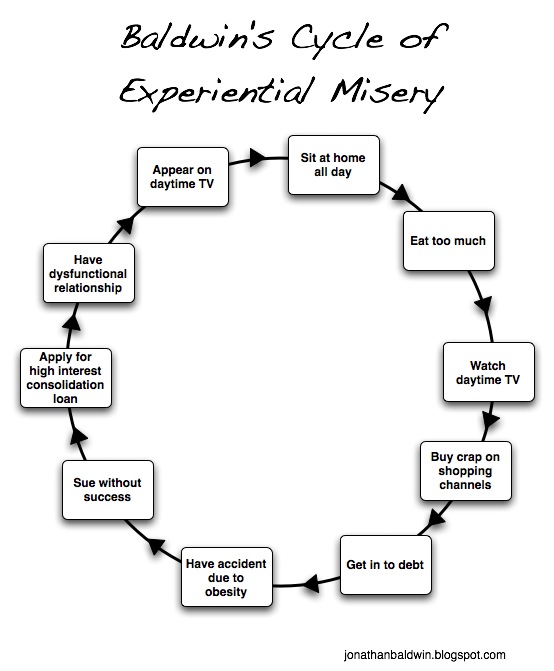
Last night, wondering if there is a pattern to people's lives I came up with what I call 'Baldwin's Cycle of Experiential Misery:


(Click on image for full size version)

Bookmark and Share

Sunday, February 19, 2006

Why is online shopping still so linear?

Many moons ago I remember playing Pathways into Darkness, a Mac-only game from Bungie that begat, eventually, Halo.
At the time I wrote an unpublished letter to MacFormat, or MacUser or someone suggesting that if it's possible to run round corridors killing people and picking up items, why shouldn't it be possible to run down corridors picking up tins of beans and bags of carrots? (I suggested too that you could still kill people with wonky trolleys and parents who scream at their kids, if the gaming element helped.) I even started to build a 'Dark Forces' level based on my local Morrisons at one point just to show what I meant.

At the time, remember, 'virtual reality' was The Next Big Thing but whenever it was featured on TV it included images of people wearing odd headsets and gloves. And really bad graphics. Yet the games world - though a long way from what it achieves today - was miles ahead of that. Why weren't the two sides talking to each other?
It also has to be remembered that the idea of shopping via computers was also a bit of a pipe dream at the time.

But two things happened to me this weekend. First, I ordered an organic fruit and veg box from a local supplier and added items to it via a drop down menu. Easy enough, except that the way the site was organised wasn't particularly logical. Oh sure, it was logical to the site owners, but it wasn't logical to a customer. We expect cheese to be near margarine and milk, but on the site, they're in three different categories.

Internet shopping is still, for all the metaphors that are used, a database-driven experience and that means it's linear. But we don't shop in that way in reality. And while in reality we might intend to buy one thing but then see an alternative, or spot something we'd forgotten we needed, online the opportunity for accidental discoveries and alternatives is pretty limited.

The second thing that happened is that I was playing World of Warcraft a moment ago and looked at the clock to see that I have a few minutes left to get down to the shop and buy some cat food.
Why couldn't I let my Paladin go do the shopping for me? I could finish slaying this basilisk and then pop to the shops, just behind the Arena in Stranglethorne Vale. It could be like a dungeon instance, except that the cheesy piped music would start and I'd get a trolley to push around the aisles, pointing at things on shelves and adding them to my temporary 100-slot basket. Get to the check out and authorise my payment, then get back to the game.

Okay, so it's lazy and bizarre but it got me thinking back to that idea I had all those years ago. It isn't unrealistic to imagine a large retailer - Walmart in the US or Asda here in the UK - using a games engine to produce a virtual store with different departments and sections where you can select products and drop them in a trolley. Realised as a Mac/PC program or as an XBox Live 'game' I'd bet loads of people would use it. A company that either created such an engine or modified an existing one, that could be used by online retailers large and small, would surely be on to a good thing.

I'd insist on being able to attack parents who don't control their kids, though. Perhaps that could be the 'Hot Coffee' hack...

Bookmark and Share

Legal Action

It looks like I'm going to be having my day in court. A company I worked for is refusing to pay me for a two day 'Introduction to Dreamweaver' course because it was, in their words, 'disastrous'.

Well, let's look at the facts, shall we?

I've provided several workshops for this company, all of them with glowing feedback from clients. I've trained people how to use Dreamweaver, Fireworks, and InDesign in group and one-to-one situations. Often, clients have remarked that they will be back for more - if I'm the one doing the training. (I've been doing this for years, since 1999 in fact, with excellent results).
It didn't pay well, especially after tax, and it was unduly stressfull, but it always made me feel good afterwards, reading the comments on the feedback forms.

But then disaster struck.

One of the problems with private workshops like this is that some clients come in with raised expectations of what they will achieve. There's usually always someone who is doing one job for their company but who is being moved in to 'looking after the web site' or 'doing the company newsletter', and has been sent to find out how it's done. In just two days.

Others come with little or no prior understanding of the technology or software - fair enough for an introductory course, for sure, but there's often someone who finds using a computer a bit of a chore.

Then there are the print designers who are moving to new software (e.g. from QuarkXpress to InDesign) or from print to web. For them, spending any time explaining grids or typography is understandably time wasted.

Another category is the project manager, people who want to know how to handle web designers, manage complex projects and what the limitations and time constraints are.

There is nothing wrong with being in any of these categories. But it is not a good idea to lump them all together and try to deliver the same learning experience to them all. Someone in the group - probably everyone - is going to get short changed no matter how good the person at the front of the room.

Now, being a professional teacher, I believe I can deal with all those expectations. It's something I pride myself on. And I can even deal with them when several of these types are in the same group. It's a difficult balancing act, looking after the novices while keeping the fast learners happy. But for some reason the group I had in this workshop was unusually diverse. Not impossibly diverse, by any means, but certainly diverse enough that it took a great deal of energy on my part to balance the different needs. It helped that as a group they were one of the friendliest and good humoured I'd ever had.

It didn't help that early in the workshop I happened to say that, in my experience, most web site projects took 6-9 months to launch, and that no one was ever happy with their first site so people shouldn't expect to produce anything stunning after just two days.
For one member of the group this was unacceptable. She very publicly took me to task because the blurb for the workshop promised "Dreamweaver Training provides clients with the expertise to produce innovative, professional and dynamic websites using Dreamweaver" and I had just said it wouldn't.
I tried my best to deal with that by saying expertise comes over time, not 48 hours. She wasn't at all happy and, though I could appreciate why, I was the wrong person to complain to.
I was as diplomatic as possible and went to the front desk to suggest that maybe the line in the blurb needed to be modified. It has been, funnily enough, to something far more vague.

This was bad enough, and I'd estimate that the combination of dealing with that complaint and ensuring the different types of student were catered for lost us around three hours. But to make things worse, three of the computers broke down on the first day and I was the person who had to fix them, but only after students had gone home. For half of the first day (a quarter of the course) three people could not complete any of the assignments. These were the graphic designers in the group, using the Apple Macs that had been set up incorrectly, and who quite rightly expected a little bit more for their money than being asked to follow over someone else's shoulder.

At the end of the workshop I got everyone to fill in their feedback forms. I asked them to be honest and I made it clear I wasn't happy with the way things had gone, apologising personally for the disruptions.

The feedback wasn't good. But it wasn't bad about me - far from it. It was bad about the company, focusing on misleading course details, computer failure and the fact that the group was too big and too diverse.

Not all feedback was bad. Some was complimentary about me, the way I handled the difficult situation, the patience I'd shown and the way I'd explained complex topics. These same people were, however, scathing in their comments about the company.

I handed the feedback over as I left, along with my own appraisal of the workshop, feeling about as low as it's possible to be. All teachers have bad classes, not necessarily because they've been bad, but because circumstances have conspired to work against them. I went home, had a few beers, went over the notes and eventually satisfied myself that I had done my best given the situation. If I should be angry with anyone, it should be with the company who let me, and the clients, down.

The next day I received an email telling me I wouldn't be required for the next workshop a few days later (despite the fact I'd moved heaven and earth to fit them in as a favour and would now be severely out of pocket). A couple of weeks later I got a badly written letter saying they had offered all clients a free replacement workshop and I wouldn't be paid.

Excuse me? They give people a replacement workshop because of problems that were their fault and they blame me?!

I immediately wrote a letter outlining all the points above and saying in no uncertain terms that I disagreed with their arbitrary decision and breach of contract and giving them a week to respond. I also asked for copies of all feedback from that and previous workshops under the Data Protection Act, and for copies of any letters or emails in which I was discussed (I was concerned that they had defamed me in communications with clients). The letter went out recorded delivery and they signed for it the next day.

I got no reply. Not even to the legally binding request. They have a couple more weeks to reply to that before it becomes a criminal, not civil, matter. In the meantime I've had to prepare a claim for the County Court and will be submitting it on 28 February. It's a clear cut case - I did my job, and acted professionally at all times. I've got a track record to show I've always been nothing less than good at the job, and frequently excellent, and nothing in the feedback from this workshop shows otherwise.
Yet still they refuse to pay or to acknowledge receipt of my letter.

If it weren't so stressful, I'd enjoy the prospect of having my day in court and forcing this company to hand over the cash. I'd considered organising a boycott of the place by academic institutions who send people there, and by academics who teach there. Maybe I will. It's a real shame as I like the people I normally deal with there, always friendly etc, and I have no doubt that the rest of the trainers are highly professional and excellent at their jobs. It's the people behind the scenes who clearly know nothing about using feedback to reflect and improve, judging from their decision to blame me rather than change their practices.

Teaching is not easy, and it's not just a matter of standing up in front of a class and moving step-by-step through a sequence. That would be the easy way to do it, but it wouldn't help anyone in the long term. I can show people how to do a specific thing, like how to produce a rollover button with a chrome effect. But if you ever want to do something that looks different you're going to have a hard time. It's the principles that count, not the specifics. And it's understanding that learning is something that happens afterwards, not at the time. It's a rare individual who can come out of a two-day workshop knowing much more than they knew going in. What counts is putting what you covered in to practice, reflecting on the experience, and then changing your understanding before doing it again. And that's something I stressed during this workshop, especially to the individual who felt short-changed.

The problem for me now is that this company has offered everyone a free workshop, with the insinuation that I am a bad teacher. Like someone taking an exam for a second time, everyone will leave the second workshop 'knowing more' because they will have gone through precisely the experience I said they should - except at this company's expense, without reason. To everyone concerned it will appear as though they're right, I was crap. Instead it will prove only that doing something twice is better than doing something once.

There have been a few times in my life when I've felt worthless and that I cannot do my job. This has been one of those experiences. It was unnecessary of the company to put me through this, and unprofessional of them to refuse to discuss the situation with me, to learn from the experience, or in the end to acknowledge receipt of my letter asking for an explanation. There was a more productive way to deal with this. Hopefully they'll come to see that eventually - but in the meantime I'd really rather have the money they owe me.

UPDATE: They paid up. What a sweet feeling. However, no apology, no confirmation that they haven't defamed me in communications with clients, and no compensation for the unfair and late cancellation of the second workshop.

Bookmark and Share

Tuesday, February 14, 2006

Do you mind if I smoke? No - do you mind if I fart in your face?

As I type, MPs are debating whether to ban smoking in pubs and clubs in England. The choices are a total ban, a ban in pubs not serving food (with complex definitions of food, so it has to be cooked on the premises I think - peanuts don't count), and a ban in pubs but not private clubs.

I'm all for a total ban. an opponent said this morning that MPs shouldn't be telling people what they could and could not do, but that argument only goes so far. Presumably this chap would object if Parliament said they weren't going to legislate about people going round stabbing random strangers.
This whole 'nanny state' argument gets my goat. We elect politicians precisely to take up challenges such as this.

It isn't about smokers' rights, it's about everybody's rights. A smoker's right to light up extends as far as the next person's nose or, more importantly, their lungs. It's bad enough visiting some pubs but imagine working there. For many bar staff it isn't a matter of choice whether they work in a smokey atmosphere or not, it's a matter of necessity. I'm old enough to remember the days when offices allowed people to smoke. I used to sit next to a girl who lit up several times a day and let me tell you, as nice as she was, it really wasn't a pleasant experience. Working in a bar with smokers must be a thousand times worse - more so, I would imagine.

If there is no ban, or only partial ban, I for one will begin a campaign to ensure that all public swimming pools have 'urinating' and 'non-urinating' sections clearly marked. And why not make pubs have masturbation and non-maturbation zones too? It makes far more sense than having smoking and non-smoking sections.

Actually I can see that one catching on. Sorry for any images popping up in your head right now...

Bookmark and Share

Monday, February 13, 2006

Levelling up (no, nothing to do with Warcraft, but you'll wish it were...)

Someone just made me stop in my tracks.

I'm involved, from time to time, in course writing and validation, and one of the reasons I think I'm a popular choice as an external advisor is cos, to quote one former colleague I'm 'shit hot' when it comes to ensuring that courses are written at, and assessed to, the right standards.

One of my big bugbears is courses that spend three years doing nothing but introducing students to new areas. To give an example, a course I used to run had a module called 'Introduction to Sound Production' or something - not only was it on a graphic design course (oh my god, when will graphic design courses actually start teaching graphic design and not try to be a taster for the best bits of every other subject?! I can't imagine that students on sound production courses suddenly get to spend 15% of their final year learning about kerning type) but it was also presented in the third year of the course.

The system of degrees in the UK is very simple: you start off broad and at an introductory level. You then begin to ramp up the complexity and the specialism, without losing the interplay of different specialisms. Finally a student graduates by demonstrating a knowledge of their subject at the forefront of the discipline. Or something. I forget the official language.
We call them 'levels' and it goes:


  • C: Certificate level (first year undergraduate, CertHE)

  • I: Intermediate level (second year undergraduate, DipHE)

  • H: Honours level (third year undergraduate, BA, BA(hons))

  • M: Masters level (PgCert, PgDip, MA)

  • D: Doctorate level (MPhil, BPhil, PhD, DPhil, EdD etc)


I think that's right. If you're interested in reading the descriptions of these levels see the QAA web site.

Anyway, the number of courses I've encountered where this plainly isn't happening is quite frightening. (As is the fact that I can count the number of academics who actually know this on the fingers of one hand - and have fingers left over! I remember one academic telling me he felt bullied because people used all this 'jargon' and introduced initiatives without telling people, which I found odd considering he was a big boy now and knew how to read newspapers, look at web sites, read his email and respond to little things called 'consultations'. Self-imposed ignorance is no excuse - if one of his own students had said the same thing about his own subject he'd have been down on them like the proverbial).

I'd like to think I've done my bit, through working as an external advisor on validation panels, to ensure fewer such courses get through the net. It's not vindictiveness on my part, I just don't see why students should have to suffer badly thought-out courses that don't advance their understanding of their chosen subject.

One MA I was asked to validate was being submitted along with another. Both shared the same modules here and there which is fair enough - I think it was the research methods module. However, in this particular MA is was worth 30 credits, while in the other module it was only worth 15. The industrial representative on the panel questioned whether the module was needed at all (it was a film studies MA and she thought film studies people didn't need research skills. 'You do to get an MA' we said, ad infinitum).
The course was about to be rubber stamped when I pointed out the imbalance in credit rating. Why was the module worth 30 credits and not 15? 'Oh, we'll just do a bit more of it than they will on the other course'. Not even the beginning of an appropriate answer, and scandalous from someone with the rank of Professor. It was also clear that no one on the programme team had actually noticed the problem - it seemed they hadn't even read their own course document (not as rare a situation as you'd imagine!)

There are many degrees out there that don't even scratch the surface of what a degree is supposed to mean. And there are lots of MAs that don't begin to stretch beyond the whole 'introduction' thing. Some art and design MAs have actually been described to me by staff around the UK as serving the purpose of 'letting students get their portfolio up to scratch' or 'find themselves'. In other words, no research to speak of, no going beyond the boundaries of knowledge in the subject, just a bit of sitting on your arse seeing what happens. In no way are they MAs. Whether this situation goes beyond my own discipline I don't know, but I suspect it does. It is, fortunately, rare, but not as rare as you'd think.

A few years ago I was involved in the validation of a PgCert (postgraduate certificate) in teaching and learning, a teaching qualification for university lecturers. A PgCert is one quarter of an MA but it has to be validated at M-level (or masters level to avoid the jargon). We weren't happy about this as these level descriptors are written at what we call 'exit point' - in other words they describe the level and depth of learning a student should have achieved at the end of the programme of study.
The issue with this is that a student assessed at the start of their first year can't be expected to have demonstrated 'C-level' understanding (C-level being first year undergraduate, or 'certificate' level. Are you keeping up?) On modular courses this poses a problem that unitised courses don't share (oh let's face it, I've lost half the audience now, haven't I?) But as a fan of modular courses, when done right, the fact that a student on a unitised course doesn't know if they've passed or failed until it's too late seems like a much bigger problem.

Anyway, back to the plot. A PgCert is written at M-level but it doesn't make sense that anyone studying a PgCert should be expected to demonstrate masters level understanding. We didn't win the argument. In the grand scheme of things, considering the shocking reluctance of lecturers to actually gain teachng qualifications, it seemed like small potatoes. (I hate the word 'potatoes'. Always makes me think of former US vice presidents... Or was that tomatoes?)

However, as James Atherton points out there's a very strong case to say that teaching qualifications should start at undergraduate level. Why do we presume that someone wishing to gain a teaching qualification should go straight in at masters level without first of all gaining degree level understanding of how people learn and how teaching can facilitate it?
It's really made me think hard about things I'd just never questioned (and regular readers will know how seriously I take the whole questioning thing!) It's also timely because of a project I'm working on at the moment - outlining a course at M-level that I'm now going to look at again and ask if it should really be at C-level.

James has a much more interesting blog than mine, incidentally. Worth checking out if you're involved in education or fancy an insight into the weird world of higher education...

But it gets worse. Now it all has to be at M level. Master's level "mastery" of the moment to moment practice of teaching cannot, in my opinion, be achieved with less than five years' practice. It simply needs at least that much time to try things and evaluate them, and to repeat the cycle and refine them, and to grasp the wider implications, and to try again... The fudge is to assess via writing about it, so-called "praxis". It is not the same thing. In my view, M level direct practice is University Teacher Fellow standard. I lost this argument in the validation process, but it is still a very important one.


Oh look - it's 8pm! I can't believe I've just spent my whole evening having a rant...
Mind you, I can't believe you've just read the damn thing!

Bookmark and Share

Sunday, February 12, 2006

Naked iChat


I love instant messaging: now I'm being ignored by several million people instead of just the ones I know.

I have an iSight camera on my Mac. Sadly, no one I know is similarly equipped so it's gone unused except for an emergency photo for a newspaper article and scanning barcodes for Delicious Library.

One day, I left myself logged in to my iChat account and got a message from some guy in the US asking me if I wanted to... well, I won't say what he wanted me to do. I don't think I've dared log in since.

However, I came across an interesting site today (via del.icio.us, I should add!) Looks like someone's found a use for those lonely unused iSight cameras: Naked iChat!
If you decide to sign up for it, just be careful you don't accidentally prepare yourself for a session and then contact your granny or boss. Worse still, let's hope you don't find your granny or your boss on there already...

Bookmark and Share

US Elections 2008: Let the content analysis begin

One of the things which amused/angered me about the US election in 2004 (and I speak as a Brit here, bear in mind) was the way in which images of Bush tended to be 'Presidential' - him in front of crowds of servicemen, behind the seal, meeting prime ministers and other heads of government. Meanwhile, John Kerry seemed to be shown ski-ing, at anti-Vietnam war protests and as far removed from affairs of state as possible.

So it's interesting to read the current reports of Hilary Clinton's possible candidacy in 2008 and how she is being characterised. Heaven forbid that anyone should actually have a go at her for her policies. The best anyone seems able to do is describe her as 'too angry'. That incisive piece of analysis comes from Ken Mehlman, chairman of the Republican National Committee
'I don't think the American people, if you look historically, elect angry candidates,' he said.

Three years away and we've already found the new 'flip flop'. Say the word enough and Clinton goes from being (as I understand it) a top flight lawyer who won an impressive mandate to represent New York in the Senate to being a woman with hormone problems. So that's alright then.

This quote from Mehlman was in the New York Times. And what picture did they use to illustrate it?


So here's the challenge. Every time you see an image of Hilary Clinton or anyone else in the context of the 2008 presidential election, save it. If it's online tag it at del.icio.us or somewhere so that we can watch how they are represented, and if it has any bearing on the public's perception of the candidates. I think it could be an interesting experiment.

Bookmark and Share

Wednesday, February 08, 2006

Touch screen interface


Take alook at this video over at NYU.

It looks like a really cool method for navigating around a screen and, naturally, the rumours have already begun that this is what Apple will use in their so-long-rumoured-it-must-be-about-to-happen tablet Mac.

The section in the video with the movement of photos on the screen would be a neat update to iPhoto or Aperture, that's for sure.
But you try watching the video and not asking 'how awesome would it be to play World of Warcraft on that?!'

Bookmark and Share

Monday, February 06, 2006

Out of office auto-replies

My university has an odd policy of only enabling out-of-office auto replies for internal addresses. In other words if a student emails me from one of their increasingly bizarre hotmail addresses about something urgent, but I'm on holiday or away at an international high-flying conference (you never know, one day I may be) then they don't get an auto-reply. But if the canteen emails me to say they've got a deal on stale baguettes they'll be told I'm away.

I always try to keep my auto-reply informative and friendly. But I usually forget to turn them off rendering them useless and annoying. Here are some ideas for yours:


  1. I am currently out at a job interview and will reply to you if I fail to get the position. Be prepared for my mood.

  2. You are receiving this automatic notification because I am out of the office. If I were in, chances are you wouldn't have received anything at all.

  3. I will be unable to delete all the unread, worthless emails you send me until I return from holiday on 4 April. Please be patient and your mail will be deleted in the order it was received.

  4. Thank you for your email. Your credit card has been charged £5.99 for the first ten words and £1.99 for each additional word in your message.

  5. The e-mail server is unable to verify your server connection and is unable to deliver this message. Please restart your computer and try sending again. (The beauty of this is that when you return, you can see how many people did this over and over).

  6. Thank you for your message, which has been added to a queuing system. You are currently in 352nd place, and can expect to receive a reply in approximately 19 weeks.

  7. I've run away to join a different circus.


(from today's in-box)

Bookmark and Share

Passion

One of the most overused, and therefore meaningless, words in the English language is 'passion'.

I hear it a lot. We are told we must be 'passionate' about our jobs, or our vocations. On Masterchef, (BBC2 6pm weeknights, as they say in the TV guides) the resident chef says he is looking for contestants who are 'passionate about food'. In universities I hear teachers who condemn students who aren't 'passionate' about their subject.

It's a meaningless concept, mostly because one's passion is seemingly judged by others. It's not enough to claim to be passionate, others need to judge it in you. And presumably they compare it with their own particular passion.
It's a little like the word 'strongly' - people write to newspapers saying they 'strongly object' to something, as though that outclasses a simple objection and should end the discussion.
Anyone recruiting for a post who gets a candidate who uses the word 'passionate' as the prime reason for being given the job should be shown the door. 'I'm passionate about graphic design' translates as 'I need the money but can't think of an actual reason why I'm worth it beyond a meaningless adjective'; if it didn't then see how long they'd do it for free.

I'm not passionate about graphic design, or music, or literature or any of the things about which I might get, let's say 'emotional'. I may be interested, even deeply interested, in these things. I may come away from a Shostakovitch symphony feeling uplifted or moved, but passion is a word I'd try not to use anymore.

The thing that's made me watch how I and others abuse this word is talking to a friend who is currently living on a bare sustenance wage of a few pounds a week, working for a charity helping young children who have been deemed to be at risk of getting involved in criminal activity. It's a job that is dispiriting one minute, uplifting the next (two conversations, within a few hours of each other - after lunch she was on top of the world having made a small difference, last night she was crying down the phone at the burden of responsibility). Talking to her I understand the word 'passion'. It's not necessarily emotional - in fact often it's emotionally deadening - but it is about change. And it's not about changing yourself, but about changing other people.

How a wannabe chef can get passionate about (as someone did last week) baking an apple and covering it in coconut and doubtless charging a fortune for it is beyond me. That's enthusiasm, it's not passion. The same, I'm afraid, for graphic designers who sell shampoo and trainers - but I reserve the right of those who focus on ethical and educational issues to claim to be passionate.

I think I'm partly justified in claiming a 'passion' for teaching, but even then I'm working in a somewhat different sector from primary and secondary school teachers, from social workers preventing child abuse, and from counsellors helping victims overcome their experiences - all for far less money and recognition than they deserve.

I think we need to stop abusing the word 'passion' and recalibrate our respect for those who show the genuine article. Anyone who claims to be passionate about pushing a mouse around or baking a cake needs not just to get a life, but to experience someone else's for a few minutes. Passion stems from compassion and is demonstrated through action, not claims.

Bookmark and Share

Wednesday, February 01, 2006

Music and Movement


It strikes me as odd, working in the university sector and so surrounded by cutting edge research, that no one has ever thought to investigate the origin of the race memory that leads five year old children everywhere to instinctively know the meaning of the word ‘gnarled’.

Try it: say the word to any child (or adult if no children are present) and say ‘gnarled’ to them. Instantly they will grit their teeth and curl their lips, bend their elbows and distort their fingers in ways that could only be achieved through some long forgotten double jointedness gene.

I’ve been wondering for a while now whether being asked during music and movement classes to act like monsters, and responding – as do all children – by walking very slowly and with large strides, arms in front of our face and hands gnarled, was shaped by the media around us (especially Doctor Who, of course) or whether the actors in programmes with monsters in them based their monster-like movements on their scarred memories of childhood aerobics. Chicken and egg, I fear, chicken and egg…

Whatever, I always hated PE at school and now I know why: it was always about enacting our darkest nightmares. ‘You’re a seed, trapped underneath the soil in the freezing winter. Curl up as tight as you can and imagine yourself buried in the cold and dark under several feet of solid dirt…’

Actually, you’d think that getting to ‘big’ school and finding out that PE no longer consisted of mental tortures like that, but instead took the form of cross country runs in the middle of winter, rugby on muddy fields (muddy, that is, under the ice), cricket in the blazing sunshine wearing jumper, trousers and pad and being pummelled by a rock-hard ball, and cold showers in a school that only started taking boys the year previously which meant racing back to beat the girls before they ‘accidentally’ walked in to their changing room a little too early (looking back you sort of regret not enjoying it more, but at that age it wasn’t fun) would have been good, but in a choice between mental and physical cruelty I’ll take, well, the fake letter from my dad excusing me from PE any day.

I wasn’t fat as a child myself, but I wouldn’t be surprised if I had been. Although I blame a lot of childhood obesity on crap food and lack of exercise I think the form of that exercise has to be considered carefully. If I develop any illnesses in the future that can be assigned to lack of exercise as a child, I’ll be suing both my schools for putting me off PE. What’s wrong with a gentle stroll through the countryside instead of bloody running around it? And in the same vein, why can’t I mime being a tree instead of being a seed and re-enacting the trauma of my own birth? Primal scream therapy was discredited long ago – why not music and f***ing movement?

Bookmark and Share

Visit my 'official' site

www.jonathanbaldwin.co.uk
contains links to my articles and books.

Tags

Books by Jonathan Baldwin

Visual Communication: From Theory to Practice (Winner of 'Best Higher Education Title' at the British Book Awards 2006) by Jonathan Baldwin and Lucienne Roberts Buy from Amazon.com Buy from Amazon.co.uk

More Than A Name: An introduction to branding by Melissa Davis and Jonathan Baldwin Buy from Amazon.com Buy from Amazon.co.uk

Blog Archive

Followers