A blog about design, education and anything else that takes my fancy

Showing posts with label education. Show all posts

Friday, August 14, 2009

Interns - something needs to be done

I'm getting more and more angry about the subject of design internships and the bizarre excuses that many in industry and, let's be honest, education, use to excuse the practice.

Internships, also known as placements, are "opportunities" for graduates to get experience of "real world work" which apparently makes CVs look better and increases your chance of getting a job.

The trouble is, the likelihood of getting a job is much reduced as a fair proportion of work is being done by interns working for free!
Or as Tory MP Philip Hammond recently told a constituent after being asked why he doesn’t pay his own interns: "I would regard it as an abuse of taxpayer funding to pay for something that is available for nothing"1. This, unfortunately is the endless loop we find ourselves in: many people agree that internships are bad, however there are many people wanting to do them, therefore you either stick to your principles and miss out on all that lovely "experience", or you give in.

Internships strike me as evidence firstly that the design industry doesn't rate qualifications much, and secondly that it certainly doesn't think "outsiders" (i.e. design educators) should be the ones to judge who's good enough to work among its number2. To support the first argument we can point out that the majority of designers don't have degrees - it's not a "degree-level position" and many degree-holding designers work at the same level, for the same "salary", as non-degree holders. In that sense, design is meritocratic - you're valued on how good you are, not on how qualified you are.
I don't have a problem with that. What I do have a problem with is undervaluing graduates. Other sectors don't do it - law, retail, medicine, architecture, teaching. What sets these apart is that either they recruit graduates in to well-paid jobs with responsibility and then train them, or they require a period of high-level apprenticeship which is highly structured and leads to a well-paid career at the end of it.

The argument that graduates shouldn't be paid because they are not experienced enough is, quite frankly, one of the most stupid fucking arguments I've ever heard a supposedly intelligent person make.
(And yes, I said fucking. It's unacademic, it's unprofessional, but it's how I feel, okay?)
Seriously, think about it for a moment. Try this scenario:

You go to visit your daughter's school to find out how she's doing. You chat to the young teacher who's in charge of her class, and who your daughter absolutely adores. She's young and you realise you're getting old for noticing. She talks expertly about your daughter's progress and clearly takes a lot of interest in her, and you're grateful. You later go to the head teacher and compliment her on the quality of her staff, making particular mention of your daughter's class teacher.
"Oh her," she says. "Yes, if she keeps this up we might start paying her and take her on full time. But only during term. We can't afford to keep her on during the school holidays".

This is plainly nonsense. It doesn't happen. New entrants to teaching are paid a decent salary (it could/should be higher, but let's not get in to that - the point is, they're paid a graduate-level salary and given responsibilities. They are also mentored and given time to continue with their development. Indeed, all teachers are. It's how people stay on top of their game.
But can you imagine if you discovered that schools were employing unpaid interns to do the teaching?

Compare that to design. New entrants are not given responsibilities, they are often not paid (and if they are, it's often peanuts) and, ultimately, they're not trusted. Internships or placements are trials. A company that uses them as a way of recruiting new staff is acting in a bizarre manner. It makes little sense.

When I left college at 19 I got a job as a designer/marketing assistant. I hadn't really wanted to be a designer but this was all I could get. So I effectively taught myself on the job, having gained a bit of experience with Pagemaker at college. Three days after joining the company, because of the oddities of their pay cycle, I received a payslip for three weeks' salary. I'd only just started, and I wasn't even up to speed. I didn't even know how to use the phone system, or have my own desk. Yet there I was with more money than I'd ever had before. Because I was - get this - working for them. Giving them my time in return for money. They didn't say "hey, you're new. We're effectively giving you our time so really, you owe us money. So how about we just don't pay you and call it quits?"

Which is interesting because that's exactly how internships work.

And you know how the company knew they wanted me to work for them and not someone else? They interviewed me. Twice. They looked at my work, they asked me questions about myself. They decided I was worth a chance and knew, as I did, that if it didn't work out, either of us could say "thanks but no thanks" and I'd be on my way.
Yes, employing someone is risky, yes it requires time and effort on the part of the employer but you know what? That's part of running a business. Building a team, nurturing it, valuing it.


I'm going to come back to this issue as there's much more to say but let me end this first instalment with a pointer to Seth Godin's blog where he talks about free work versus internships.
Like me he doesn't like internships for some of the same reasons. "Most of the time, the employer thinks he's doing the intern a favor, but he doesn't trust the interns to do any actual thoughtful, intelligent work worth talking about."

He loses me with the next bit: "And to be fair, most of the time the interns are busy hiding, not grabbing responsibility but instead acting like they're in school, avoiding hard work and trying to get an A."

I disagree with this assessment because an internship generally is not carried out as part of a course, it's a prelude to employment. I think he's mixing things up a bit here. Genuine work placements, part of a course, are rare. They shouldn't be, but it's not for want of trying. Many of the ones I know of are just a couple of weeks' "work experience" but a truly educational placement should be well-structured, include shadowing, not working, and be assessed. Which means the host has to be heavily involved in planning, implementing and evaluating it. And if that were the case, then anyone "trying to get an A" wouldn't do it by "avoiding hard work". For one thing, they shouldn't be working. That, after all, would be a case of the taxpayer subsidising free labour for the design industry, and in England and Wales, and other countries where students pay fees, it would be a case of the poor bastard literally paying to be "employed". But really, if Seth's first point is correct, that many employers don't trust people on placements, then I really couldn't blame anyone for not giving 100% in return. You get what you pay for, after all.

But Seth goes on to talk about the concept of "free work" like it's something else entirely. Now I have long advocated "free work" to my own students but I mean working for non-profits - local groups, charities, schools etc - as a way to give something back to the community and to get something in your portfolio. I would never advocate working for nothing for a company that can not only pay you, but is getting paid themselves. Seth seems to excuse it by its networking potential or karmic value - but you can network without selling your soul. It's this passage that really caused me to spit out my dummy:

"But you'd be amazed at how many fast-moving companies or influential individuals are all too happy to share credit if it helps the work get done."

As I twittered to Fergus Bisset, 'he says companies will "share credit". Wow! Thanks! Er, why not the money then?"'
If the argument is that a start-up needs help, and that if they're successful you will be too fails on a simple logic test: if that start-up is going to be successful you can bet your life they don't do it by doing free work for people. So why should you?3

And this ultimately boils down to the best argument against internships. I'll discuss the social impact of internships and the legal implications another time, but let me leave you with this: if the company you are working for is making money from the stuff you produce, they should be paying you. There is, as far as I can see, no reasonable argument against this. To do otherwise is theft, plain and simple. And something needs to be done.

[end of part 1. Coming soon: why internships are unfair and why they are illegal]


Update: as you may see from the comments, as well as Interns Anonymous, you can also discuss internships at The Water Cooler

1For what it's worth, I made a complaint about Mr Hammond to the Low Pay Commission. Phil Willis MP is, quite rightly, raising the issue on his site and via a press release.

2Easy answer: stop recruiting graduates and start recruting school leavers and run proper apprenticeships! Oh you used to do that. What happened? Oh yes, you "subcontracted" the role to colleges, funded by taxpayers, and saved the money didn't you? Trebles all round, as Private Eye would say.

3There is, of course, another aspect to this which is the concept of co-ops or labour exchanges. In this, you contribute your skill or time to help others and in return others help you. ("Time Bank" is a similar idea).

The important thing is that they need to be organised with a strong social aspect. When I lived in Brighton there were a few schemes like this kicking around including a skills swap for techies where someone who knew a few tricks in, say, CSS, would give a presentation to others and learn something in return. Or maybe they'd help someone out on their small company's site. In return that company might "pay" with free printing.

In effect, it's not work for free: it's work for favours. It relies on strong social/peer disapproval along the lines of the attitude you get if people you occasionally drink with notice that you always seem to benefit from someone else's round, but never seem to buy one yourself. Before you know it, you're not part of the group any more.

I recently advised someone to try this method of getting work but it does depend on you being in the right location and tapping in to an existing group - or setting one up. One thing it's not, though, is "work for free".

Bookmark and Share

Monday, July 27, 2009

Critical Response to Art Projects


It's a dirty little secret in art and design education that the beloved routine of the "critique" or "crit" doesn't work. Although many tutors cling to it as an essential way of providing guidance and feedback, plenty of research has shown that it leaves the vast majority of students confused and, in some cases, distressed (trust me, I've seen the tears - and from normally "tough" students).
The only purpose the crit appears to serve is to emphasise the tutor's status as alpha male (or female, but it's usually male).

The crit was wonderfully lampooned in "Art School Confidential" by Daniel Clowes (transferred moderately well from comic book to big screen in 2005).

The big problem with crits is coming up with things to say. From my observations they have to sound profound, critical and completely vague and meaningless so that what a student thinks is "encouraging" can later be claimed to have been a warning of dire consequences. And with so many students these days, it's becoming much more difficult to come up with something new.

What we need is a tool to create endless amounts of critical responses to art projects (CRAP) from a few random seeds. Ladies and gentlemen, I give you the CRAP generator!


Click the green button to start!

Disclaimer: the words come from a document circulating among staff at the university I worked at, and I don't know who wrote them (I added some of my own).

Incidentally, if you're interested in the research I mentioned, drop me a line and I'll send you a list. It's interesting that I've never found one bit of research that suggests the crit is a positive experience for anyone other than the person doing it.

Bookmark and Share

Sunday, June 28, 2009

A logical response to the "too many design students" argument

One of the common complaints that crops up every now and then from "industry" is that there are too many design students. In fact I had a go at Ken Garland about 18 months ago after he got up at a panel I was on and said exactly that - basically his argument was that design was a "special" craft that only an elite few should be allowed to pursue which, as I told him then, is a bloody stupid thing to say. I'm not one for hero worship, me.

But the usual motivation for complaining about the number of design students is either that it must in some way mean the overall quality is rubbish (oh really? Funny how that argument never gets trotted out when we call for more doctors, or teachers, or policemen. Or, indeed, plumbers), or that it's unfair on students and/or employers because we're training people the industry just can't absorb. (In fact, the complainers are almost always employers* who, let's face it, couldn't give a tinker's cuss about students or graduates because if they did, they'd pay them decent salaries and give them decent jobs instead of expecting them to work for nothing until a "vacancy" arises).

Now of course the correct response to this argument is that education isn't about training - that a good undergraduate education in design produces... graduates, not designers. Same as a degree in history produces graduates, not historians. And so on.

But for some reason that argument just butters no parsnips with some people so here's a better argument. It's perfect because it's beautifully logical.

If you have a vacancy in your company, what would you rather have? A choice of one candidate, or the pick of ten?

Well there you go, then.


----
*What's worse is when students say there should be a limit on the number of students. Nothing gets my wick up more than that. Well, almost nothing.

Bookmark and Share

Thursday, February 26, 2009

The Studio Unbound: Social Networking in Design Education


The Studio Unbound: Social Networking and Design Education from Jonathan Baldwin on Vimeo.

University of Dundee Master of Design student Lauren Currie, and design writer Kate Andrews explore the power of online social networking, and demonstrate the tools students they use to move ideas forward, form networks with practitioners around the world, and build a reputation before and after graduation.

“For the designer to become a producer, she must have the skills to begin directing content, by critically navigating the social, aesthetic, and technological systems across which communications flow.” (Ellen Lupton, 1998).


In highlighting the creative people all over the world using social networking to their advantage, Lauren discusses the dynamic, conversational value of online networking and shows how ideas of teaching and learning need to move away from the confines of the studio towards other, often ad-hoc and virtual, venues.

Joining from London via video conferencing, Kate Andrews, design writer and networker extraordinaire, shares her own insights into the potential offered by new technology.

Focusing on the new possibilities and opportunities the digital world presents, this talk will demonstrate that the world has changed and is changing, and that design courses must change with it if they are to stay relevant.

Bookmark and Share

Thursday, February 05, 2009

How do you define an under-utilised graduate?

My current research is looking at the way in which the design industry uses graduates of any subject in design and non-design roles (according to the Design Council only 15% of the UK design consultancy sector is made up of designers, and only 40% of those are graduates).

One of the central theses is that the design industry is not very good at utilising graduates, especially in design-related roles, compared with other industries. (This varies - I suspect that the service design sector does better here than the fashion sector but that some areas of fashion are better than others. The term "the design industry" is problematic).

An early issue in the research has been "how do you define a graduate position"? Mason (1999) studied the chemistry, steel and financial sectors and found that when the supply of graduates started to increase in the early 1990s different sectors took different routes. The steel industry started upgrading a lot of previously "non-graduate" roles so that they took advantage of graduate skills and knowledge, or began creating new roles to attract talent and benefit from what was available. In particular, they began to expand their employment of graduates in roles related to design of products and systems*.
The finance industry, on the other hand, simply replaced non-graduates with graduates often without changing the roles they were expected to do. This he views (rightly) as under-utliisation of graduates.

I suspect the UK design industry is more like the finance sector than manufacturing in this regard. The campaign by representatives of the fashion and textiles industries, Skillfast-UK, to get universities and colleges to ensure graduates are skilled to be pattern cutters is an obvious example of under-utilisation of graduates. But I'm also interested in how graduates from non-design disciplines are used, for example those from English, accounting, law and business. I have a suspicion that there may be a significant difference which points to a failure to acknowledge the potential degree-level design qualifications offer. However it will be interesting if there is widespread under-utlilisation of graduates in all areas of the design business. This would certainly change the current emphasis on blaming educators for the perceived malaise in the design sector and instead focus on how the industry recruits and uses graduate talent.

A common definition of "graduate level" employment is simply one of responsibility. Is a graduate employed in a role with some strategic responsibility, with a degree of autonomy? It's not a satisfactory definition because you could categorise a lot of jobs in this way: someone working behind a perfume counter could be argued to be autonomous and to have responsibility to meet sales targets using their initiative. But basically working in a shop like that is not viewed as a graduate-level job while managing a branch of a large retail chain is. To many, including me, the reasons are obvious but the problem is explaining why. And linked to this is another issue, which is a value judgement. To many, managing a branch of a major retailer is not seen as "worthwhile" - I can imagine several former colleagues of mine thinking a graduate of theirs were a failure if this is what happened to them. And it leads to contradictions: a jewellery graduate working in a jewellers is probably seen by some to be working in a related field to their degree** while another who is training to be a police officer with fast track promotion is not. The former is in a non-graduate design-related post while the latter is in a graduate but non-design related post.
So who is better utilised? And of whom should we be prouder?

Something I found useful in Mason's paper is a set of three simple criteria for judging whether a graduate is being utilised properly or not, and which removes the value judgement. I mapped these as a flow-chart for ease of reference:

utilisation of graduates flowchart.jpg


(The third criterion may be problematic for some but Mason explains it: "The latter condition is one way of testing for the possibility that graduate performance in unchanged jobs is significantly better than that of non- graduates and is recognised as such in higher salaries" - in other words, is the graduate performing better and being recognised as such even though the role does not meet the first two criteria).

This of course strips out questions of whether the job is a good one, if the graduate is enjoying it and so on, but I suspect it is value judgements like those that need to be removed from the equation, at least at the initial stage because it points to company policy towards graduates. Questions of whether the jobs are challenging, enjoyable, offer paths to promotion etc are important but can be tackled later. What the flowchart offers is a quick and simple way of evaluating if a graduate is being utilised as a graduate and this will tell us about the company's attitude to graduates - are they employed strategically or seen simply as people to fill vacancies? In Mason's research, the steel industry was doing this very well, while the finance industry used the sudden growth in graduate numbers to place graduates in to jobs traditionally taken on by school leavers.***

With some adaptation I think this flowchart could be a useful tool for very quickly judging if a design company is utilising its graduate workforce. If the artworkers are a mix of graduates and non-graduates, all on similar salaries, then the answer is no. If the pattern cutters are all graduates, the answer is no.
And if it turns out that agency X is utilising its non-design graduates well, according to the tool above, but under-utilising its design graduates, it points to a further issue which I'll let you ponder.

My suspicion is that "the industry" is a mixed picture. That there are some companies that make good use of graduates from all disciplines, there are some that do not, and there are some that value graduates in some areas of its business more than others (e.g. a graduate in a business management role compared with a graduate artworker or pattern cutter).
What's important is that the tool be used not to condemn those that don't do it, but to educate them. It's far better to change expectations and understanding of what a graduate offers a design company than to alter courses to meet incorrect beliefs. Instead of changing all fashion courses so that graduates are well-trained pattern cutters, we should change the fashion industry's recruitment strategy so that it hires school leavers or manual workers from other sectors and trains them, and recruits graduates in to more strategic roles.

---


Mason. (1999) Graduate Utilisation and the Quality of Higher Education in the UK. www.niesr.ac.uk

---

*It's worth noting that despite what the design industry thinks, designers do not just work in design companies, but in-house. In this regard, its claims to be the "customers" of design courses are questionable. That would be like tabloid readers demanding that a newsagent stops selling broadsheets. Makes sense to the tabloid readers, but little sense to the shopkeeper.

**(And the former student will be seen by many in academia as "on their way" - it's often claimed that design graduates take their time to make their mark which is an argument I get annoyed with. Barristers make their mark from day one. So do doctors, nurses, teachers. Why does the design industry think it's okay that graduate talent languishes behind shop counters or in pattern cutting rooms? What if we changed that?)

***This, of course, inflates the number of graduates because if the only way to get an entry-level job is to get a degree, there'll be a growth in demand for degrees. And if the only jobs on offer to graduates are entry-level, why bother putting in much effort? You can see where this argument leads: claims that the quality of graduates is dropping may be better explained either by the quality of the jobs on offer (advertising an entry-level job to graduates is not going to attract the best candidates) or by the minimum requirements (a degree). To further complicate things, expecting a graduate to have "school leaver" skills (a famous designer who shall remain nameless once complained he couldn't find a design graduate who knew how to answer his phone properly) will only lead to a perceived lack of quality. If you hire a French speaker to deal with your Spanish customers, whose to blame when you find they're not very good at it? Similarly, then, if you hire a design graduate to cut cloth, where should you look when it turns out they can't do it?

Bookmark and Share

Thursday, January 15, 2009

Design versus innovation

I've posted a long (and typically, I hope, controversial) entry over at Design Cultures on the debate between design and innovation. I'm experimenting to see if a more provocative approach to that student-oriented blog will get them more involved rather than passive readers.

We'll see...

Here's a choice extract for you:

"Why do we still see the ability to draw a naked woman as the primary qualification to be a designer?"

Head over to see the rest and please add your comments!

Bookmark and Share

Tuesday, November 11, 2008

Hooray another design manifesto!

Bruce Nussbaum of Business Week (one of the few non-design publications to take design seriously, and arguably one of the few publications full stop to take it seriously) was at the World Economic Forum in Dubai, where design was discussed. The result? A new design manifesto:

Throughout history, design has been an agent of change. It helps us to understand the changes in the world around us, and to turn them to our advantage by translating them into things that can make our lives better. Now, at a time of crisis and unprecedented change in every area of our lives – economic, political, environmental, societal and in science and technology – design is more valuable than ever.

The crisis comes at a time when design has evolved. Once a tool of consumption chiefly involved in the production of objects and images, design is now also engaged with developing and building systems and
strategies, and in changing behaviour often in collaboration with different disciplines.

Design is being used to:
  • Gain insight about people’s needs and desires

  • Build strategic foresight to discover new opportunities

  • Generate creative possibilities

  • Invent, prototype and test novel solutions of value

  • Deliver solutions into the world as innovations adopted at scale


In the current climate, the biggest challenges for design and also its greatest opportunities are:

  • Well-being – Design can make an important contribution to the redefinition and delivery of social services by addressing acute problems such as ageing, youth crime, housing and health. Many designers are striving to enable people all over the world to lead their lives with dignity, especially the deprived majority of the global population - ‘the other 90%’ who have the greatest need of design innovation.

  • Sustainability – Designers can play a critical role in ensuring that products, systems and services are developed, produced, shipped, sold and will eventually be disposed of in an ethically and environmentally responsible manner. Thereby meeting - and surpassing - consumers’ expectations.

  • Learning – Design can help to rebuild the education system to ensure that it is fit for purpose in the 21st Century. Another challenge is to redefine or reorient the design education system at a time of unprecedented demand when thousands of new design schools are being built worldwide and design is increasingly being integrated into other curricula. Designers are also deploying their skill at communication and visualization to explain and interpret the overwhelming volume of extraordinary complex information.

  • Innovation – Designers are continuing to develop and deliver innovative new products at a turbulent time when consumer attitudes are changing dramatically thereby creating new and exciting entrepreneurial opportunities in the current crisis. They are increasingly using their expertise to innovate in new areas such as the creation of new business models and adoption of a strategic and systemic role in both the public and the private sector.


I don't disagree with any of this but call me an old cynic... I'm fed up with manifestos. I want action!

(Imagine the scenes from Life of Brian where the supposed revolutionaries are sitting round arguing about the wording of their demands. Then wonder what would have happened if, say, Barack had sat with Michelle and never got further than writing down things they'd like to do. Or if John Adams and Thomas Jefferson had been happy just to write and not to act?)

In a discussion on sustainability in design education today I got quite frustrated with colleagues who kept saying that changes to the curriculum need to happen slowly, over time, to help people adapt.
No, I said, they need to happen now. I've been hearing that line about gradual change for ten years.

"People don't like change. But make the change happen fast enough and you go from one type of normal to another."
(Terry Pratchett, Making Money)


We have a choice: we try to be nice about it, persuade people, get them to come around to our way of thinking, and then in 20 years time we can look back and see how far we've come. Which, if we look back 20 years to 1988 and think how far we've come along, won't be much.
Or we can say "look, we haven't got time to piss about. This is serious. If you're with us you're welcome. If you're not, then go off and tend your garden 'cos we've got some windmills to chop down". I appear to be mixing my literary allusions there but you get the point. Shirking the challenge isn't an option. We claim to be creative, radical, free thinking, revolutionary. It'd be nice to show that were true. (I happen to think at Dundee we're well placed to do that, and already are, with great results).

"The needs of the many outweigh the needs of the few. Or the one"
(Spock, The Wrath of Khan)


Manifestos don't work if all that happens is students write essays on them and critics celebrate them years later for what they said rather than what they did. Forty years on from the First Things First manifesto, what's happened? Oh we got an updated version in 2000 and that's about it. Forty years on from Victor Papanek's Design For The Real World, what's happened? It got reprinted for the anniversary.

What we need are not more manifestos which, by the way, are all saying pretty much the same thing. What we need are courses, institutions, industries and governments who say: "stop talking, and just do it".

As it happens, my colleagues and I are currently writing our own manifesto for our course but the key thing is it won't say "we should", or "we want", or "we envision" or even "we hope". It'll say "we will". And "we do". And "we have done". Essentially, the difference between a wish list and a real manifesto is the grammar.

Actions, not aspirations. That's my manifesto.

Bookmark and Share

Friday, October 31, 2008

Northumbria University Design School

I was invited to go down to Newcastle on Wednesday to give a talk at the University of Northumbria's School of Design, now situated in its rather spiffy new building (the one on the left in the second image below)

IMG_0212.JPG


IMG_0213.JPG


Northumbria is Jonathan Ive's old stomping ground. Like me, he got his first break designing for the toilet industry so it's almost like we're twins. Er...

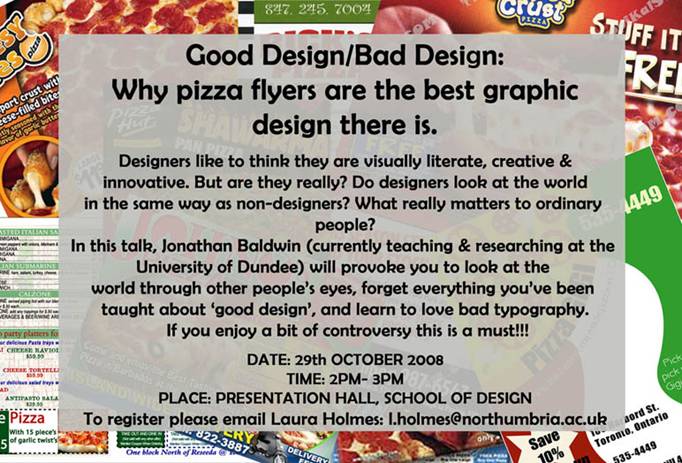
I was given an open brief which is always a bit tricky so I decided to do an amalgam of two talks, my annual "Good Design/Bad Design" lecture (where I challenge conventional wisdom on what 'good design' is) and the best bits of the keynote I gave in Texas in June (where I suggested university-based design education should be about making a difference in the world, not just churning out industry fodder).
When I arrived in Newcastle (I hadn't been there for a while and had forgotten how cold it can be, despite it being a few hundred miles south of where I live now) I was pleasantly surprised to see this sign:

IMG_0215.JPG


Resisting the urge to add the missing apostrophe and correct the spelling of my name (ahem) I quickly took a photo with my iPhone and emailed it to my boss. I've now decided to make similar notices and pin them up around my own uni to make me seem much more popular than I am.

The lecture theatre we were moved to unfortunately was a little lacking heat-wise which (and here's my excuse) led to me forgetting quite a few of the points I wanted to make, as did the fact that the head of design for Philips was in the room and I had planned on making quite a few criticisms of some of their products, including an electric shaver I was asked to review for Amazon.co.uk! (I must post that this weekend, in fact - suffice to say it doesn't get very good marks from me, largely because of the excessive packaging and use of proprietary chemicals for cleaning). Needless to say I hastily skipped all the slides relating to that but because I couldn't quite remember where they were I was keeping half an eye on my presenter display ready to click my remote furiously.
I was told later he'd have loved to have heard my take on things. Oh well.

It was, incidentally, a pleasant surprise to be greeted by a never-before seen sight: students voluntarily sitting on the front row:

IMG_0217.JPG


Despite the cold (the hats and scarfs above were a necessity) and having to skip through the last bits due to time constraints (top tip: when combining two different talks, both an hour long, you might want to chop half of it out if you still want to stick to 60 minutes) I think it went okay. I'm always a bit nervous about these things - as an outsider I'm able to be a bit more controversial than I could be normally and drop a few metaphorical bombs before leaving them to carry on the discussion, and I had planned a few zingers but was in the end a bit more restrained than usual, even skipping my traditional (half joking) rant about typography. Oh well.

I was also a bit down what with it being my birthday - enough to depress anyone the wrong side of 35.

Excuses, excuses.

I was really pleased to be asked and appreciated the audience's participation in some of the 'magic' tricks (one of which I tried on a colleague in the pub when I got back to Scotland that night and, much to my surprise, it worked). I won't tell you any more about it - if you want to see it you'll have to invite me to come and talk ;-)

My thanks of course to the students who found their way to the new venue and suffered through the cold (and my talk), to Jamie Steane, Head of Visual Communication and Interactive Media Design, for inviting me, and to Dr Joyce Yee for taking me to lunch and giving me a tour round the new building. Design is clearly a feather in Northumbria's cap and the university's investment in the building sends a clear signal about that. One that, I noticed on my way home, lights up for all in Newcastle to see at night:

IMG_0219.JPG

Bookmark and Share

Wednesday, October 15, 2008

Speaking in Newcastle later this month

I'm giving a talk at the University of Northumbria at Newcastle on 29th October - my birthday, as it happens!

image001.jpg

Bookmark and Share

Tuesday, October 07, 2008

Being too literal in logo design

Cross posted from my other blog:

In one of my lectures, on visual communication, I use a little exercise to illustrate an aspect of semiotics.

I give the students a brief: they are to design a logo for a law firm that specialises in family law, dealing with families who are facing some form of legal entanglement. I tell them they have two minutes to come up with an idea.
Two minutes later I stop them and ask them all to stand up. I then start eliminating them by saying things like "sit down if you drew a police badge". That usually gets rid of about half. A gavel gets rid of several more, as do jail bars, a law book, a police light and so on.
Before long we're down to the last few students and I can usually get rid of them too with 'hands' or 'cut out people'. I also eliminate anyone who used just words or initials (words aren't so bad of course, I'm just being mean, but initials for firms always bemuse me - IBM and a few others aside, of course).

If there's anyone left standing it's either because I've missed a really obvious one (last year it was a bird, this year it was a court house) or because they've done something quite abstract - this year it was a square with four circles around it. Nice one. We have a winner.

(Just remembered, Orlando Weeks now of The Maccabees, "won" this a few years ago when he did a logo of "a unicorn jumping over a rainbow". Mmm...)

The point I'm trying to make in that exercise, other than it being a bit of a break from them listening to me drone on, is that when faced with a quick challenge like that, students (everyone) tend to to think not in cliches (I happen to think cliches are good things - they're how we communicate) but in too literal a sense. The last thing, I say, someone who is facing juvenile court on a shoplifting charge wants to see is a logo for a lawyer that screams "you're going to jail!".
Look at supermarkets - how many of them have logos that show a basket of shopping? (I seem to be the only one who thinks the Lidl logo looks like someone pushing a trolley)

BE4D2667-9A33-42F8-B82D-D820A5871AB2.jpg


I came up with this little game (which makes more sense in the context of the lecture than it does here) a few years ago when some graphic design students at a previous job were asked by a local law firm to come up with a logo for a similar brief. The winner was a half open door with light coming through it. The tutor loved it, the clients loved it. I hated it. They thought it said "there is hope". I thought it said "you're doomed". But then, that's me for you.
It did, however, make me look anew at logos to try to find the overly literal. And while there are a few, they're pretty rare and almost universally poor. I won't link to any here - look for yourself you lazy git.

All of which brings me to something that amused me. A couple of years ago, after I'd done this exercise with them, some students came in to my office with something they'd found in the Yellow Pages. An ad for a law firm which fell in to exactly the trap I'd laid for them (click on the image for a larger version). I think this is a pretty amazing/bad piece of advertising - I'll have to add prison tattoos to my list for next year's lecture.

Lawyer ad.jpeg

Bookmark and Share

Wednesday, September 24, 2008

Autumn lecture programme

Here's my Autumn semester lecture programme in 3D. Click on the link for a higher definition version. Of course it looks better in the flesh on the big screen :-)

(The timeline was created in the rather clever program Timeline)


University of Dundee Design History, Theory and Practice lecture series from Jonathan Baldwin on Vimeo.

Bookmark and Share

Friday, September 19, 2008

Designers win medals too

This is something I wrote for the study guide for my Design History, Theory and Practice (DHTP) module which starts next week. The first lecture asks "what's the point of DHTP?" and I try to head off the usual complaints about having to write and read and go to the library. I've found spending the first lecture on making the case for approaching design from an intellectual point of view not only saves time later, it tends to improve attendance and grades!

Plus, I happen to believe in it.

The 2008 Beijing Olympics offered a showcase not just of excellence in sport, but in design as well. Everything from the equipment being used to the garments being worn was designed. Ask the average person what we mean by this and they will undoubtedly talk about what things look like - the ‘style’ of the outfits, the shape of the bikes and so on.

brennan_sydney_main.jpgBut to take a view like that is to miss what we might arguably call the ‘real’ design, the design that’s the product of years (if not decades) of intense research into textiles, alloys, aerodynamics, ergonomics and more. When people talk of the millions of pounds spent on sports in the UK, they may think that all gets spent on training. But it doesn’t. Chris Hoy’s bike, Rebbeca Adlington’s swimming costume, Charlotte Burgess’s bow, and Deborah Brennan’s wheelchair are all the result of investment worldwide in design research.

And then there are the games themselves - everything from the obvious opening and closing ceremonies to the transport networks, the global television feeds, the ticketing systems, the catering, even the queues — all designed.

Design history and theory are no longer simply endless slideshows of the great and the good; pictures of this designer and that piece. Over the next three years you’ll be exposed to, and encouraged to discover, not what’s gone before but what’s possible. DHTP is about the future as much as it’s about the past. It’s also about broadening your view of what design is, from the ‘man on the street’ idea of design as style to something a little more ambitious and all-encompassing. And it’s about encouraging you to pursue a role in the cutting edge through your own research.


If I get the time, I'm going to do a video to go with it too...

Bookmark and Share

Monday, September 01, 2008

New design-related schools diploma - competition or support for product design degrees?

The Guardian reports that:

The government's qualifications regulator, Ofqual, has accredited five new diplomas that will be taught from September next year.

The diplomas will be in business, administration and finance, environmental and land-based studies, hospitality, and manufacturing and product design.


Whether this diverts potential design students straight in to industry rather than in to colleges or universities remains to be seen. And of course, whether that's a good thing or a bad thing also remains to be seen. But the immediate(ish) implications are clear: in the next few years product design courses will start to see applications from students with diplomas, not A-levels. That needs some preparation.

Bookmark and Share

Tuesday, August 26, 2008

Art and design degrees 'need overhaul', say academics

The Guardian reports that:

A group of 50 academics have called for major changes to be made to the teaching of art and design at UK universities after a review concluded it was not fit for purpose.

The Group for Learning in Art and Design (Glad), a forum of academics who discuss learning in the sector, said teaching needed to better prepare students for work in a fast-paced, changing world.

[...]

Students should learn more than the bones of their own subject to reflect 'the multi-disciplinary nature of the creative industries', and work with different groups of people during their studies.

Prof Linda Drew, dean of academic development at the University of the Arts London and editor of the study, said: 'The creative industries have changed dramatically and so must we. Art education is at risk of becoming conservative – it is important that art and design remains at the cutting edge of higher education.'

Teaching staff should also be given extra training to improve the general quality of education, says the report.


The GLAD conference is taking place next week where I'm assuming this report will feature prominently.

This echoes much of what was discussed at New Views 2 in July (see this post, this one and this one).

So we're all agreed. Let's get on and do it, shall we?

Bookmark and Share

Monday, August 25, 2008

Kermit on Visual Thinking


Via Qin Han

Bookmark and Share

Filling buckets

"Education is not the filling of a bucket, but the lighting of a fire."


WB Yeats

Bookmark and Share

Monday, August 04, 2008

What design is versus what design was

Aaron at Product Behaviour contributes to an age-old discussion:

What is ‘design,’ anyway? Is it the ability to draw stuff? Is it the ability to cobble together a mechanism? Those may be part of it, but they miss the real point. Design is how you decide what to draw, and what to cobble together.

[...]

The project teams are made up of smart people with widely varying backgrounds. They’re capable of analyzing the situation in the field, coming up with solutions, building and testing prototypes. What they need help with, in the end, is making decisions: filtering the requirements; rating the criteria for a ‘good’ solution; knowing when to stay within the paradigm of current solutions to a problem and when to develop completely new technology.

Those are the things ‘professional’ designers really do. The technical skills are important, sure, but it’s decision-making that separates an OK solution to a problem from a great solution.


(Via Product Behavior.)


This ties in to previous posts here, and to the thinking at the New Views 2 conference. Design, at university certainly, shouldn't be focused solely on 'skills' as traditionally perceived (life drawing, typography, pattern cutting etc) but on 'higher skills' (strategy, decision making, analysis), and the design industry should be employing graduates in roles that use those higher skills.

Unfortunately, look at any issue of Design Week or Creative Review, or look at the D&AD student awards, and you see higher skills almost completely ignored in favour of technique and aesthetics. And this drives what design courses try to achieve, meaning that what design is, as defined above, gets shoved out in favour of what design was.

Bookmark and Share

Friday, August 01, 2008

"It’s a shame that the design industry looks to other places to do the groundwork and expect the finished article to turn up on the doorstep"

Great comment over atThe Serif where they're debating comments I made on internships in design companies:

"I graduated in 2006, and am currently working as a team secretary in an office, because I needed to pay my bills and survive basically. There’s two points I’d like to make. [...]

I started working at this office as a temp. (Paid well, I might add) I got taken on as an admin assisstant full time and within a couple of months I was being trained to become a team secretary. It’s a shame that the design industry looks to other places to do the groundwork and expect the finished article to turn up on the doorstep (the majority anyway). The main point here is that, yes, taking on a graduate is a gamble for companies, but that is no excuse not to pay someone while you make your minds up. 3 month contracts will do. Then there’s an option at the end, the person gets paid in the meantime."

Bookmark and Share

Wednesday, July 30, 2008

work+play: Notes from New Views

Laura Chessin's thoughts on the New Views conference:

I was challenged by the view that ‘Graphic Design is in Crisis’. I developed a conviction that graphic design is undergoing an evolution and it is those who operated under previously–accepted assumptions and systems who are in crisis themselves.


I think she's right here, and this is an important way of looking at it. To amend my earlier post, it's not graphic design that's dead, it's the old way of looking at it that should be put to rest.

Bookmark and Share

Thursday, July 24, 2008

Does design education work against 'Indie Fever'?

As Michiel van Meeteren points out in 'Indie Fever', one of the hallmarks of the independent programming community on the Mac is their willingness and desire to share tips and discoveries. Will Shipley is a good example of this - he blogs code, sets puzzles, and twitters. John Gruber of Daring Fireball is another example of what Gladwell would call a 'connector' - indeed it was via him that I found Michiel's paper.

I said in my last post that I thought this paper has implications beyond the programming community, and that this sharing of knowledge is typical of design in general. But then I wondered if this is true. While I can think of many examples of designers who blog, and who run workshops for others, or who meet up socially to discuss what they do, I can also think of many more who guard their knowledge jealously.
This even happens among design teachers - I once worked with someone who told his students "I'm not going to tell you how to do this because you might be a competitor one day", which half the class actually thought was entirely reasonable!

Design education is horribly individualising. We set students briefs and then set them against each other, making it all a competition to see who is better than everyone else. The 'critique' or 'crit' is a great example of the sort of judgemental, competitive element we've built in to how we teach what we teach.

Of course, most programmes include 'group work' which, as a colleague and I tried to explain to others recently, is not really the same as 'team work'. I'll let you try to figure out the semantics of that one.
But team work isn't really 'taught' - we just put students in a group, tell them to get on with it, then punish or reward them for producing something at the end based on whether they got on. Teamwork needs to be taught, not just assumed to be a natural talent.

Whatever, team work is pretty much a 'tick box' exercise, something programmes include because it's on the list of key skills, but it's not something students enjoy or see a value in doing (because what happens if they're in a 'bad' team?) and I haven't met many teachers who are particularly good at it (either teaching it or, let's face it, doing it themselves)

But team working, or rather collaborative working (another important distinction, see below), needs to be part of the culture of design education, not the focus of a single project, because it is the culture of design practice.
There are many who do this, or encourage this. In my own teaching I've encouraged students to collaborate in 'tutorless tutorials', peer mentoring and chats over coffee (or even beer), and though it's unscientific I suspect there's a direct link between students' desire to talk about stuff socially and their grade.

But there is a proven link between collaboration and success: Angela McRobbie's study of fashion graduates from Central St Martins makes it clear that success is not a measure of the skills you're taught at university, but the social and cultural capital you acquire just by being there (something that the 'skills agenda' being driven by industry at the moment completely misses). Every time I think of that I think this is what university should be about. Not the accumulation of skills but the accumulation of social and cultural capital. Without this, you stop learning the moment you stop being in class. With it, you never stop learning.

And so my programme for second years next year is based around collaborative 'design quests' that are all about developing this sense of shared knowledge-finding and out-of-hours discussion. And in the past few months we've launched a book group, a sustainable design group, and a documentary film club to get this culture of sharing going. (Some people reading this will no doubt have been doing things like this for a long time, or their students will).

The future of design practice depends on collaboration, not just at the client/designer level, or even designer/end user level (co-design) but more fundamentally between designers for continuing development and research. The indie developers Michiel writes about are working for themselves, by themselves. Yet they still collaborate and this definition of 'collaborative working', as opposed to 'group work' or 'team work' is not something we encourage in design education.

It's something we need to make a core aspect of what and how we teach.

---

Two quotes worth sharing. A jewellery student complained to me about having to work with others. "It's a waste of time, I don't need to learn that. I'm going to be a jeweller, I'll never work with other people".

So wrong on so many levels, but do you see how a culture of 'collaboration' rather than 'team work' might have helped here?

And my favourite (told to me by a colleague) from a computing student: "I'm not very good at working in teams, but that's okay because I'm going to be an academic".

Bookmark and Share

Visit my 'official' site

www.jonathanbaldwin.co.uk
contains links to my articles and books.

Tags

Books by Jonathan Baldwin

Visual Communication: From Theory to Practice (Winner of 'Best Higher Education Title' at the British Book Awards 2006) by Jonathan Baldwin and Lucienne Roberts Buy from Amazon.com Buy from Amazon.co.uk

More Than A Name: An introduction to branding by Melissa Davis and Jonathan Baldwin Buy from Amazon.com Buy from Amazon.co.uk

Followers