A blog about design, education and anything else that takes my fancy

Showing posts with label politics. Show all posts

Wednesday, October 14, 2009

The Tax Payers' Alliance and the BBC

I'm getting fed up with the bloody Tax Payers' Alliance. They seem to crop up more and more on the news and in newspapers, trotted out to provide a comment about council or government spending which usually involves them saying that whatever it is is bad news, and that tax payers demand better.

The Guardian has been giving them some attention recently, exposing their funding and ties to right wing politics. It's ironic that many of their highest profile supporters are also people who benefit most from government spending such as those involved in building the 2012 infrastructure (the Olympics being a TPA target) or transport subsidies (don't get the TPA started on that). The contradictions are rife.

As the cleverly named anti-TPA group The Other Taxpayers' Alliance points out, journalists seem keen to include quotes from an organisation that only has 20,000 "members" (they don't pay, just sign up to an email) rather than, say, a union that represents a million or more taxpayers.

It's worth visiting The Other Taxpayers' Alliance for some excellent analysis of the TPA and an amusing quote generator.

I read a story on the BBC's news website earlier that typifies the sort of crap we're having to put up with. Kent County Council has spent £20,000 on producing an online soap opera to help educate young people about issues such as sexual health and personal safety. Sounds interesting, sounds innovative, sounds like the sort of thing that other councils and organisations would be interested in hearing more about. Let's see some samples, let's hear from the people involved, let's hear from some of the target audience. What a great story! Does it work? Does in not work? £20,000 seems quite cheap...

Oh but I'm sorry! The story doesn't cover any of that. Instead it simply says how much it cost and then devotes a third of the story to a quote from Matthew Elliot, chief executive of TPA which the BBC describes as a "pressure group which campaigns for lower taxes."

Here's the section:

The TaxPayers' Alliance said people would prefer to pay lower council tax than spend money on experimental drama.
Matthew Elliot, chief executive of the pressure group which campaigns for lower taxes, said: "I'm sure most taxpayers would rather their money was in their pocket in the form of lower council tax, especially in the middle of a recession.
"Most young people will see through such blatant propaganda.
"It would be better to teach them about these issues in the classroom than try to be young and hip, reaching them by online television."

So here we have a problem. It's clear Matthew Elliot hasn't seen the video, or spoken to the people involved. He says "I'm sure most taxpayers would rather their money was in their pocket in the form of lower taxes". So he's not talking about research here - he hasn't gone out and asked anyone. He's offering an opinion. But he hasn't offered any evidence or context. For example, how much does Kent County Council spend on youth education and other projects each year? What's £20,000 as a proportion of that? How much does it cost to get someone off drugs? Or help a single teenage mother?
He then says "Most young people will see through such blatant propaganda" but hey, if a journalist at the BBC can't see through the TPA's blatant propaganda I think it's a fairly safe bet that young people will fall for anything too. Never mind, because there's another contradiction here: "It would be better to teach them about these issues in the classroom" because of course, young people will fall for anything if it's taught in the classroom in front of their peers rather than watched privately at home, won't they? You don't have to be a genius to know why online video is likely to be more successful than forcing a lesson on teenagers from a teacher who'd rather be talking about anything other than underage sex.

The Other Taxpayers' Alliance has a very funny media guide on their site which includes an analysis of a story on Moray council's advertisement for a street football coordinator. The TPA spat feathers and their press release was dutifully printed in various newspapers without any attempt at seeing the bigger picture. Their assertion was that spending money on someone to set up street football was a waste of money as all it takes is a couple of jumpers for goalposts and a football. Er, wrong! Street football is actually an excellent scheme that has managed to reduce petty crime and vandalism in areas where it's been tried out. It saves more money than it costs, but it needs coordinating because just dumping a couple of cardigans in the road doesn't cut it.
Street football is an excellent example of an easy, cheap scheme that gets results and should be encouraged. It saves taxpayers money, it doesn't cost them anything. But the arses at TPA don't care about that. They don't do research, they don't network, they don't think.

Well I give in. I just sent a complaint to the BBC which I've asked them to reply to. I'll post their response here when it comes. I think it's ironic that the BBC, a taxpayer-funded organisation that really should know better, is stooping to the same level as tabloids by failing to give value for money by simply recycling a press release and not entering into any actual journalism beyond getting a balancing quote from the council rather than, oh I don't know, talking to the people involved?
It's also ironic that the BBC is reporting this story without realising that the biggest producer of educational video tackling similar topics is... the BBC! Brilliant.

Here's my complaint:

In your story on an innovative scheme in Kent to educate young people on social issues using online drama, the report gives a great deal of coverage to criticism from the Tax Payers Alliance. There is no analysis and there are no examples of the videos in question.

There is no attempt to interview people who work in the area - for example social workers or teachers - or who have worked on the project, or to talk to the intended audience. Neither is there any context provided, For example, have similar schemes produced results? What are the costs associated with the issues being dealt with (for example, how much does it cost taxpayers to deal with the consequences of poor sexual health or personal safety?)

The quote from TPA is clearly one from someone who knows nothing about the issues involved, or who has seen the materials, or who has entered in to any research on the matter. The UK has many academics and professionals who would have been better options for comments based on knowledge, rather than politics.

This is a potentially very interesting story but has been turned in to the sort of thing I'd expect from a tabloid newspaper - hardly the standard I expect from the BBC. Perhaps the TPA should be asked if this is the sort of quality journalism we expect from our license fee?

I am particularly concerned that you have used the Tax Payers Alliance, yet again, for a comment. This organisation is not representative of tax payers, undertakes no research other than a trawl through local papers looking for odd-sounding stories and, as demonstrated in this story, is clearly willing to come up with some damning reactionary quote rather than look in to the story more carefully before offering a considered opinion.
It's "membership" is tiny, especially compared with, say, the unions that represent the people concerned here: social workers, teachers, council staff. Or, indeed, the many voluntary organisations that work in this area. These would have made far better sources.

This is a very poorly written story, and relies on an uneducated non-specialist comment to frame the project as "a waste of money" when in fact it could be money very well spent. A better-researched story might have offered illumination. Instead it demonstrates poor practice and poor journalism.


Bookmark and Share

Saturday, March 14, 2009

Jon Stewart takes down CNBC and Jim Cramer

If you've been watching the Daily Show over the past week you'll know that Stewart has been exposing the shoddy and dodgy advice that CNBC gave out before the collapse of the stock markets. That led to a war of words with Jim Cramer which culminated in his appearance on Thursday's Daily Show.

If you missed it, here it is in three parts. It's crazy that it takes a comedy show to expose the bullshit that came out of that network but this is exactly what satire is for:


Bookmark and Share

Thursday, October 16, 2008

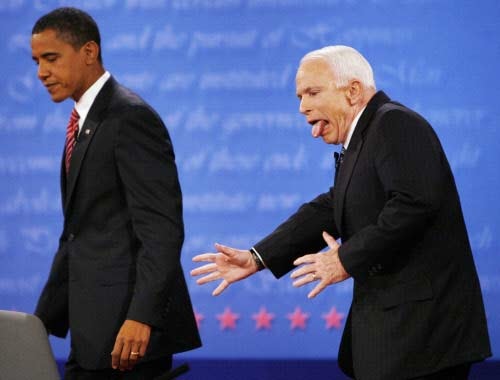
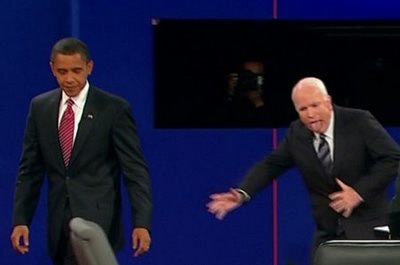
Vote McBlinky and Winky

C8B9FE2A-D551-4EB4-8806-8539550F1DF6.jpg


45D793AE-3814-4A18-A3DA-B161D446E838.jpg


According to Sarah Palin you can't blink. It's a sign of weakness.


But it's okay to wink


Mmm...


McBlinky & Winky 08

Bookmark and Share

Thursday, September 25, 2008

Sarah Palin at the UN: The secret footage


(I'm not the only one to spot the similarity - Andrew Sullivan got there first)

Bookmark and Share

Argh! Make it stop!

If only this film were real:


Oh wait a minute. It is:


Watch CBS Videos Online

And in case you've still not scratched your eyes out of your head...

Bookmark and Share

Saturday, September 13, 2008

Sarah Loves Charlie

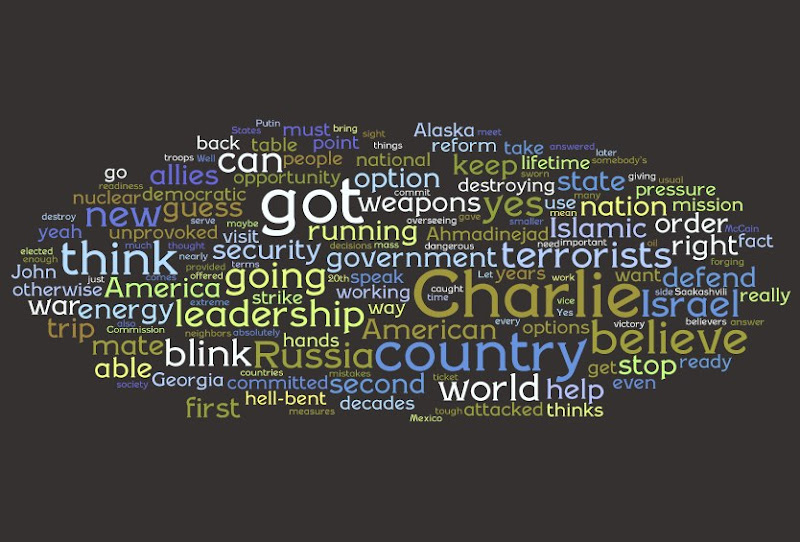
I ran Sarah Palin's Charles Gibson/ABC interview (part 1) through title="Wordle: Palin 1">Wordle and, as suspected, she uses "Charlie" like it's some sort of punctuation mark. A great bit of coaching by her handlers.

If you read the transcript and substitute your chosen expletive, it's a lot funnier. And God knows, reading it back, we need all the laughs we can get...

Wordle - Palin 1.jpg


Quick summary: the woman knows nothing. Heaven help us all.

Bookmark and Share

Thursday, September 04, 2008

Americans left abandoned by Bush

The parallels were amazing: in the wake of Hurricane Katrina thousands of Americans were huddled together in a sports centre wondering where their president was. And in the wake of Hurricane Gustav, thousands (just about) of Americans were huddled together asking the same question.

I was glad to see The Daily Show spot the irony. This is one of the funniest things I've seen in a long time. Enjoy:

Bookmark and Share

Friday, August 29, 2008

Being runner up in Miss Alaska is great practice for being runner up in November

A061F8D1-0606-41D2-A096-88FEA740F2F5.jpg


Apparently Sarah Palin, McCain's pick for Vice President, was a runner up in the Miss Alaska competition. (The swimsuit round must have been nippy, no pun intended - but go ahead if you spotted it).

Seeing as the female population of Alaska numbers around 260,000, that's not saying much. Given those odds, I reckon if I padded up and wore a dress I'd stand a pretty good chance.

On a more serious note, given that she is three years younger than Obama and has even less experience of government than he does, it seems inconsistent to argue that he's not ready to be President but that she is. Watching her next to McCain earlier just made him look even older and more wooden than usual. In a few weeks time I think the Republicans who thought this was a good idea will think again.

Bookmark and Share

Saturday, August 09, 2008

John Oliver analyses Fox News

I loved this when it was broadcast on The Daily Show. Take a look - as well as being extraordinarily funny, it's also pretty good analysis of an appalling "news" network.

Part 1


Part 2

Bookmark and Share

Saturday, July 19, 2008

Like-ability does not equal ability

Jamison Fraser on why the US media's obsession with politicians' "like-ability" is a bad thing


Voting for president based on who seems the most likable -- or, in the media's favorite shorthand, based on who you would rather have a beer with -- is a spectacularly bad idea, what with the almost total lack of similarity between talking about the Knicks over a bottle of Bud and running the world's most powerful nation.

It requires very little judgment or analytical skills to determine that the Knicks stink. Deciding whether to send Americans off to die in a foreign land is (or should be) a little different.


(Via Media Matters for America.)

Bookmark and Share

Thursday, July 17, 2008

Nice to see the US media focusing on the real issues in the election

5E451606-932D-4863-B2BE-D466CDBFBE40.jpg


Good grief

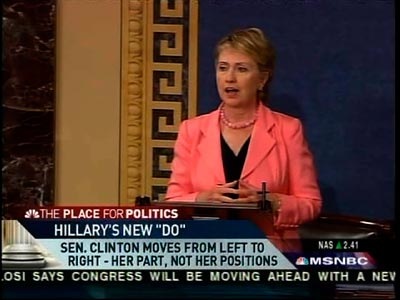
During the 10 a.m. ET hour of the July 16 broadcast of MSNBC Live, host Monica Novotny devoted a segment to discussing Sen. Hillary Clinton's 'new look,' specifically the 'short[ness]' of Clinton's hair and the fact that Clinton 'shifted her part from the left side to the right side.'

At the beginning of the segment, Novotny contrasted a video of Clinton's July 15 speech on the floor of the Senate with her official publicity photo in order to illustrate the difference, stating, 'All right, if fashion -- as far as hairdos go -- isn't your forte, Clinton's hair is apparently shorter than it used to be, and she's shifted her part from the left side to the right side.'

Novotny asked MSNBC congressional correspondent Mike Viqueira, 'So, it's Hillary's part that's shifted to the right? Not her political positions?' Viquiera replied: 'Monica, all I can say is, I'm not really crazy about standing here talking about a senator's hair, especially Senator Clinton's hair, but I'll just say this: When it comes to senatorial hair, she's way ahead of the game. I mean, we've got some combovers around here that are engineering marvels, modern engineering marvels, I tell you. And look, I mean, you know the price of Grecian Formula these days -- I could use -- I could use a raise for that, and some Rogaine.'

Novotny later stated: 'Look, I'm just going to say this: I mean, you remember there have been some other reports where people were focused on other things, so I say, better the coif than the cleavage. That's just me.'

As Media Matters for America documented, on July 30, 2007, MSNBC devoted a total of 23 minutes and 42 seconds to segments discussing Clinton's (D-NY) 'cleavage' between the hours of 9 a.m. and 5 p.m. ET.


Better the coif than the cleavage... oh yes, I get your point. We wouldn't want people focusing on other things in this election, would we?

(Via Media Matters for America.)

Bookmark and Share

Tuesday, July 15, 2008

What the New Yorker teaches us about visual literacy


Richard Adams on the New Yorker cover 'scandal' makes a valid point:

John McCain can say that he doesn't know much about economics and later deny it flatly, then have one of his top economic advisors say it will take one term for a McCain presidency to balance the budget, only to turn on a dime and say it will take two term, and almost nothing of it gets reported in the media. But hey, Jesse Jackson gets overheard using the word 'nuts' and it's time to break out the ink.

If that's what the 'mainstream' news media can do when left to their own devices, a cartoon is nothing.


Seems to me, as one of the commenters on this article says, this is another example (like the 'nuts' episode) of the media reporting on itself rather than on the stories.

But it also suggests something else: when we start summing up complex issues in illustrated form the scope for misunderstanding is huge.
At the New Views conference it was asked why critiques of design have to rely on words, why can't we use design? (Similar arguments are made in favour of letting students create 'visual dissertations') Because writing depends on redundancy - it contains clauses, clarifications, opportunities to go off on tangents or rehearse devil's advocate positions. Create a design to critique a design and you can't guarantee that the message will be decoded correctly. The irony here is that I've just read several thousand words explaining what the New Yorker cartoon is supposed to be saying.

I think the New Yorker cover is a brave attempt to highlight the way the media and others pick apart minutae like the Obamas' fist bump, unpicking images (often because there's not really enough real news to fill a 24 hour news 'culture') but falls foul of precisely the same problems: images have no redundancy. The article that accompanies the cartoon is a few thousand words long and makes it clear what it is saying. The cartoon has no words and is consequently translated differently depending on who reads it, or (importantly in this case) reads about it. If the cover had instead been a cartoon alongside the article it might have made sense. As a cover, it doesn't and simply exacerbates the problem it seeks to analyse.

Barthes famously said that images are polysemous, they have multiple meanings. Text, he said, fixes meaning.
I don't think we've yet reached a level of visual literacy (or ever will?) where images like this can be divorced from the textual context.

Bookmark and Share

Saturday, May 03, 2008

The Post-American World

Bruce Nussbaum reviewing The Post-American World by Fareed Zakaria.:

When the US was the overwhelming power, everyone else had to learn American culture. The big change in the 21st century is now the US has to learn everyone else's culture. It needs to share power, build coalitions, create legitimacy, in order to lead and prosper. It has to stop being the Voice of Authority and learn to Curate a Global Conversation--or many of them.


(Via BusinessWeek Online - NussbaumOnDesign.)

Bookmark and Share

Wednesday, February 27, 2008

Academics denounce courses tailored for businesses

I've been writing a blog post on topics similar to this over the past few days but as it's reached over 5000 words I might have to edit it down before I post it. In the meantime, read this Guardian story.

I share the worries, but wonder why it's come as a surprise given that Sector Skills Councils have been around for about four years now with an overt policy of getting the government to make universities stop pushing the boundaries of knowledge and instead deliver nicely formed employees. Oh look, I'm off again - I'll stop now and let you read the article yourself...


Lecturers today condemned reports that the government is planning a major expansion of the role business plays in the delivery of degrees, warning it will lead to graduates being 'churned out' of 'identikit' institutions.
A leaked document, seen by the Financial Times, suggests that ministers are considering ploughing extra funding into degrees jointly designed and funded by employers.

It also suggests that degrees could be redesigned to make them shorter and more intensive, reflecting an increasing interest in two-year qualifications.

The document, Higher Level Skills Strategy, dated from last November, recognises the 'risks' for universities in tailoring courses for businesses.

But it makes clear that the short-term expansion of higher education will be dominated by courses involved with industry.

'An institution may worry about its public image,' the FT reported the document as saying.

'We expect the majority of this growth to be in provision that is developed with employer input - either foundation degrees [two year vocational degrees co-designed by employers] or employer co-funded places,' it said.

A spokesman for the Department of Innovation, Universities and Skills, refused to comment on the leaked document but confirmed an announcement made last December to plough £105m into 'employer engagement', including co-funded places.

Sally Hunt, the general secretary of the University and Colleges Union, said: 'University is about so much more than just getting students through their degree and out the other side. We should be celebrating universities that are prepared to take risks and push the boundaries in their pursuit of knowledge and research.

'We need to trust people who have spent their lives working in education, not allowing business to dictate the short-term direction universities should be taking.

'The creeping marketisation of higher education seems only concerned with a bottom line and treating students as commodities. Identikit institutions in all our towns and cities churning out graduates in a couple of years is not what the country needs to protect its proud position as world leader in teaching excellence and innovative research.'

Bookmark and Share

Friday, February 22, 2008

The creative industries are the engine rooms of a modern economy? Not really...

According to Davide Kester, Chief Executive of the Design Council: "The creative industries are the engine room of a modern economy built on ideas and knowledge."


Erm... really? Compare the 'knowledge' that's come out of, say, the film industry or the fashion industry to the number of patents, medical discoveries, technologies and who knows what else that researchers in universities produce each year.

The creative industries may be built on ideas and knowledge, but that knowledge is produced elsewhere.

So not so much the engine room of a modern economy, more the onboard shopping mall.

The creative industries are important, but a little perspective would be good here.

Bookmark and Share

Tuesday, January 29, 2008

The New Economy Is Here

The New York Times asks an interesting question that could be asked of UK politicians too:

Why do presidential candidates touting their concern for the economy pose with factory workers rather than with ballet troupes? After all, the U.S. now has more choreographers (16,340) than metal-casters (14,880), according to the Bureau of Labor Statistics. More people make their livings shuffling and dealing cards in  casinos (82,960) than running lathes (65,840), and there are almost three times as many security guards (1,004,130) as machinists (385,690). Whereas 30 percent of Americans worked in manufacturing in 1950, fewer than 15 percent do now. The economy as politicians present it is a folkloric thing ...

It is that the transition is over. The new economy we have been promised is in place. ...The ‘jobs of the future’ that were promised 20 years ago are here. Choreographers, blackjack dealers and security guards have replaced factory workers as the economy’s backbone, if not yet its symbol. New economies have always required a kind of initiation fee of those who would participate fully in them.


(Via The Creativity Exchange.)

Bookmark and Share

Visit my 'official' site

www.jonathanbaldwin.co.uk
contains links to my articles and books.

Tags

Books by Jonathan Baldwin

Visual Communication: From Theory to Practice (Winner of 'Best Higher Education Title' at the British Book Awards 2006) by Jonathan Baldwin and Lucienne Roberts Buy from Amazon.com Buy from Amazon.co.uk

More Than A Name: An introduction to branding by Melissa Davis and Jonathan Baldwin Buy from Amazon.com Buy from Amazon.co.uk

Followers