A blog about design, education and anything else that takes my fancy

Showing posts with label society. Show all posts

Saturday, December 20, 2008

English Ways of Saying Goodbye

My friend Qin, who is Chinese, rang me the other night and after about 30 minutes the time came to say goodbye. I had to go do something (can't remember what - eat, I think) so I said so. "Okay, bye" she said.
I panicked. "What?"
"Bye" she said.

This was new to me. Normally when the English (I would say British but I don't know if it's true of the rest of the UK) say goodbye they enter into a protracted process of drawing things to a close. I first became aware of this when watching The West Wing, and then other US TV shows. In those, a telephone conversation would suddenly end, often without any form of goodbye at all. The last sentence would be spoken and bang the phone would be hung up.

How rude. How very un-English. But how efficient.

I think most of my hang-ups (no pun intended) about the telephone revolve around the whole process of starting up and winding down the conversation. It is almost entirely redundant but you start off with the "how are you?" stuff that takes up a few minutes before you get on to the meat of the conversation. If you're calling someone you've never spoken before you have to give your life story and explain who you are.

But it's the "good bye" that is particularly draining. We can't just say "bye" and hang up. When I told Qin I had to go eat I was telling the truth but I was signalling that I would shortly have to go and do this. I wasn't saying "go away I need to have food". To the English the signal is like the coda in a piece of music. It says "right, we're all done but let's bring things nicely to a halt". Saying "well I suppose I'd better go let the cat in" is just that - it's a polite signal that the conversation has run its course, you have nothing new to say and, much as you may love the person on the other end of the line, pretty soon all you'll be able to do is resort to a bit of heavy breathing cos you're all out of conversation. The signal is a way of politely saying you know you're both about to get to the end of the conversation and moving the discussion on to a roundabout way of acknowledging it.

When Qin said "okay, bye" it pulled the rug from under me. "What?" I said. "Bye" she repeated.

If she'd been English she'd have said "ok - what you having?" I'd have said "a ham sandwich" or something and she'd have told me what she'd had to eat, or was planning to eat. We may have riffed on that for a minute, swapped recipes, delighted in each other's preferences for mustard or mayonnaise, brown bread or white before gently bringing the conversation to a halt. "Okay, I'll let you get on" is often the preferred conclusion to the coda, the imperfect cadence, if you will, (to keep the music metaphor going) that leads to the final "good bye" and hang up.

It always has to be the person who made the call who "lets the other one go" - the receiver of the call can't do it.

I tried to explain to Qin the etiquette she was breaking by simply accepting that I had to go and hanging up but she couldn't get it.

There are similar things in English behaviour: we can't buy anything without saying thank you several times, for example. I seem to remember hearing a comedy routine on this years ago but can't remember. Basically it goes like this...
We take our goods to the counter and put them down. "Just those, thanks" we say. The cashier puts everything through and tells us how much. "£5.65, please". We hand over the cash. "Thanks" we say. We get our change. "Ta". We gather up the bag. "Cheers". We head off "See you later. Thanks" We may add another "Cheers, bye" and then we're off.
I count at least five or six instances of "thank you" or its variants.

It's hard work being English, sometimes.

Bookmark and Share

Tuesday, July 22, 2008

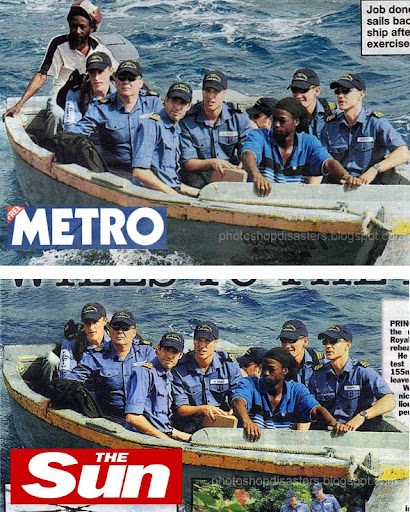
Spot the difference


(Via http://photoshopdisasters.blogspot.com/feeds/posts/default.)


Yes, that's right. There's a disembodied knee in the bottom picture.

Bookmark and Share

Wednesday, June 25, 2008

Rituals of Violence

As a prelude to a radio programme on the rituals of violence, Laurie Taylor writes about his memories of following my own football team, York City. The last line is a great image...

I’ve supported York City ever since I took up my lecturing job at the university in the late sixties. There have been a few magical moments over the years since then – a 3-0 win over Manchester United at Old Trafford in the 1995-6 League Cup – but most weeks the fans have to dine on pretty thin gruel.

Like other supporters of lesser teams, though, they keep themselves going by telling jokes about their own team and its relative lack of success. They’ll talk about the time the new and much criticized striker finally earned a corner and the entire team did a lap of honour. And they’re bound to come up with the story of these two York fans fighting each other on the terrace. A policeman jumps over the barrier to separate them and says ‘Why are you two fighting. You’re on the same side.’ And then the fellow who started it all points to his protagonist and says ‘It’s not my fault. It’s his. He tried to shove a season ticket in my pocket.’

At some matches the only thing that enlivened the proceedings was the prospect of a little hooliganism. Even though visiting teams rarely brought more than a couple of hundred fans with them, these were routinely segregated from York supporters by a line of constables.

All was usually relatively quiet for the first half-hour of the match. Nothing much more than the routine chanting of insults between the two groups of fan. But then, after a particularly nasty foul, or a dramatic goal-mouth incident, matters would escalate and fans from each side would attempt to breach the police line, waving their fists in the air and shoving and pushing.

From close-up, it might have been disturbing but viewed from the other end of the pitch, it had a deliciously ritual quality. Half-a-dozen fans who were braver than the rest would shove against the police line, while their rivals would shove back the other way. And so it went on with neither side striking a blow until one fan – there seemed an element of arbitrariness about this – was picked on by the police and then, to cheers and chants all round, escorted along the touchline and out of the ground.

In the old days what added even more to the ritual quality of the hooliganism was that at half-time away supporters were often allowed through the police line so they could join home supporters in the queue at the tea stall.

Bookmark and Share

Saturday, May 03, 2008

The Post-American World

Bruce Nussbaum reviewing The Post-American World by Fareed Zakaria.:

When the US was the overwhelming power, everyone else had to learn American culture. The big change in the 21st century is now the US has to learn everyone else's culture. It needs to share power, build coalitions, create legitimacy, in order to lead and prosper. It has to stop being the Voice of Authority and learn to Curate a Global Conversation--or many of them.


(Via BusinessWeek Online - NussbaumOnDesign.)

Bookmark and Share

Sunday, March 30, 2008

Percentage wars

Anna Pickard in The Observer:

Marvellously, The Apprentice brings with it a welcome return of moronic businessisms, as candidates trot out trite examples of things that sound fine in brightly coloured motivational books, but idiotic when tumbling out of mouths.

A favourite is the search for the highest percentage. You may have thought that the highest percentage would be 100, but that would be naive and non-managerial.

For some time, it has not been enough to give 100 per cent effort. To impress, nothing less than 110 per cent is necessary. Or 150 per cent. Or 200 per cent. Percentage wars have broken out and 1,000 per cent is bandied about.

At this point, the notion of percentage flies out of the window and the contestants find themselves stuck in a 'who can think of the biggest number' competition. These are, apparently, some of the best new business minds in the country. Which terrifies me 38,476 per cent.

Bookmark and Share

Tuesday, March 11, 2008

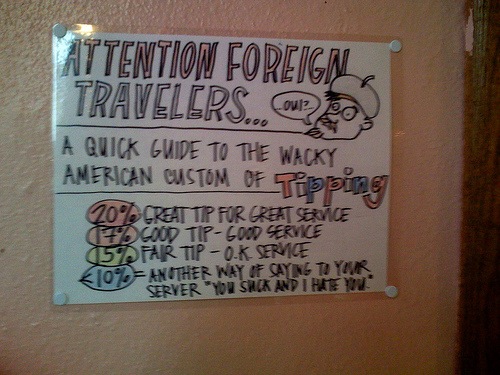
What does no tip signify?

82C1A1BD-6EE5-437D-9FA8-038D2B536D27.jpg


I'm going to New York in April so this handy little guide (via Passive Aggressive Notes) is well-timed. But if a 10% tip indicates you hate the server and they suck, then what does no tip signify?

What a weird system...

Bookmark and Share

Monday, February 04, 2008

And for your homework, please design a torture device (Updated)

On first reading, this seems like a bit of a 'whoops' story (and that's being kind). But as I read it I kept thinking, 'hang on, there's a possible logic to this' and there it is, right in the last line. But don't spoil it for yourself, read the whole thing...

My thoughts after the article.

An architectural school was at the centre of a row last night after it emerged that students were required to design a fully operational torture device.
The project, part of a masters course aimed at first-year students of the University of Kent's School of Architecture, was described as 'sick'. One student has lodged a complaint on the grounds that he was uncomfortable about carrying out the brief. Illustrated by a skull and a view of a Gestapo electric torture chamber, the brief handed to a class of students at the school was to 'design, construct and draw a fully operational prototype torture device based on ergonomic principles'.

They were encouraged to 'be original' and instructed: 'You may use a historical precedent as a point of departure or attempt to develop something completely without precedent. Through design development we hope you may advance your understanding of ergonomics as it pertains to torture.'

Paul Hyett, a former president of the Royal Institute of British Architects (RIBA) responsible for the Treatment Centre for Torture Victims in London, said the school was dabbling in 'dangerous territory' and called for the project to be stopped.

Hyett said: 'It's sick. Architecture should be about enriching our lives culturally and lifting the spirits of the people who live or work in the buildings we create. There is absolutely no circumstance where any piece of equipment for torture has any positive use in our lives or our society. This is monstrously complicated territory and I don't think that amateurs should mess around in it. I'm appalled.'

George Ferguson, also a past RIBA president, said: 'Architecture isn't practised in some Britart external gallery. What we should be teaching students is about people-friendly buildings and it is obtuse to start with extreme discomfort as a way of teaching it. I would understand it in a philosophic course but I do not begin to understand it in a serious architecture course.'

The head of the University's architecture department, Professor Don Gray, confirmed that one of the 12 students had complained. He said: 'The only person who has raised any objection has been given the opportunity to address the project from a different angle. I agree that it is a slightly shocking introduction to a very serious long-term design project. I'm neither justifying it or defending it but that is how we are going about it.'

The two-week project was designed by course tutor Mike Richards, in advance of a project to design a new headquarters for Amnesty International.


So here's my two penn'orth:

I've used provocation with students in the past to get them to see a problem from 'the other side' as it were. It can be controversial, but it's in keeping with the spirit of free enquiry enshrined in our university system and culture. If you're designing something for Amnesty International, it makes complete sense to immerse yourself in the problem of torture and the minds of those who do it.
Without knowing the full story, it's stupid to speculate. So in the best tradition of 24hr news programmes let me do just that.

I suspect Mike Richards believes this is a legitimate way to help his students understand the issues that Amnesty campaign on, and if that's the case then I support his novel approach. I would have suggested that the brief be explained in these terms and, seeing as only one student has complained, suspect that this did in fact happen (there's always one).

The people quoted in this article have either not appreciated that higher education isn't a cosy world of teaching students what they need to know to do a docile job, but of confronting them with knowledge of how the world works, or they've been given only half the story. If the former, they should think again. If the latter, they shouldn't have commented at all (and the Guardian should be ashamed of itself).

(Update: Design Week is carrying the story, and even more badly written)

Bookmark and Share

Wednesday, October 10, 2007

Talk to your daughter before the fashion industry does

Here's an interesting campaign from Dove, though as David Airey points out, Dove are owned by Unilever who also sell SlimFast slimming aids...


He also mentions that

Unilever’s subsidiary based in India, Hindustan Lever Limited (HLL), markets Fair & Lovely Skin Cream and Lotion, the largest selling skin care product in India. Fair & Lovely is being promoted as a ‘fairness face cream’ that will lighten your dark skin. Through their advertisements, Hindustan Lever spreads the message that a light skin is better than a dark skin.


No, this ad is not a joke:


Perhaps you had the same response to that that I did, but as David points out, is it any worse to want to lighten your skin than to darken it through tanning products and treatments? That's a tough one and I don't know enough about the cultural issues to venture an educated opinion. Is skin lightening an attempt to beat racism (and therefore a result of racism) or simply a cosmetic desire?

Bookmark and Share

Tuesday, October 09, 2007

Teaching kids financial responsibility with Barbie

Seriously - does anyone think this is a good idea? "I love shopping with a credit card - you never run out of money!"

Bookmark and Share

Thursday, September 20, 2007

The global village and the McCann case

Mark Lawson on the US media and the McCann case:

"Marshall McLuhan, prophet of the modern media age, would be thrilled. The McCann case has shown that we truly are a global village."

(Via The Guardian.)

Bookmark and Share

Thursday, August 16, 2007

Cityware - an interesting Facebook application

Here's an interesting idea from the uNiversity of Bath. Cityware is a Facebook application that connects to a Bluetooth-enabled device and logs who you encounter throughout the day (assuming they are also on Facebook and using Cityware).

It has a lot of potential in teh social networking area, not to mention making those adverts in Time Out redundant ("to the girl with blonde hair on the 7.12 to Paddington. I was the weirdo who kept staring at you. Call me.") as you could, in theory, look at your daily log and then pry in to the personal details of anyone who even so much as wandered past you in the supermarket.

Scary. But there you go. I'm up for giving it a go, in the name of science.

(Of course, it'll give the civil liberties lot nightmares. If the government suggested everyone wander round with devices tracking their movements there'd be uproar. But as it's Facebook, it's okay...)

To sign up you need to visit the Cityware page on Facebook. Oh, and you also need to be living in a Cityware node but there are only three in the world at the moment. However, it's easy to set your own computer up as a node.
So although I'm now using this application, as I don't have any plans to visit UC San Diego, the University of Bath, or UCL in London any time soon it'll be a long time before I pop up on anyone's radar. Unless we can get one started where I work. In the interests of science.

On second thoughts I've just thought of several reasons why this might be a bad idea... It would obviate the need for gossip, for one thing. Just check Facebook every morning and you'd immediately see if your suspicions about Jill from Accounts and Fred from Catering were true (made up names and people, incidentally - heaven forbid I've stumbled on something there!)

Edit: In a (rare) moment of self-doubt I looked up 'obviate' wondering if it's one of those words I've either misheard or used incorrectly. Like 'fulsome'. Turns out I'm right - it means 'avoid' (which makes me wonder why I didn't say that - but wrong in that 'obviate' means 'avoid the need for' so instead of 'obviates the need for gossip' I should've said 'obviates gossip'.

You learn something new everyday!

Bookmark and Share

What's in @ name? Chinese watchdog queries parents' choice

A Chinese couple who wanted a distinctive name for their baby boy and came up with the symbol @ have earned a rebuke from the government's language watchdog.
The parents claimed the commonly used email symbol, pronounced in English as 'at', sounded like the Mandarin for 'love him' when spoken by Chinese.

But the government's state language commission has taken a dim view of the attempt to break the mould in a country where almost 90% of the country's 1.3 billion people share just 129 surnames."


Full article in The Guardian


I like this story but the parents have ignored an important issue. What's his email address going to be?
Especially if he gets his own domain...

Bookmark and Share

Saturday, August 11, 2007

Stopped Clocks


Here's an interesting project. Stoppedclocks.com aims to catalogue Britain's thousands of stopped clocks on high streets and in villages, and then work with the people involved to get them started again.

There's something a bit sad about a stopped clock - it suggests all is not well with the world.

From the site's creator:

I once took a walk around a square mile in central London, I found 11 stopped clocks, either Municipal clocks, church clocks or otherwise public clocks. After poking about and doing some research, I discovered that it really does not cost much to fix a clock, as there is a tendency within clock repair to replace very old clock mechanisms with a mix of digital and analogue mechanisms. For an average of £1,000, each of the clocks that I found could be repaired.

Clocks in the public sphere were once really vital - not everyone had watches, let alone wrist-watches until the early 70’s - you needed to be able to see what the time was and so they truly had a public function. Nowadays, with digital watches and mobile phones being the norm, the function of these clocks has disappeared.

As a metaphor for our relationship with our past I think that stopped clocks are a potent symbol of the loss of our analogue past, how almost unknowingly we left behind so much when we entered this digital age. I hope you enjoy the blog, and will help me create a deep database of stopped clocks around the country, with the aim of getting them fixed.

Bookmark and Share

Visit my 'official' site

www.jonathanbaldwin.co.uk
contains links to my articles and books.

Tags

Books by Jonathan Baldwin

Visual Communication: From Theory to Practice (Winner of 'Best Higher Education Title' at the British Book Awards 2006) by Jonathan Baldwin and Lucienne Roberts Buy from Amazon.com Buy from Amazon.co.uk

More Than A Name: An introduction to branding by Melissa Davis and Jonathan Baldwin Buy from Amazon.com Buy from Amazon.co.uk

Followers