A blog about design, education and anything else that takes my fancy

Sunday, December 31, 2006

A culture change is needed - but in industry or academia?

One of the issues that keeps coming up in my current research project is the complaint from certain sectors of the design industry that they are not seeing the same quality of graduates that existed before (in the mythical 'olden days' presumably). I posted last week about how I thought that was so much rubbish, and could even be argued against using basic maths.
The complaints are based on anecdotal evidence from employers but there are two real problems with this: firstly, it's anecdotal evidence. If things were really so bad then the British design industry would be in the pits, so there's no actual evidence of such a decline. Secondly, it's been said for years - in fact I can't remember a year when exam results in the UK weren't met with a press release from the Confederation of British Industry moaning about falling standards.
What we really mean by falling standards is that I can't believe kids these days don't know when the Battle of Hastings was, or who Edward Heath and Richard Nixon were. Whereas I remind myself that when I was sixteen I couldn't do half the things today's kids can, the 'suits' confuse trivia for knowledge. I suppose if you were recruiting on the basis of putting a winning pub quiz team together you could rightfully complain about 'falling standards', but otherwise, I'm not sure you can.

Anecdotal evidence has its value, mind you. I'm a big fan of it (especially when it supports my point of view!) and I think it's wrongly frowned upon in academia. My own anecdotal evidence, based on many conversations with students and graduates, suggests that contrary to what employers are saying, we are producing 'quality' graduates. And I agree that employers aren't seeing them. How can both sides of the story be true?

Simple: the qualities, not the actual quality, are changing, and the things that mark out a high quality graduate these days, certainly in graphic design, are cynicism and scepticism, a healthy distrust and dislike of the way a lot of businesses work, and a growing preference for a job and lifestyle that contents them, rather than propels them on a glittering career and wealth. (I suspect those things may change as they get older, of course...)
In other words, the reason a lot of design firms in the UK are complaining that they are not seeing the same number of top quality graduates applying for jobs is not because the quality of teaching has dropped, but because those graduates are more choosy about who they go and work for. The tradition in the design industry of undertaking unpaid work placements, and then accepting poorly-paid 'trial periods' is something that today's cash-strapped and culturally-aware graduates are no longer willing to take part in, and a good design graduate would rather take a post in an independent coffee shop than work in a soulless office all the hours God sends for little or no pay (this is what the 'suits' call 'passion' incidentally).

And that's not a crazy comparison, as though working in a coffee shop is a really menial thing just one step above being a designer. As Richard Florida points out in The Rise Of The Creative Class, in today's cafe culture jobs like this are seen as fulfilling ones for the people you meet, the conversations you have and so on (we're talking about arty, independent cafes here, not your greasy spoons and chains). While 'suits' think having a workforce of waitresses and hairdressers with degrees in English Literature is a sign of educational oversupply, I think it's a sign of a society that values knowledge and creativity.
It seems odd that the body that represents the creative industries in the UK seems hell-bent on stamping out the very things it depends on, not just because designers use them, but because so do clients and consumers.

These thoughts were reinforced for me today by an entry over on Florida's blog. It's worth noting that Creative and Cultural Skills, the body I'm talking about, uses Florida to make their case about closing courses, building artificial communities of creative people servicing communities of bio-scientists, businessmen and so on. It's clear they've never actually read his book beyond the introduction, if that. In calling for things such as a more business-oriented approach to design education, less frivolous (i.e. no fun, I assume) and less interdisciplinary in social terms, they actually contradict a lot of what Rise suggests is needed to nurture creativity. He makes the points again today in response to an article in the New York Times:


Three things crossed my mindas I read the story and scanned its pictures, which interestingly enough appeared in the fashion and style section and not the business section.


  • (1) You can't pump creative work out of people, assembly-line style.' Motivating this kind of mental work requires a new kind of' workplace, one that appears to be nurturing,' attuned to individuality, and 'fun'-' a trend I dubbed 'soft-control' in Rise.


  • (2) It's a mistake to see this stuff as all frills and perks. Companies are doing it because it is increasingly required to attract top talent.' Offering a stimulating environment, flexible work hours, and the ability to be 'yourself' is an effective and relatively 'cheap' way of competing against, say, investment banks and hedge-funds.


  • (3)' Scanning the photos, I was struck by the similarity between these new work-spaces and college dorm rooms, where so many of these high-tech companies come from, or even the play-spaces of middle age teenagers. Could it be that the demographic trends toward postponed marriage, extended single years and what Ethan Watters dubbed the 'urban tribe' are being projected into the work-place?

(Via The Creativity Exchange.)


Those graduates the industry say they are not seeing will not magically show up because you put a pool table in the studio or let people play music (something, incidentally, that drives me mad - I would never work anywhere I was subjected to other people's music!) but only when the entire culture of the employer changes. And yet there's a long way to go before unpaid placements, long hours, 'flexible contracts' and other strange practices are consigned to history. Will these things ever happen? Well it's telling that the industry bodies think it would be easier to force university courses to turn out exactly the type of graduates they want (i.e. willing to work for nothing, over long hours, and with little job security) than to change industry practice.

Bookmark and Share

Saturday, December 30, 2006

Another reason why the 'business' approach to design teaching is wrong

I think [design schools] have a good shot at helping the university turn out capable innovators. They are better positioned, for instance, than [business schools].

For one thing the design schools believe in consulting carefully with the consumer [...] the design field believes in ethnography, and this method flourished there well before its present popularity in business research circles.

For another thing, the design school believes in culture.

As it stands, the business school tends to think about the product or brand in terms of utilities, functions or benefits. Brands and products create value by doing work in the world.


From Grant McCracken via Richard Florida

Bookmark and Share

Tuesday, December 26, 2006

How graphic design writing causes problems in student learning


Earlier I mentioned that there was a need for the design industry and press to ensure it reflects more closely the realities of how design is produced and consumed.
One example worth looking at is the book Dialogue: Relationships in Graphic Design by Shaun Cole. This book intrigues me because designer/client relationships is a particular research interest of mine. Unfortunately, none of the examples cited in the book matches up with my own experience of designer/client relationships, either as a designer myself, or as a researcher on the outside looking in.

That's because the book focuses exclusively on the 'prestigious' end of the market. All the clients and designers here are well known, or share certain cultural backgrounds, knowledge and tastes. It's an interesting book, and I heartily recommend it, but with the proviso that it is an accurate description of a tiny aspect of the graphic design profession and you don't have to move far outside that little world before you begin to encounter the sort of horror stories recounted on Graphic Design Rants.

But this is a massive problem in graphic design - just about all the writing on the subject focuses on a tiny proportion of the industry. I would wager it's not even a classic 80:20 split (where 80% of writing about graphic design focuses on 20% of the industry), more 99:1.
This is what I meant when I mentioned the focus on 'the visual' and 'heroes' in my last post - pick up any design history book and the link between it and the truth of how design is produced is infinitesimal - which is probably why there's little market for it among most designers themselves, never mind the general public (pace Rick Poynor). It isn't quite fiction, but it's not far off when compared with the experiences of 99% of designers and their clients.

Take a look at the index of Dialogue and you'll see what I mean; it's a roll call of the great and the good: Jonathan Ive, Ken Garland, Bjork, Madonna, Steven Spielberg, Dream Works, Saul Bass... not one mention of the everyday realities of getting graphic design produced - finance, trademarks and copyright, spreadsheets, negotiations, chasing clients for copy and images etc etc.
But it's books like this that students read, and that give them their impression of what working in graphic design is all about. If employers think graduates lack a sense of realism they blame people like me, the teachers. But I, like so many of my colleagues, am constantly placing design in to a real world context, but we're fighting against this tide of publications that 'big up' design and attempt to make it sound sexy and arty and heroic. And the biggest culprits in this mis-selling of the job of graphic design? Industry. It is seeking to reposition itself, to give itself a legitimacy (academia has a big role to play in this too - the elevation of design to academic status means it has needed to develop a sense of history and it has done this by borrowing it from the art world). This legitimacy comes from ignoring the dirty little secret, that graphic design exists at a basic, fundamental level in society and commerce and instead focussing on prestigious jobs and clients.

It's no wonder that potential clients for design are turned off by what they perceive as irrelevant (a major threat to the future of the industry), but equally it's no wonder that employers complain that graduates have no understanding of the context in which they will work. They've been lied to for years, reading articles in Creative Review and Grafik that try to hide that dirty little secret. Yet it's those self-same employers who encourage this, by trading in prestige and taking part in profiles and case studies that contribute to the idea among students that 'business skills', of the sort CSS says should be taught, are irrelevant

Funny, though, how it's teachers who get the blame.

Bookmark and Share

Why design students reject lessons on legal and business issues

Creative and Cultural Skills (CCS) claim that UK design courses are not teaching the right things and cite copyright and trademark issues, and accountancy and design management as examples.
Now let's ignore the obvious problem with this - that you can't on the one hand claim a big threat to the UK design industry is 'amateur designers' and then claim we should be producing designers who are also 'amateur lawyers' and 'amateur accountants' - I would imagine our colleagues in those disciplines would think it odd that we try to teach their specialisms in a few weeks).

On one course I taught, all level 2 (one year before their final year) design students were given a talk by a representative of a government-funded agency established to help people in the creative industries with copyright and trademarks. They also received a series of talks from a similar agency on issues such as finance, pricing jobs and setting up in business. The response from students was that the talks were 'interesting but irrelevant'. (Personally I found them to be highly relevant, but then I've got nearly 20 years of experience).

Clearly CCS are wrong in this instance - students are being taught the things they say are important and by specialists from outside academia (CCS claim, among other things, that academics shouldn't be teaching but that specialists and practitioners should - I'll come back to that bizarre argument another time).

But the problem is not, as CCS claim, with the teaching, but with the learning - and this is one of the reasons CCS's claims about education need to be questioned, because they demonstrate a fundamental lack of pedagogical understanding. The question that needs to be asked is why do students perceive these topics to be irrelevant?

I propose two reasons: the first is pedagogical - if you do not assess something, then you can 'teach' it all you want but the likelihood it will be 'learnt' is low. And other than setting examinations to test theoretical knowledge of these areas, the opportunities to assess practical knowledge are few - the only real way is to experience them, something that could be done on work placements (but rarely is as hosts tend to put placement students to work on menial jobs rather than shadowing graduate-level areas) or in an actual job. (The role of employment in 'completing' an education is ignored by CCS who seem to believe that a graduate should be 'ready baked').

The second explanation is important. Initial research for my paper suggests that the graphic design industry rarely, if ever, discusses aspects such as copyright or trademarks in its communications. Indeed, a study of a sample of Design Week, Creative Review, Grafik and Eye found no mention at all of any of the issues CCS identifies as 'threats' to the future of the industry (e.g. accountancy skills, design management, law etc). (My focus in the paper is the graphics industry - whether it applies to other areas of design remains to be seen).

Without doubting CCS's assessment of the problems it is clear that their proposed solution - to teach them more - is unlikely to succeed if it cannot first persuade the design industry and the design publications industry to change its public focus from 'the visual' and 'the heroic' to the 'nitty gritty'. If students' perceptions of the design industry are changed at this level then the job of courses will be made much easier. When we try to teach students about the realities of the practice of design, they reject it as irrelevant because that's not what they're hearing from the industry and, after all as CCS say, what would academics know about 'the real world'?

At the moment, many courses do teach these aspects, but with little success - not necessarily because the teaching is poor but because students understandably believe them to be irrelevant. Those courses that do not teach these areas are arguably making a wise choice as there is little point expending valuable resources with nothing to show for it.

CCS, instead of blaming design courses for a lack of awareness of these issues among graduates, needs to pressure the industry and design journals to be more reflective of the realities of the business of design before it can make claims about, or force changes on academia.

Bookmark and Share

Monday, December 25, 2006

Academic and Vocational Qualifications - what's the difference?


One of the big problems we face in design education is the still popular notion that degrees in design are 'vocational'. They aren't. A degree is, by definition, 'distinctively academic', no matter what subject it is in.
Unfortunately, this is generally forgotten or even unknown to a large number of employers, students and - worryingly - teachers.
In the UK we have what's called a 'qualification framework' which is overseen by the Quality Assurance Agency (QAA). This lays out a range of qualifications and levels defining (admittedly in quite woolly terms) the difference between what a student on the first year of a degree course should be expected to know compared with, say, a final year student, or an MA student. (The fact that a first year undergraduate should not be expected to have the same level of understanding of a topic as the post-grad teaching them is sadly forgotten by a significant number of teachers).

There are two basic types of qualification: a vocational one, and an academic one. Neither is better than the other, they are simply different, intended for different purposes. I can't do the system justice by boiling it down like this, but essentially a vocational qualification should be your choice if you want to do something without necessarily understanding the bigger picture, while an academic qualification takes in the bigger picture but may still enable you to practice - though the possibility of you practicing the subject is just that: a possibility, and not a given.

So if you want to be a lawyer, you would choose a BA in Law, but if you want to work in one area of law, or advise people, or run a law firm, a vocational qualification might be the ideal choice (vocational qualifications are - or should be - designed to be studied while the student is working if necessary).
Similarly if you wanted to be a researcher in art or design history, a BA in the subject is ideal. But if you want to run a museum then a vocational qualification in museology might be better.

What I don't think many people get is that you can have an academic qualification in a vocational subject, and a vocational qualification in an academic subject. And this failure to 'get' it is why we have degrees in some subjects when they should be vocational qualifications (in the UK the two main types of vocational qualifications are the Higher National Diploma - HND - and the Foundation Degree - FdA - which is largely replacing the former).
Design educators who claim a design degree is 'vocational' are missing the point. There has to be a difference between a BA and an FdA, and the difference is the type of things studied and the depth to which they are studied. A BA in graphic design is not simply a two year FdA with a dissertation on top and a bit more time to work on your portfolio, which is exactly what a lot of design degrees are.

To give an example, there are many many design students on BAs who would be much happier on FdAs - and many design teachers who would be happier teaching on them too. Equally there are many design students and teachers who would love to study and work on academic design courses but find themselves trapped in poorly disguised and mis-labelled vocational courses which aim only to turn out designers.

The problem is that the industry recruits graduates for ground-floor jobs, then complains that the graduates are not 'right' for the job. That's because the job isn't graduate level. But instead of doing what the FdA was designed to do - giving employers a say in the creation of qualifications that suit their needs, and enable them to recruit someone from school and send them on a part-time FdA while giving them real-world experience - they continue to recruit graduates and seek to influence what is taught and how it is taught. In effect, the design industry appears to be trying to turn degree courses in to FdAs and HNDs instead of simply sponsoring new vocational courses.

There is enormous value in studying design at degree level, but there are too many students who simply want to work as designers without understanding the bigger picture, (and, conversely, not enough people who see design as a legitimate area for academic study). That's not their fault - it's ours, and industry's (for insisting on degrees for jobs that don't need them). Worryingly, there are many design degrees which do not actually meet the criteria for a degree, simply being vocational training courses stretched needlessly over three or four years.

I don't agree with Creative and Cultural Skills that there are too many design students - the more people who study design the better design will be understood by clients and consumers (Margaret Thatcher knew that, which is why she insisted that craft and design be part of the national curriculum in schools).
But there are too many people on the wrong courses, and too many courses of the wrong type. What CCS should be doing, instead of criticising academics and trying to shut down courses and prevent people from studying design at degree level, is telling its constituency to stop recruiting graduates to non-graduate positions, to begin recruiting people at a younger age and sponsoring them through a vocational qualification (instead of criticising school curricula as well as university courses), and respect the value that design studied in an academic environment brings to the industry and the world in general.

Bookmark and Share

Sunday, December 24, 2006

Nailing the myth of graduate quality - with a bit of simple maths


A few weeks ago I attended the Competitiveness Summit 06, organised by the Design Council to mark the anniversary of the Cox Report. On the whole I enjoyed the day and got a great deal from it. Some things rankled with me, however, and I suspect I will write about them over the next few weeks.
In particular was the number of times the old myth about graduate quality was trotted out, especially by a representative of Seymour Powell, the product design firm. I have to say this chap managed to cram into five minutes some of the most insulting and patronising crap I have ever heard, and if what he said was any indicator of the response he and the company gives to applicants for jobs, I'm not surprised they're having difficulty recruiting! (But of course it is all 'our' fault - academics who apparently are out of touch with 'the real world' - unlike anyone sitting behind a Mac in a design studio, for example).

Anyway, back to this myth. It is claimed by many people, especially Creative and Cultural Skills that the quality of design graduates is decreasing - it isn't as good as it used to be in 'the good old days' basically. They offer no evidence for this, interestingly enough, and base the claim on two things: anecdotal evidence (of the type spouted by Seymour Powell), and the conclusion that as there are more design courses, students and graduates than ever before 'it stands to reason' that quality must be suffering.

I can offer my own anecdotal evidence to counter that: it isn't. Each year I am amazed to find the quality of graduates getting better, despite the fact that I tell myself it must be a statistical blip - surely this year can't be as good as last year? I haven't met one educator who agrees with the assessment that quality is suffering - only that the qualities themselves are changing, and this is one of the central arguments in my forthcoming paper.

But I wonder why companies like Seymour Powell believe that quality is getting worse. The conclusion I've come to is actually quite staggering, and I want to save it for January (sorry about that), but for now let me share with you a really simple 'proof' that the myth of graduate quality being linked to increased student numbers is wrong.

Remember that the claim is 'the number of quality design graduates has decreased sharply in recent years' and that the co-relation to this is the equally sharp increase in the number of students. (If you study statistics you'll know instantly what the problem is with this hypothesis).

Let's assume, for the sake of ease, that twenty years ago there were 1,000 design graduates each year (the actual discipline is irrelevant). Let us also assume that of those 1,000 graduates 250 were what might be described as 'high quality'.
Now come to the present day and say that the number of graduates per year has increased tenfold to 10,000.
If the proportion of 'high quality' graduates were to drop equally dramatically, from 25% to only 2.5% there would still be 250 high quality graduates. In other words, even if critics are correct and the proportions are suffering, the actual number of high quality graduates in a worst case scenario remain exactly the same. Given that this is a worst case scenario, the actual truth must be that rather than the number of high quality graduates diminishing, as claimed so loudly (and believed by many), the number has increased.

This certainly ties in with the anecdotal evidence from within higher education and, believe me, academics are not known for their Pollyanna attitudes - I have worked with some real sceptics in my time and even the worst grudgingly admit that standards are at least as good as they ever were and by most accounts so much better.

The claim by certain sectors of the design industry that the number of quality graduates is diminishing is, to use some frank and un-academic language, bullshit.
What my research is suggesting is that what these people are seeing is a change in the number of traditional graduates applying to them - they wrongly jump to the conclusion that this is a sign of bad teaching and over-supply of graduates. It isn't. What it is, I'm afraid you'll have to wait until mid-January to find out...

Bookmark and Share

Why the Chartered Society of Designers does not get design

I've been busy researching the relationship between the graphic design industry and academia recently for a paper I'll be giving in London on Jan 5th. This has invovled analysing the role of 'Creative and Cultural Skills', an organisation that claims to represent employers and makes several broad claims, which basically boil down to the 'fact' that university courses in design are no good and that industry knows better. (It's a little more complicated than that and I'll post more about it after the conference).

One of CCSKill's partners in their campaing is the UK Chartered Society of Designers, an organisation that has been around for quite some time but until recently has not had much of a profile in the design industry. This is changing, largely because of the CCSkills campaign to replace academic skills in the industry with 'practical' skills.

One policy of CSkills and the CSD is to create a licensing scheme for practising designers. I have a real problem with that: licensing practitioners is protectionism (funny how when other people do that we cry foul, but see no problem in doing it ourselves).

The aim of CSD is to remove unlicensed designers from the market because a) they are taking business from 'professionals' and b) they produce bad design that serves clients poorly.
These are strange assumptions that are not borne out by reality - a simple check would be to see if CSD members only ever produce 'good' design and never have disgruntled clients. I imagine 'no' would be the answer to both those points.

But why would anyone want to be a member of the chartered society of designers? And why would anyone use such a person?
One of the arguments commonly heard in favour iof licensing designers is that similar schemes have worked in other areas, with architecture and gas fitting being commonly cited. Membership of the Royal Institute of British Architects (RIBA) is seen as a badge of quality, and it is difficult to practice as an archtitect in Britain without membership.
Membership of Corgi is a legal requirement for anyone fitting gas appliances such as boilers and fires. Rather than it being a badge of quality, it is a badge of competence - to gain membership you have to pass an exam and demonstrate that you understand basic concepts and theories regarding, among other things, carbon monoxide poisoning. It is illegal to fit a gas appliance without Corgi registration, but such registration does not mean that a member will not make a mistake, or do a bad job in future.

Now it makes sense for someone who is having a wall knocked through to check the qualifications of the person doing the job - after all, a bad job could be fatal. Similarly, it makes sense to check that someone fitting a new boiler knows what they are doing for the same reasons - a bad job could kill someone.
You would have to have a massively enlarged sense of the importance of graphic design if you believed you had to use a member of the CSD to have your new restaurant menus produced, or your new business card and letterhead. Or your small ad for the local paper.
No one, as far as I know, ever died because a menu was badly designed. There is no comparison between graphic design on the one hand and archtecture and gas fitting on the other.

There is no doubt that some clients would seek out a CSD member to do their design for them, but for every one who does I imagine there would be another ten who either wouldn't care (or even know) about CSD membership, and several more who would actively reject the notion of employing such a person because they would assume they were too expensive.
CSD membership has many benefits but the most important one is a sense of belonging - because membership is based on peer approval it must feel good to get in, and the prestige or social capital it brings is what you exchange the membership fee for. What it is not is a guarantee of future income, nor is it a guarantee to the client of a good job and good design.
You have to invest a lot of time and effort in gaining CSD membership and maintaining it - this is time and effort (and therefore money) that a lot of designers cannot afford and that a lot of designers simply do not need to expend, because they are managing quite well without being a member.

It all comes back to the idea that the CSD is essentially a club for graphic designers, nothing more. As such I have no problem with it. I have occasionally pondered joining but I'm not sure what I would gain from it, or even that I would be accepted (are my clients prestigious enough?).
But the notion that the CSD wants to grow into a licensing body so that the message going out in future is that only members should be approached for design work in future is a dangerous development. It is, to repeat what I said earlier, protectionism - an attempt to counter competition from a perceived threat of amateur and untrained designers and to improve the quality of design, as determined by the design elite.

The licensing will extend to education too, with the CSD having a role in approving courses in the same way that RIBA does and, by implication, closing down those that do not adhere to its policies and curriculum, or worse limiting the number of courses on a supply and demand basis - if the CSD doesn't need any more members then presumably they will not license more than a handful of design courses. This is wrong and worrying on so many levels.

My prediction is that colleges and universities will split - some will seek out membership as a marker of prestige but then be shocked when the local FE college also gains membership (as it will, largely because FE colleges are traditionally more willing to change curricula to suit local employers' needs). This will then result in universities deliberatly not seeking membership and moving to distance themselves from the CSD, perhaps even forming their own organisation in direct competition.
When I suggested this, one senior member of the CSD said this was fine 'it's a free market'. Which sort of begs the question, why seek to ensure that the market to buy and practice design is anything but free?

(Incidentally, it's worth noting that there are major ructions going on between some architecture courses and RIBA over their approach, and similar things are happening in the world of psychology where courses are rebelling against the British Pyschology Society).

Let's go back to that assumption that untrained designers are bad designers and need to be stopped. It is more a case that the design industry simply does not get design - people go to 'amateur' designers because they want a cheap, quick job without any pretentions or angst over typeface choices. They also go to such designers because they are happy with what they get. Are we seriously saying that a local cafe needs to go to a design studio licensed by CSD to get its Christmas menu designed? Is the local hardware store owner really going to be forced to go to a CSD-licensed agency to get its three-page web site done?

Design is subject to the free market in so many ways, and any attempt to restrict the market, to protect 'good' designers from amateurs through a licensing scheme somewhat misses the point. Before it can hope to license designers and courses, those in charge of the Chartered Society of Designers need to do a little re-education of their own and try to get a better understanding of how design is really produced and consumed.

Bookmark and Share

Tuesday, November 28, 2006

Information Architects Japan » Blog Archive » Read different: Apple ads in Japan

The 'I'm a Mac' Apple ads have started playing in Japan with different actors and, it turns out, different scripts.

Information Architects Japan have provided a translation and something of a commentary, and it's quite revealing. On the face of it that ads sound awful, but there's method in the madness:

"In Japan you’re considered particularly dumb and obnoxious if you’re caught bragging about your strengths, and smart and nice if you play them down. The western Mac ads would backfire in Japan (the Mac would appear to lack class). The Japanese ads wouldn’t work in the west (no real message)."


The rest of the page is worth reading too for some interesting insights into why translating an ad from one culture to another doesn't always work as simply as you'd think, even in the supposed global village.

Bookmark and Share

Tuesday, November 21, 2006

Why is academia seen as not the real world?

I've just sat through a very interesting presentation (by my boss, so I would say that, but it was) about his research and he showed an image of Delft University and how they have a recruitment shop on campus where students can meet employers, learn about job opportunities, develop certain skills etc. He said it showed how the university was integrating academia with 'the real world'.

Now that's a phrase I hear a lot, and use myself. But the thing about me is, I'm a contrarian. If I hear someone use some sort of cliche I like to challenge it, usually privately and at length. (I'm a very boring person to know, it has to be said).
I found myself wondering why it is that people, us academics as well, contrast academia with 'the real world' as though the two are separate.

I usually use it tongue-in-cheek (I call it TRW) but actually it has a major role to play in a paper I'm writing at the moment on the gulf that exists between the UK design industry (as represented by Creative and Cultural Skills and design courses who, according to industry, are not doing their job properly. I'm finding that there's no evidence to support the view and quite a lot to suggest that the way the industry views itself is based on dangerous misconceptions about the way it operates.

More on that in January after the conference I'm speaking at.

But this mention of TRW was fortuitous today because it jolted me. It's another myth, and one we gladly play along with - that academia has nothing to do with the real world.

But it's not true. At the same presentation a colleague explained how she'd been researching the factors that make hospitals comfortable places to work in. Now I've not done it any justice in that brief description; suffice to say it's very complex stuff with some fascinating results and potential applications. In what way is that not related to 'the real world'?

Given the major contribution the academic sector makes to the economy as a whole, and the impact it has (often invisible but there) on society (in the building outside my window they discovered the cancer gene, apparently) I think it's about time people started acknowledging that academia is the real world.

Bookmark and Share

Saturday, November 18, 2006

Winner


My first book Visual Communication: From Theory to Practice took the award for Best Book in the Tertiary Education category of the British Book Awards on Wednesday night, beating off what I thought was a tough rival.

Congratulations to the team at AVA, my co-author Lucienne Roberts, and to designer Bob Wilkinson. Also to the designers who took the time to be interviewed for it, including (among others) Neville Brody, Michael Beirut, Erik Spiekermann and the young and up-coming Emmi Salonen.

Buy it at Amazon.com or Amazon.co.uk

I spotted someone buying it in Borders in Brighton the other week and plucked up the courage to ask them why. Then realised it made me look like I haunt book shops desperately trying to see if anyone will buy it. I don't, honest!

Bookmark and Share

Halo 3: A lack of perspective

I've been looking at some screenshots from the upcoming Halo 3 (which, sadly, looks like more of the same as the other two games - maybe I'm wrong) and something has been worrying me. The same niggle occurs looking at a lot of images from games for the new generation of consoles.

Take a look at this shot, for example and see if you can spot it. (More shots here)

It's far too detailed. It seems to be a case of 'just because you can' design. So the new processors mean we can have lots more detail, so why don't we?

Take a look at the mountain in the background. Well, is it in the background? Or is it actually just a few metres away from the emplacement we're supposed to be looking at.

Admittedly this is a shot from the pre-beta of the game, so maybe the problem will be sorted soon, but essentially what this boils down to is a lack of perspective, specifically 'atmospheric perspective'. Even on a bright, dry, sunny day, the atmospheric conditions should cause objects in the distance to become blurred and more blue in hue. Even the ground to the bottom left of the image, close by, should not be as detailed as the ground nearest the camera.

There's just too much detail in these shots and not enough realism. Which is ironic given that the boast of these new consoles is the increased realism.

Bookmark and Share

Wednesday, November 01, 2006

Stick to the brief

I got the complete box set of "A Bit Of Fry & Laurie" on DVD the other day, and this sketch, 'Architect', stands out for me as a rather good analysis of how some designers just can't seem to follow a brief...


Stephen is sitting behind, yes, a desk. On the desk there is what appears to be an architect's model of a fairly pleasing housing estate. Nicely done, trees, a stream, model people walking dogs and so on. Hugh is explaining it.


Hugh And basically I think ... or what I hope I'vemanaged to achieve with this design is a new direction. The emphasis is very much on the quality of people's day to day lives. I know it doesn't correspond exactly to the initial brief, but I hope you'll agree it has qualities that really set it apart from any other contemporary design. Hah.
That's it really. I'm very excited about it.

Stephen Yes.

Hugh So what do you think?

Stephen Ahem. Mr Braganza ...

Hugh Please be honest.

Stephen I will. I will. But first of all can I ask you why you chose to depart from the ... er ... shall we say traditional ... ?

Hugh You mean the old shoe box approach.

Stephen That's it.

Hugh The strict, rectangular lines ...

Stephen That's right. Shoe box.

Hugh Well to be honest, Mr Catchpole, that style is out, it's dead. Brutalism, modernism, post-modernism, all those isms are finished with. We've got to look at people's lives.

Stephen Yes, quite. The thing is, when we asked for a shoe box, we did actually mean a box for putting shoes in. We are a shoe manufacturer, you see. And we really do need to put our shoes in a box.

Hugh Oh I know that. I know that. But by carrying on with the same old rectangular prisons, you're only stifling the human spirit. I'm trying to free the human spirit.

Stephen Well that's ... that's fine. But you see, I'm left with the problem of where to put our shoes. I need a box to put our shoes in, you see? I need a shoe box.

Hugh Need? Who are we to say what's needed, in the sense of some fancy design idea that's going to blight the lives of generations to come?

Stephen I don't think our shoe boxes have blighted any generations.

Hugh Well I wouuldn't be too sure about that.

Stephen Nick. Let me put it this way. To me, a shoe box is just a machine for keeping shoes in.

Hugh Oh yes? And to hell with human spirit, that's what you're saying.

Stephen Not really.

Hugh I know what it is. It's the cost, isn't it? You're frightened of how much it's going to cost.

Stephen No, I'm frightened of where I'm going to put our shoes.

Hugh Well forget money. Because there are some things that can't be calculated to the last penny. I'm talking about human lives.

Stephen Yes, you see, I'm talking about shoes.

Hugh Oh shoes, shoes. Is that all you think about?

Stephen When I'm at work, yes.

Hugh Well then I feel sorry for you. In fact, I pity you.

Stephen Well ...

Hugh But I'll do you a shoebox, if that's what you want. I don't know how I'll live with myself, but if that's what you want, I'll do you a nice, safe, ordinary, rectangular shoebox.

Stephen Thank you.

Hugh picks up the model.

Hugh I'll take this away, then.

Stephen No no. Leave it here. I think we can find a use for it.

Hugh What?

Stephen Some of our workers might want to live in it.

Bookmark and Share

Tuesday, October 31, 2006

How to interest people in accountancy (not)

This video by Hong Kong accountants is a brave, noble and sadly awful attempt at correcting people's misconceptions of the profession.
So here's a new challenge (or 'meme' if you will): produce a rap video that shows your own occupation off as a hip 'n' happening way to spend the years before retirement...

Bookmark and Share

Wednesday, October 25, 2006

The bigger the bill, the harder to swallow the meal


Eating out in London is expensive - you always get a big bill. Of course it helps if you bring your own, I suppose.
This rather horrific photo was captured by Cathal McNaughton in St Jame's Park, London, and shows a pelican trying to swallow a (strangely calm-looking) pigeon.

I thought it looked odd, and wondered how the photographer happened to be in the right place at the right time. A quick Google search suggests that it's not as rare an occurrence as you might think, as this video from a few days ago makes clear:


Pelican Eats Pigeon - video powered by Metacafe

Bookmark and Share

Monday, October 23, 2006

Brighton's West Pier


This is a quick video I did of Brighton's West Pier. The photos of it blown down are by me, those of the fire by my former colleague Paul Clark (I was sitting on the beach watching it).

The music is from 'Two Piers' by me too :-)

Bookmark and Share

Saturday, October 21, 2006

Anna Russell dies

Most people below a certain age probably won't know who Anna Russell was. A few years ago on a music summer school I heard a recording of her marvellous Wagner spoof. She was, in her day (1950s), a remarkably popular entertainer and also an excellent singer, but she produced the most cuttingly accurate skits on the music world.

Among her best, were her concerts and famous recording of The Ring of the Nibelungs (An Analysis), an amusing 30-minute synopsis of Richard Wagner's Der Ring des Nibelungen, and (on the same album) her parody, How to Write Your Own Gilbert and Sullivan Opera. Russell also appeared on The Ed Sullivan Show and in a number of plays and television episodes. (from ABC in Australia


Since first hearing that Wagner sketch I tried to remember who she was and hunted down a recording of it, but it took a feature last month on Radio 4 for me to finally get hold of 'The Anna Russell Album' (MDK 47252) and I highly recommend it, especially if you're a music fan.

Sadly she died on 18 October in Australia where she'd been living for the last couple of years. She would have been 95 in December.

Here's her 20-minute Wagner spoof.
A very funny lady.

Bookmark and Share

The Daily Show - Pancakes & Sausage On A Stick


I saw this on TV a few minutes ago and I have to say, Foley scandal, Iraq, Fox News, Bush in general... they all have nothing on the sheer horror I felt when watching Jon Stewart tell me about this new snack.

Anyone who buys one of these should be escorted from the premises by security and taken to a safe and welcoming institution.

Mind you, if they brought out a mint-flavoured one I might consider it.

Bookmark and Share

New music: Inverted Handel

This is a piece of music I wrote about seven or eight years ago that I keep thinking I should do something with (least of all a new title).
It's actually a piece by Handel but inverted to produce a completely new work.

The file should play in iTunes or download automatically to your RSS reader if you've got that option enabled.

Inverted Handel

Bookmark and Share

Tuesday, October 03, 2006

Coincidence Number 2

Back in July I blogged about how I rang British Telecom to inform them of my move to Scotland and, by a bizarre coincidence, ended up talking to someone who'd just moved in to the same street I was going to.

Well blow me down if it didn't happen again: I rang my bank recently to ask for some deposit envelopes and, out of the hundreds of operators I could have spoken to, in a call centre several hundred miles away, I got through to someone who, it turns out, used to work in the pub at the end of my road!

Try telling me that isn't spooky?

Bookmark and Share

The secret of success

I went to a talk by two university alumni today, organised by the students' union (a great initiative, incidentally - I spoke to the President and VP afterwards and they were really switched on to the role the union has to play in the future of their members, not just their alcohol intake).
Anyway the two designers in question had been out in 'the real world' for a number of years and spoke about what had happened to them since, and how they got where they are today.

And there was a common theme to both their talks: social capital.
Neither made a really big play about talent or skill, but both talked about chance encounters, meetings with people who introduced them to other people, building relationships, the importance of personality...

In other words, while the design industry pressures higher education to squeeze the curriculum with yet more 'business skills' like how to use a spreadsheet, how to answer the phone, how to do accounts, how to fix a Mac, how to sew on buttons, how to turn a seam, how to create a rollover blah blah blah, the skills that industry actually uses itself at any level above Mac Monkey and seamstress are exactly the sort of social skills that going to university used to provide but is in danger of losing as the 'skills agenda' takes over.

We're in danger, I think, of producing design graduates who can work out the figures that show they're about to go bust because they haven't developed the social skills and the personal assurance and identity that they really need to get on.

There was a telling comment at the end when the graphic designer was asked about the role of technical skills. He'd been asked what he looked for in someone applying for a job: personality, communication and imagination were the top three if I remember correctly. For Mac skills, he said, while they were important to his business, he tended not to look to art school graduates for those.
This is the difference - or should be the difference - between a designer and an artworker. A degree in design isn't about acquiring technical skills but about understanding the discipline, the people design affects, the role it has to play in society, in business, in the wider world, and - for want of a better phrase - growing up. What he was basically saying was someone who knows their subject, is communicative and enthusiastic about it, will make a far better designer than someone who can work in Photoshop without breaking a sweat but is crap at talking to clients, colleagues or so focussed on learning new shortcuts that they rarely manage to read a book that isn't about their favourite program.

Moreover, it should be about being a graduate - articulate, knowledgeable, able to grow and continue to learn. Being at university is a rare opportunity to change and thrive; you can learn Photoshop anytime, but as much as society's attitude to age is changing, your youth is still the best place and time to have fun, travel, experiment learn and think.

The skills agenda being pushed by so much of the design industry is shortsighted in that it threatens to produce mindless graduates far less able to grow their business than is currently the case, but it's also immoral in that it assumes young people go to university, spend three or four years of their lives and tens of thousands of pounds purely for the benefit of accountants and directors.
University should be fun, relaxed and nurturing, not unpaid labour and cheap training for any industry. Who benefits from that?

Bookmark and Share

Wednesday, August 16, 2006

Crazed squirrel ransacks house

I shouldn't laugh...

"A family today told how a squirrel went berserk and trashed their house after falling down their chimney.
Retired engineer Alan White, 67, and his wife Janice, 65, came home from a weekend away to find their lounge had been ransacked, causing thousands of pounds worth of damage.

The couple initially feared burglars had broken into their home in Cheltenham, Gloucestershire, but the culprit was found to be a squirrel which had left sooty paw prints all over the room.

The trapped rodent had tried chewing through the window frames and tore the curtain and settee to shreds in a desperate bid to escape.
The couple's 38-year-old son found the lifeless body of the squirrel behind the settee.

'Once we realised that we looked more carefully for damage and saw the settee, which was quite a nice one, had been ripped and gnawed,' said Mr White.

'Of course, the squirrel had been covered in soot falling down the chimney and everything, even the light on the ceiling, had been covered with soot by him.

'The curtains on both sides of the window had been torn to shreds and he had torn a big hole in the carpet.'

Mr White said he and his wife had been to the International Balloon Fiesta in Bristol with their grandson Shaun, 13, and were greeted by the scene of carnage when they arrived back.

'There were pot plants and ornaments strewn across the room and we immediately thought someone had broken in. But my wife pointed out that the doors were still locked,' he added.

Mr White said the squirrel had even tried to chew its way through the aluminium frame of the patio doors.

The family are relieved that the lounge doors were closed, preventing the trapped creature from running amok around their entire house.

The couple have been in contact with their insurance firm about the damage, and the lounge will have to be completely redecorated after the squirrel's rampage.

Mr White said he was now thinking about getting a chimney cowl fitted.

An RSPCA spokesman said the incident was very unusual. 'We've heard of birds getting into houses but never a squirrel getting down a chimney. It's unfortunate for the family - and the squirrel,' he said."


(Via The Guardian.)


...but I did!

Bookmark and Share

Monday, August 14, 2006

Redesign in progress

My long-term regular readers will both notice a slight redesign to the blog. Truth be told I've chosen a pretty god-awful template as a spur to myself to finally get round to redesigning the way this thing looks, and to tie it in with my 'real' website jonathanbaldwin.co.uk, which also desperately needs a redesign (although technically it actually just needs a design as the one it has was never intended to be the proper look).

So bear with me while I get round to it. (It'll still be like this in a year's time, I bet you). The eagle-eyed among you may also have spotted that my location has changed in anticipation of my forthcoming move north of the border to Scotland.

Lots going on at the moment!

Bookmark and Share

Wednesday, August 09, 2006

British Book Awards 2006

Just heard the news that Visual Communication: From Theory to Practice has been shortlisted for the British Book Awards 2006!

Cool... results in November. Fingers crossed :-)

Bookmark and Share

Sunday, August 06, 2006

aurgasm :: your favorite music you've never heard

You'll thank me for pointing out this blog to you: aurgasm :: your favorite music you've never heard contains write-ups and sample tracks of some great music that you probably wouldn't hear otherwise.

Worth a visit, and make sure you download the tracks on offer. I've already ordered Anja Garbarek's latest album after hearing this track.

Well worth subscribing to the RSS feed to be alerted to updates.

(Actually on second thoughts you might hate me for this - it could prove very expensive. I just stopped myself buying another CD featured on the site...)

Bookmark and Share

Saturday, August 05, 2006

Creative Review

The current issue of Creative Review features a brief, er, review of my book 'Visual Communication: From Theory to Practice'.

It seems they like it! Which I have to say is a relief. You can read it (the review, that is, not the book) below. You'll have to buy the book to read it (or get it from the library, which is what just about everyone I've spoken to has said they intend to do. Tight bastards...)


Click on the image to see a bigger version.

Bookmark and Share

It's funny cos it's true

graphic design rants is a must-subscribe site - some of the stories designers tell about clients are astounding. Most of them have that 'that happened to me too!' ring to them. This one is a good example. It made me laugh but then made me remember something quite similar that happened to me once:

"There's one client we deal with weekly, rather than daily (thank God) that has a Microsoft Word issue. You see, they have one licensed copy of Word. So, the text that they type up on the computer they do in a new Word document. Then, they print it out and fax it to us so that we can retype it. When we ask for the Word document they tell us that since they have only one working copy of Word they simply type what they need, print it and delete the text from the file. They then resave it blank so they can use it over and over again. Get it? One working copy of MS Word = one document to them. We've tried to get them to type it into emails and even explain the concept of unlimited files with the program.. but yeah.. here we are still getting faxed documents.

There are other people that we deal with that still use typewriters and then fax their copy to us. I don't get how you can have a fax machine but still use a typewriter. "


(Via graphic design rants.)

Bookmark and Share

Tuesday, July 25, 2006

Thanks, Lonely Planet...

A former student writes of her solo tour of Japan:

"Lonely Planet had told me to 'head to the ramen slurpers' mecca where parties start at 2am and just keep going.' Wonderfull I thought; Friday night in Fukuoka. Turn up, get somewhere to stay (it worked last time) and see what there is on offer.

By the time I got to Fukuoka it was 9.30pm. I got the subway and head out to find 'Lady's Hotel Petit Tenjin,' a capsule Hotel just for the Ladies. I walked and I walked. It was only meant to be 8 minutes away from the Subway. I thought I was very lost, so tried to get a taxi. The taxi driver I chose was the man with the most useless eyes in the world who could not read my map. So I got out and asked someone else. Who showed me where I was on the map, which helped. And I walked up and down where it was meant to be on the map, to no avail. When finally I asked a waiter in a restaurant nearby who took me outside and pointed at it.

I guess I hadn't been looking out for a building site. For Lady's Hotel Petit Tenjin had been demolished, bulldozed. It was gone. Thanks Lonely Planet. Not so trusty anymore are we? At 11pm, into action came Plan B. I went back to the station. I put my bag in a locker. I went to a restaurant, a cafe, and a bar before ending up at 2am at Cybac Cafe, a 24 hour manga cafe where I got a little cubicle with computer, TV, and sofa and atmospheric blue lighting. There was a libary of manga porn and showers. I guess it was fun for the novelty factor! Here I stayed until 8am, generally wasting time and trying to sleep, to no avail."


(Via fothblog.)

Bookmark and Share

Monday, July 24, 2006

Coincidence

Here's one for all you fans of coincidences: I just rang British Telecom to arrange the transfer of my phone and broadband connection to my new address in Scotland, around 450 miles from where I am now.

Of all the people I could have been put through to, it turns out the woman I ended up speaking to... has just moved on to the same street as me!

Quite bizarre.

Bookmark and Share

Friday, July 21, 2006

Hot

There've been a few disparaging remarks doing the rounds in the past few days about how we Brits can't seem to cope with a bit of heat. But believe me, 35-36 degrees celsius (about 100 degrees farenheit) is not natural, not for this part of the world.
Of course it's a myth that Britain is cold and wet - there are parts of the country that get less rain than the Nevada desert, and our summers are almost always very warm thanks to the Gulf Stream that means snow is rare in winter while the parts of Canada directly opposite are besieged by polar bears.

The other day I stepped out of the house at 6.40pm for a 15 minute walk to a pub for a friend's birthday, and nearly melted on the way. It was like the last scenes in Raiders of the Lost Ark, only worse.

I've never been so hot. Except for today, of course. The morning started quite cool much to my relief (and the cat's! I may have to shave her for her own good...) but it soon warmed up. Then I had to go to London this evening for my third years' show (which was very good). But London was even worse than Brighton, lacking as it does the sea breeze and possessing all those heat-emitting buildings.

The underground was unbearable. I got on one carriage and as the doors opened a blast of heat hit me, along with the stench of several thousand people's body odour. It wasn't pleasant.

Coming back, at about 11pm, a chap sat next to me. clearly a tourist in that he started a conversation with me (you don't do that in London - worse still, I reciprocated, being at heart an affable Yorkshireman through and through). Anyway, turned out he was here on holiday from the hottest part of India. He told me - and this is no lie - that London is hotter than he ever remembers being back home. He found it as unbearable as I did.

So that's official. It's hot! Thank god I'm moving to Scotland soon - it's a bearable 28 degrees there (which is about my upper operational limit normally).

Bookmark and Share

Tuesday, July 11, 2006

Estate agents

I'm moving to Dundee in a few weeks to take up a new post (about which I'm quite excited), but have run in to the usual problem: estate agents.

Why are estate agents so fucking useless? Why do they not want to help you? Why can't they understand that, being several hundred miles away, I might like some help and advice in finding somewhere to live?

I rang one and got someone who clearly didn't want to be there, who took my details and then told me the fact I have a cat means I can't get on their list. (Maybe I should lie about the cat in future?)

I just emailed another and gave them all my details and said 'I may not be able to visit so good photos are required.'. I got a one line email telling me to visit their website. I just did that! It's crap! That's why I'm emailing you! Send me pictures! Do some bloody work! Advise me!

Moving is stressful enough. Moving a long way, in to a new job, is even worse. Doing it without any help whatsoever from people who make their money from people like me makes it almost impossible.

Bookmark and Share

Tuesday, July 04, 2006

The Comics Curmudgeon

I've been meaning to write something about this website for a while now but will have to content myself with just a quick mention.

The Comics Curmudgeon is an almost daily (sometimes several times a day) commentary on some of the many comic strips that populate the US newspapers. I don't know the vast majority of them, but I've got to know them quite well over the past few weeks and look forward to Josh's updates with wickedly funny put-downs about the bizarre storylines, the characters (who begin to seem like real people) and the often dreadful artwork. I've become quite a fan of Apartment 3-G, Mary Worth and Mark Trail...

Highly recommended - subscribe to the RSS feed to be kept up to date with the regular additions.

Bookmark and Share

Saturday, July 01, 2006

Bargain flights, high environmental cost

I'm visiting Dundee shortly and was comparing the cost of flights with rail travel. Ideally I'd go by train (it's a rare chance to read) but the return journey is 12 hours long and would mean getting back home at 5am so the alternative of an hour-long flight appeals more. Not sure how many trees I'll have to plant to make up for the carbon I'll produce (I flew to Glasgow and back last week - quite the jet-setter all of a sudden).
Anyway, I looked online for the best price for the flight and you can imagine my surprise at the lowest quote I got:


Yes, that's right: £10,165.80 ($18,408.23) for a one-hour flight.

Try as I might, that was the same price everywhere! Until I thought about going direct to ScotAirways's web site where I managed to purchase the ticket for around £150 - about the same as the rail fare. Something odd going on there, clearly, but it was a bit of a shock...

Incidentally, the amount of carbon I would produce by flying is approximately 193kg, eight times the 23.8kg I'd produce taking the train. The same figures are true of my flight to Glasgow too. Normally I use the train and in fact have only ever flown once before (to the Republic of Ireland and back in 2002) so while I feel somewhat guilty, compared with a lot of people I think my record is pretty good. Mind you, if flights really were priced at £10,000 an hour maybe we would all cut back on this form of travel.

Bookmark and Share

Tuesday, June 20, 2006

Good question

I spent the best part of an hour cleaning the bath today, and one question kept coming to mind:
Why do baths get so dirty? I mean, they're cleaned with soap and water every single day. aren't they?

Think about it, and tell me in all honesty you can't see the logic of my argument...

Bookmark and Share

Wednesday, June 14, 2006

Hello, I'm Mr Vegetable Lasagne

One of the things you soon collect when moving in academic circles is name badges in little plastic sleeves, courtesy of some conference or other.
You can tell an academic on the train by either a) the pile of essays they're marking, b) the fact they've still got their name badge on ("look at me - I'm important!"), c) the number of pin holes from said badges or d) the look of desperation on their face as they realise their rare day out is coming to an end.

A particular bugbear of name badges is when my name gets spelt incorrectly. My own fault, I suppose, for having one of those names that no one seems to be able to agree on.

Two conferences spring to mind in this regard. One insisted on getting my surname and forename mixed up, which meant I walked round all day as Mr B Jonathan. The worst, however, managed to get my name mixed up with my menu option, which meant that (for security reasons) I was forced to go through the whole event as 'Mr Vegetable Lasagne'.
I thought it might at least help to break the ice (the worst part of any conference is lunchtime where people who became academics largely because they don't like talking to other people are forced to talk to other people while trying to hold a plate in one hand and a glass of orange in the other). In actual fact, people just avoided me altogether, clearly thinking I was some sort of weirdo, which suited me down to the ground as I still haven't got the hang of small-talk over mysterious fried spicy things.

Looking back it would probably have been quicker to have nipped to a local judge and changed my name officially to Vegetable Lasagne than it was to get the conference organisers to eventually change my name on the stuff they kept sending me.

Bookmark and Share

Monday, June 05, 2006

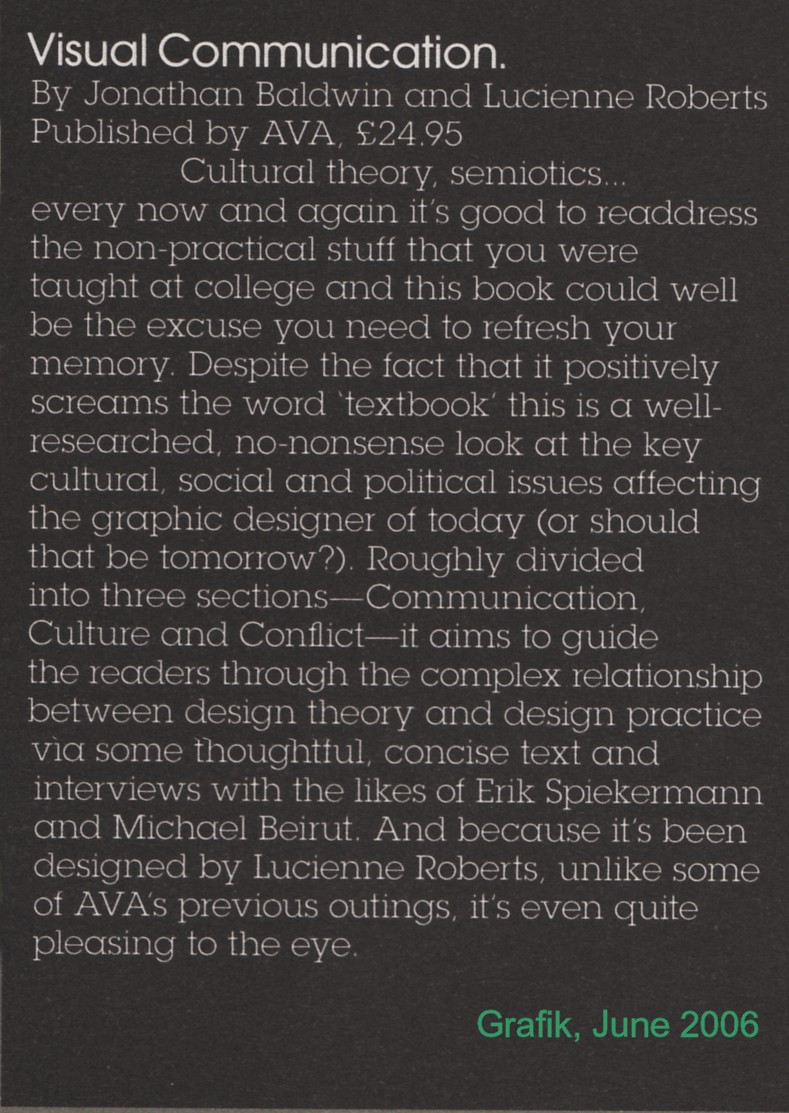
Grafik review


The first proper review of my book, 'Visual Communication: From Theory to Practice' has been published in Grafik.
Generally very positive although I thought the 'textbook' comment was a bit odd. I mean, it's a book with text in it, isn't it? Oh well, I suppose they have to find something to poke at!
They also got the designer's name wrong - it was Bob Wilkinson, not Lucienne Roberts who designed it.
(Click on the image for a bigger version).

Other reviews are coming in to the publisher from academics who've seen it. Again, they are enthusiastic which is good as it was written to act as an introduction to an area of the design curriculum which is either delivered in a very dry and uninteresting way, or simply not delivered at all.

You can order the book from Amazon.

Bookmark and Share

Wednesday, May 31, 2006

World's most expensive cat toy

This is one of the new Apple MacBook Pros (or should that be MacBooks Pro?) Anyway, whatever the correct grammar, I want one.

I also want the kitten that's playing with it. The owner is plainly messing with the remote control and sending the poor cat wild.

Cute.


really expensive cat toy on Vimeo

Bookmark and Share

Pay claim

The lecturers' strike in the UK is beginning to bite in ways that I don't think anyone anticipated. It really looks certain that students won't be graduating this summer as planned. I'm not a big supporter of the action (though I support the cause - academic pay is appalling, and it beggars belief that graduates will go into jobs earning more than the people that taught them), but the 'increased' offer made today by the UCEA (representing employers) of 13.1% over three years is laughable, particularly considering it doesn't even begin to make up for a decline in salaries over the past decade or so, which has meant university lecturers have gone from being paid the same as middle managers in industry to less than bus drivers. Seriously.

And what is it with these 'over three years' offers? 13.1% equates to 4.3% per year (although it won't actually) which is not much above inflation as it stands, but seems to be designed to look good in the papers when the 'over three years' seems to get dropped.

It made me think this morning: what's the difference between a plastic surgeon and the UCEA? One tucks up features... (you can work the rest out for yourself).

Bookmark and Share

Sunday, May 21, 2006

The fag-end of history


I was sitting in the pub the other night staring at an ashtray for some reason, when two things occurred to me (as they do after a few drinks):

The first is, there's a Turner Prize to be won by collecting thousands of soon-to-be defunct ashtrays from the UK's pubs and clubs and stacking them to form one big ashtray, or a wall of ashtrays. So that's a project to keep me going for a while. Forget "shedboatshed" I'm going to do "ashtray-ashtray-er, ashtray".

The second, rather more serious, is that I hope someone somewhere is telling bar managers what to do with all their ashtrays. With the ban on public smoking coming in to force soon, we have the potential for several landfill sites to be brimming over with the things, most of which could be recycled.

Update: Thanks Shaun for crushing that fantasy - he pointed out that someone's already spotted the potential of the demise of the humble ashtray.

Bookmark and Share

Thursday, May 18, 2006

Alice's adventures started here...


White Rabbit, originally uploaded by haadams_rpi.

Ripon, where I lived for ten years, has a few claims to fame (not including the fact I lived there for ten years, of course!)
One of them is the residence of Charles Dodgson, who as Lewis Carroll wrote" Alice's Adventures in Wonderland". His links with the cathedral (his father was a canon there) are thought to have led to some direct inspirations.

This seat (or misericord), made for the clergy to rest on during services, includes a carving of a griffin and a rabbit who is trying to escape down a hole. You can see the bottom of a more successful rabbit already disappearing down the hole on the right.
The architect Sir George Gilbert Scott included figures of the Queen of Hearts and the Cheshire Cat during building works on the cathedral in celebration of the cathedral's links with Carroll

When Tenniel was doing the drawings for Alice, he modelled the heroine on the daughter of Canon Badcock, Mary, after being given a photograph of her by Carroll. Here the links between Ripon and Alice get even stronger: Mary lived near Ripon's notorious gypsum faults, which periodically cause huge holes to appear in the ground - leading in turn to quite a few arguments between houseowners and insurers. In 1834 one of these holes appeared a short distance from the Badcock's house, 60 feet deep and 35 feet wide, and it's thought that Carroll visited it and later included it in the tale of Alice's adventures.

Bookmark and Share

Death, the jealous angler

Another Flikr discovery. I used to walk past this gravestone every day on the way to work. It's in the cemetery outside Ripon Cathedral and reads:
"Here lies poor but honest Bryan Tunstall,
he was a most expert angler until
Death, envious of his Merit, threw out his line,
hooked him, and landed him here
the 21st day of April 1790"

Bookmark and Share

Fountains Abbey


Fountains Abbey Reflection, originally uploaded by JuanJ.

When I lived in Ripon I used to do the 'seven bridges' walk which takes you from the city centre to Fountains Abbey. It's a beautiful walk to a beautiful place, any time of year.

The house I owned (I could afford a house up north!) was not far from where war poet Wilfred Owen lived before he returned to France where he was killed in November 1918 and I read in a biography that he did the same walk often, and wrote some of his best poetry at the time. It's not hard to understand why.

Anyway, I found this shot of Fountains Abbey on Flikr which reminded me of some happy times - and not so happy: I often made the trek when things were pretty shitty.

It's a truly calming place. Worth a visit if you're ever in the Ripon/North Yorkshire area.

Bookmark and Share

How do these people get elected?

Northwest Suburban High School District 214 school board member Leslie Pinney is leading a push to get seven books bumped from required reading lists next year, saying they are littered with lewd language and graphic sexual references inappropriate for teens.

Among those she says should go: the Vietnam war piece 'The Things They Carried,' Kurt Vonnegut's 'Slaughterhouse-Five,' Kate Chopin's 1899 'The Awakening,' about a woman exploring her sexuality, and 'The Perks of Being a Wallflower,' described as a modern-day 'Catcher in the Rye.'


Pinney also is targeting Toni Morrison's 'Beloved,' the best-seller 'Freakonomics' and 'The Botany of Desire: A Plant's-Eye View of the World,' a non-fiction work that examines the relationship between humans and plants - using marijuana as one example.


Pinney has not read any of the books, and 'I don't know if I would want to,' she says.


Stupid cow.

(Via Daily Herald.)

Bookmark and Share

Thursday, May 11, 2006

Itchy nose weather

I went out of my back door on Sunday, for the first time in a while (the 'garden' is a little patch of weeds down a rickety wooden staircase so I leave it to the cat).
In the few days since I last looked out of the window everything's gone green:


Very nice, though I wouldn't be surprised to find a few old soldiers chopping their way through some of that undergrowth.

Bookmark and Share

Wednesday, May 10, 2006

Copywriter wanted: must understand basic grammar

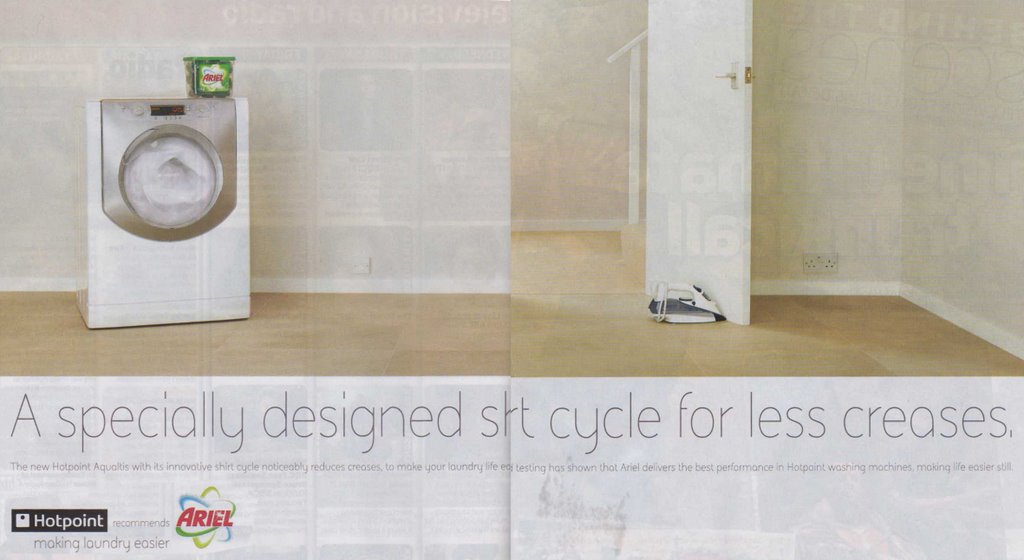
Take a look at this miserable excuse for an advertisement. (The word in the middle is 'shirt', not 'shit').


Why am I so down on it? Forget the layout that means the key word is lost in the fold, forget the weak weedy typography, forget the far-too-subtle joke, or the fact that the washing machine appears to be unplugged and in the living room. Take a look at the headline.

Spot the mistake?

It's 'fewer creases', not 'less'! It's wrong, no matter what you might say about "well everyone says 'less' these days". I don't care. It's inexcusable. It's up there with apostrophes in the wrong place, ellipses with two dots or more than three, 'I' instead of 'me'.

(Marks & Spencer, the leading high street retailer in the UK, changed their checkout signs from 'Five items or less' to 'Five items or fewer', I'm told because of a customer complaint. Sadly no other store seems to have followed suit).

If I were Ariel or Hotpoint I'd be having serious words with my ad agency...

But it's not as bad as this example of piss-poor proofing. The cheese company Leerdammer recently launched a new brand extension complete with inappropriate apostrophe. I first noticed this over a year ago and they're still doing it!
I mean, I might expect it of a greengrocer, but not an international food company:


Unbelievable. Who approves this crap?

Bookmark and Share

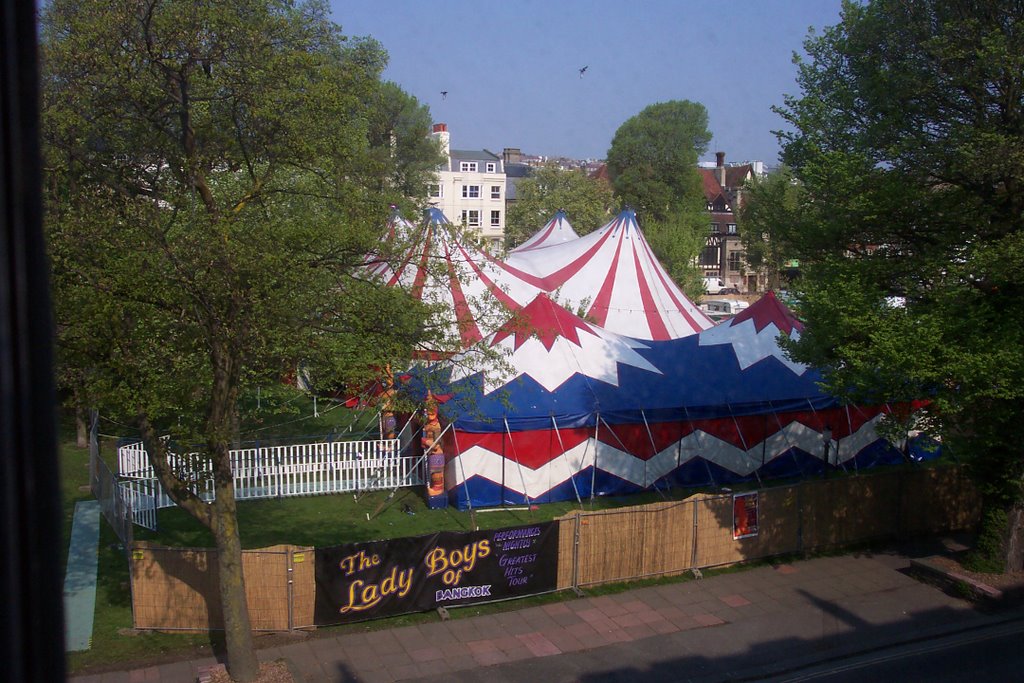
View from my office window


Every year the 'Lady boys of Bankok' turn up, pitch tent in front of my window, only to disappear several months later leaving nothing but a patch of brown grass.

As this is my last summer in Brighton, it seems, I might have to go and see what this is all about.

Bookmark and Share

Tuesday, May 09, 2006

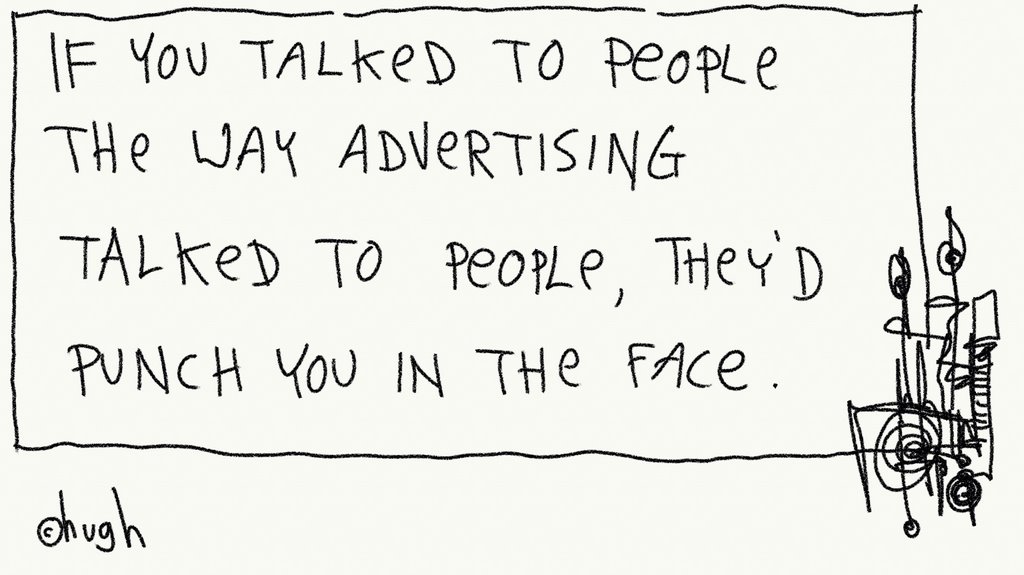
Good point, well made


(Via Advertising Ourselves to Death.)

Bookmark and Share

More Women's Masthead Mayhem

The second story about women's magazine mastheads this week:

Spot the difference between these two magazine covers:


On the face of it, they appear different (in as much as any women's magazine cover looks different) but the similarity between the masthead design led the publishers of 'Red' to take the publishers of 'Real' to court. the case was settled before it came to trial, which is a shame as it means there'll be no case law to add to that already in existence through previous 'passing off' cases. (An explanation of why 'passing off' remains a civil matter in the UK is provided here).

I have to admit I was confused by these covers, assuming some link or mixing them up, although that's just in passing, but the legal test is whether any ordinary person would make a connection so I think that counts and is probably why the offenders gave in.


But the story doesn't end there. Condé Nast, the publishers of Vogue have warned The Mail on Sunday that the typeface used for 'You' magazine, which has just gone from being a supplement to a paid-for news-stand title, is likely to cause confusion in the mind of consumers. The issue here, I think, is not that people will think 'You' is 'Vogue' but may think it is in some way associated with it (this is the issue that caused Apple Corp's action against Apple Computer to fail, I think - no one in their right mind thinks iTunes is anything to do with the Beatles).


Let this be a lesson to you: imitation is not flattering.


Real magazine will be forced to completely redesign its masthead after agreeing an 11th hour legal settlement to a copyright action brought by rival title Red.
Red, owned by Hachette Filipacchi UK, which also publishes Elle and Psychologies, took legal action against Real magazine for copyright and intellectual property infringement.

Both magazines have mastheads that feature a capital letter R in a cursive font on a red background.

The action was due to be heard in court today, but Real settled late on Friday, agreeing to redesign its logo within 12 weeks and pay Hachette's costs.

Hachette Filipacchi UK, which was represented by the firm M Law, took legal action against Burda, the German group that acquired Real when it bought UK company Essential Publishing last month.

Real was originally owned by German publisher Bauer, which redesigned the title before selling to Essential. Burda was represented by Marriott Harrison.

"I am thrilled that Hachette has finally reached settlement at the 11th hour, literally before going to trial. I wish new owner Burda every success with the rebranded title when they relaunch it," said Kevin Hand, the chairman of Hachette Filipacchi UK.

Red magazine, aimed at women in their 30s, for which it coined the term "middle youth", was originally a 50-50 joint venture between Hachette Filipacchi and Emap.

When Hachette Filipacchi set up in Britain in 2002, the two companies held an auction for the sole rights to the magazine. Hachette Filipacchi UK won, paying £34m, out bidding Emap by £17m.

Earlier this month Hachette Filipacchi UK closed B, its monthly glossy for young women, after a sharp decline in sales.

In February, lawyers representing Vogue magazine wrote to the Mail on Sunday complaining that the newspaper's You magazine masthead's typeface was "virtually indistinguishable" from the fashion magazine. The next month You launched as a paid-for newsstand weekly with a £1 cover price.

Condé Nast, which owns Vogue, requested that You take "all steps necessary" to ensure that readers did not confuse the two titles.

"We note that the typeface in which the word You is written is virtually indistinguishable from the typeface in which our client's Vogue magazine has for decades been presented," the letter said.

"In addition, like our client's magazine, You magazine generally features a fashion model on its front cover to indicate the fashion-related topic on which the issue in question focuses."


(Via The Guardian.)

Bookmark and Share

Destroy all the satellites and we might have some proper news for a change

Only 18 months to go and we will be drowning in 'ten year anniversary' programmes, books and no doubt musicals about the death of Diana, Princess of Wales (no, I can't believe it was that long ago either).

I was discussing Diana's death recently with students when discussing the speed with which news spreads around the world. Although instant alerts of events from the other side of the globe are touted as a 'good thing' I can't help but wonder if the price we pay is authority and consideration. What I mean by this is that news programmes are filled with speculation (usually prefaced by the phrase 'of course we shouldn't speculate') and commentary from people who are ill-qualified to do so. For example, if you want to get on TV, set up a pressure group, membership 1, appoint yourself media spokesperson, and let the news channels know you are there. If you correctly guess the next big thing, you're bound to be called up to fill a few minutes while the real experts sit down and have a think.

Having said that, the quality of TV reporting these days, with patronising graphics and metaphors, is beyond a joke. Last week's local council elections were covered by the BBC having a graphic pop up in the middle of the studio floor showing 'the evolution of Tory man', with ex prime minister John Major slouched like an ape, and each successive Tory leader getting gradually more erect (cue pun about John "two shags" Prescott) ending with David Cameron as 'homo sapiens'. Crass, childish and rather disrespectful of the audience. The poor turnout in elections and mistrust of politicians isn't the fault of politicians, it's the fault of people who think that is an intelligent way to represent politics.

Anyway, back to the plot...

During the discussion I mentioned that people in America heard about the death of Diana before people in Britain, because of the time it happened and satellite communication. One student put her hand up and said she had been in Paris at the time on holiday with her family and didn't hear about the accident until the end of the day. Staggering, but entirely believable.

Maybe I'm feeling my age, but it would be great if we heard about news stories properly, rather than when they were 'breaking' because few of the stories that are flashed up on screen turn out to be as dramatic as they seem to be at the time, with breathless reporters rushing in to the studio to tell us how little they know, and then being flown to the scene for a live satellite hook-up where they tell us nothing is happening and no details are emerging. If they'd stayed in the studio maybe they'd have been able to research a proper story, you know, like journalists used to do.

However... the term 'journalist' seems to be applied rather loosely today. Citizen journalism is another term for uninformed gossip (yes, I'm aware of the irony of a blogger complaining about such things. Leave me alone!) and another problem with news programmes these days is they spend far too much time reading emails from idiots instead of, oh I don't know, talking to politicians and experts. Half the problems the UK government is facing come not from genuine problems but from the bullshit spouted by 'Derek from Tonbridge who emails in to say "Tony Blair is a disgrace, he has no idea what he is doing and he is responsible for releasing murdering rapist foreigners into the community"' - or some-such. Er, Derek's opinions aren't news, they're bollocks. If I wanted to listen to Derek and people like him I'd go to the pub - or get in any cab that's passing.

I seem to have strayed somewhat from my original point. Where was I? Oh yes, Diana.

Well, she may be long gone but as anyone who ever casually passes the news-stand to see what drivel the Daily Express is ranting on about (and it takes a ranter to know one) will be painfully aware that as far as some 'newspapers' are concerned, she is still alive and well and busy selling copies like there's no tomorrow (which sometimes I wish there weren't).

The Guardian (sometimes guilty of proper journalism, and long may it continue) published a list of Diana-led headlines from the Express today. Read them and weep, not for Diana, but for the poor sods who buy into this crap.


While, for many people, Diana Princess of Wales died nearly a decade ago. But for the editors of the Daily Express, it seems, she lives on. As the following list of headlines from the newspaper over the past six months attests, the disappearance of the Princess of Hearts from the physical realm has not diminished her ability to make 'news'.

05/12/05: "Diana's death threat"

08/12/05: "100k for Di's spare gown"

08/12/05: "Questions on Diana need to be answered"

12/12/05: "Diana's death: poison expert called in"

12/12/05: "Charles is asked: did you kill your wife?"

19/12/05: "Diana's grief for her piano man Pryor"

23/12/05: "Diana mother's priest father flash vanishes"

03/01/06: "Dirty tricks wont airbrush Diana"

04/01/06: "We've long suspected a cover-up"

09/01/06: "Death squad has to tidy loose ends"

11/01/06: "French finally being made to cooperate"

30/01/06: "Why did spies visit the morgue?"

01/02/06: "Perhaps Diana should have worn seatbelt"

06/02/06: "Spies flashed laser beams"

07/02/06: "Diana was stupid, says Lagerfeld"

07/02/06: "Diana inquiry chief's laptop secrets stolen"

09/02/06: "Theft of Diana laptops proof she was killed"

11/02/06: "Film tells of Diana's murder"

13/02/06: "50,000 to marry at Diana's home"

18/03/06: "Diana fountain condemned by MPs as a costly fiasco"

20/02/06: "Diana's name used in scam"

22/03/06: "£250,000 a year bill to run Diana fountain"

23/02/06: "Spy started car death chase"

27/02/06: "Spies bugged Diana's last calls"

04/03/06: "Queen's new snub to Camilla - Diana ousts duchess on birthday website"

06/03/06: "Diana's death - yet another lie exposed"

09/03/06: "Diana's death 'dirty' tricks by MI6"

13/03/06: "Diana's death inquest a sham"

17/03/06: "Queen's anger at insult to Diana"

05/04/06: "Diana: Queen's secret anguish"

05/04/06: "Diana seatbelt sabotage probe"

06/04/06: "Queen cam can't replace Diana"

21/04/06: "Diana butt of sick jokes on TV"

25/04/06: "Diana seatbelt sabotage probe"

26/04/06: "Wife quoted Diana before stabbing husband's mistress"

06/05/2006: "Diana death: truth at last"

· Research by Luke Waterson

(Via MediaGuardian.co.uk.)

Bookmark and Share

Monday, May 08, 2006

I was right! (Manic laughter)

Although I don't like to revel in other people's misfortunes I can't help but smile wryly at the news that Silicon Graphics are filing for bankruptcy. Back in the late 90s I had several, erm, 'conversations' with finance directors and others at the company I worked for who insisted our request to purchase new Macs was pointless, as they would soon be bankrupt or (the old myth) had been bought out by Microsoft. (To give one ludicrous example I was told to stop developing our new website on my Mac because 'it won't be compatible with PCs'. In jest, when my Mac crashed inconveniently during this conversation I blamed my mousemat, saying it was for PCs, and it was only half an hour later that I realised they'd believed me...)

In my first teaching job the then principal had ordered that no more Macs be purchased (though he was talked out of that by several leading graphic designers, threats of strikes, and just about every student) and instead invested heavily, and publicly (he got the Mayor in to cut the ribon) in row upon row of SGI machines with the intention of taking Hollywood by storm based on a (rather impressive) demo reel of a former student.

Seven years on and the scene has changed. For one thing, the real geeks love Linux, not Windows, the ubergeeks love Mac OSX, Apple is the darling of the stock exchange while Microsoft are being criticised at every corner for the late delivery of Vista (something that seems to lose features at every beta) and the piss-poor performance of the tablet computer and the new UMPC (which managed to have one of the most successful viral campaigns that unfortunately promised far, far too much).

So the smile on my lips is not because I'm glad a company has gone bankrupt but because, once more, I am able to recall a heated argument that I won. True, it took seven years and the people I beat are hundreds of miles and several career moves away, but I'd like to think they're lying awake tonight thinking 'damn, he was right after all'.

I know revenge is a dish best served cold but this is downright freezing. Nice on a summer's day, though...

Silicon Graphics files for Chapter 11: "

We can't help but feel a twinge of melancholy as we ponder Silicon Graphics' announcement today that the company is filing for Chapter 11 bankruptcy. However, the SGI of today is a mere shadow of it former self, with a mixed bag of products that range from overpriced, Linux-based, Intel-powered workstations to overpriced, Linux-based, Intel-powered supercomputers. But it wasn't all that long ago that the SGI Indy was considered the hottest thing on the market, and seemed to herald the future of multimedia computing. Of course, that future was pre-empted first by cheaper Unix and Linux options, and later by Mac OSX and even Windows, which was hardly a factor in the graphics industry back in the early 90s when the Indy debuted. So, best of luck emerging from bankruptcy, SGI. We'd like to see you stick around for a bit just for old time's sake. But if we want one of your boxes, we'll skip the new ones, and hunt down an Indy on eBay.

(Via Engadget.)

Bookmark and Share

Visit my 'official' site

www.jonathanbaldwin.co.uk
contains links to my articles and books.

Tags

Books by Jonathan Baldwin

Visual Communication: From Theory to Practice (Winner of 'Best Higher Education Title' at the British Book Awards 2006) by Jonathan Baldwin and Lucienne Roberts Buy from Amazon.com Buy from Amazon.co.uk

More Than A Name: An introduction to branding by Melissa Davis and Jonathan Baldwin Buy from Amazon.com Buy from Amazon.co.uk

Blog Archive

Followers