A blog about design, education and anything else that takes my fancy

Saturday, March 29, 2008

Time for designers to take responsibility for Terminal 5?

When Heathrow Airport's terminal 5 opened it was hailed as a marvel of engineering and design. Now that it's all descending in to disaster, everyone seems to be blaming British Airways and the British Airport Authority. Why not the designers?

Take a look at this excerpt from The Guardian:

The overnight BA inquest looked at how luggage was loaded on and off the airplanes - one of the biggest failures in Thursday's fiasco.

According to airport sources, the baggage hold-ups were caused by handling teams being in the wrong place to pick up checked-in bags, which had been delivered down chutes from the main conveyor belts.

If those bags are not picked up and loaded on to planes, the sources added, the chutes become full and the conveyor belt overloads.


If this had been a success you could guarantee that someone somewhere would be hailing the miracle of service design, the technical feat of automated luggage sorting systems and, ooh, doesn't the ceiling look lovely too?
But now it's all going pear shaped the role of designers in the mess is being ignored.

Design can't be selective. It can't crow about its successes and then vanish in to the night when it falls apart.
No doubt in 50 years time it will crop up in lectures as an example of 'when design goes wrong' but that's too late. It needs to be looked at now as a case study for current designers to learn from.

Update

Having just had my flight from Edinburgh to Heathrow cancelled, the first leg of my trip to New York, I'm not best pleased with this story.

Jeff Howard says it's system design at fault, not service design and he's technically right, but it's really just semantics - I don't separate systems from services and I'm not convinced you can. Indeed that's a problem we encounter when trying to teach service design - people come up with great ideas for services but ignore the back-end stuff that makes it worse. I suspect selling service design is rife with the same problem.

The 'service' here is checking in your bags. The system supports the service and it's all part of one big whole.

But Jeff's right to point out that the problem is exactly the back-end aspect of the service. Seeing the images of all those cases piled up makes you realise that no matter how shiny the terminal building, or how long the conveyor belts, at some point your bag is going to be tossed on top of hundreds of others by guys in overalls.

Bookmark and Share

Tuesday, March 25, 2008

Who's this Williams guy?

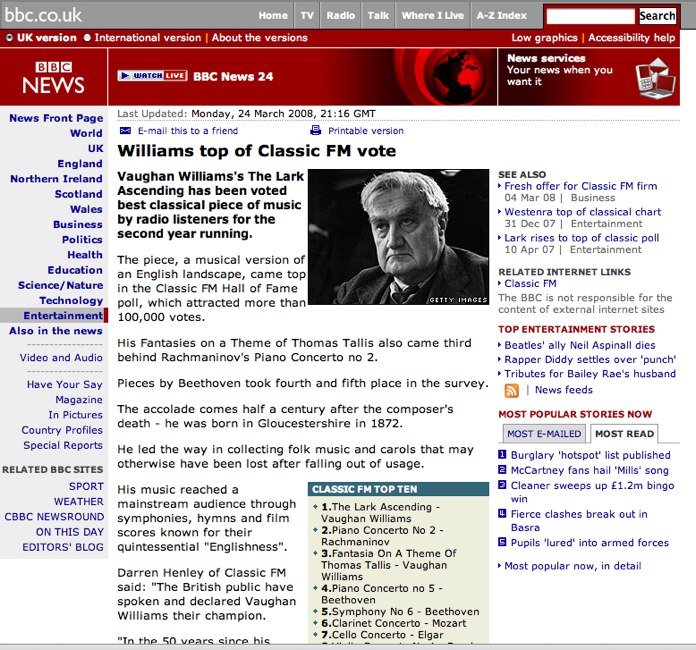
BBC NEWS | Entertainment | Williams top of Classic FM vote.jpg

The BBC is reporting that The Lark Ascending is once more the 'best classical piece of music' for Classic FM listeners. Not sure about the best but it's certainly a great piece. In fact, I might just have to play it right now...

But look at the headline: Williams top of Classic FM vote. Never heard of him.
I just emailed the web site editor to correct it (9.35am) and will now refresh the page every minute to see how long it takes to change it...

UPDATE: It worked:

BBC NEWS | Entertainment | Vaughan Williams tops radio vote.jpg

Bookmark and Share

Saturday, March 22, 2008

Universities fear imminent student drought

EducationGuardian.co.uk:

The number of school leavers is expected to plummet over the next 10 years, leaving 70,000 university places unfilled - the equivalent of nearly six universities.

Universities will have to compete harder, target more mature students and those from outside the EU to fill seats in lecture halls as a historic dip in the birth rate translates into fewer student numbers, vice-chancellors said.


Or as some would have it: Head, meet sand.

Bookmark and Share

Friday, March 14, 2008

If medical education had progressed at the same rate as design education


I started writing a post on this subject and it got to a 1000 words. Then I thought a picture would do so cobbled this together. It sums up my thinking far more concisely.

Click the image for a larger version.

Bookmark and Share

Tuesday, March 11, 2008

What does no tip signify?

82C1A1BD-6EE5-437D-9FA8-038D2B536D27.jpg


I'm going to New York in April so this handy little guide (via Passive Aggressive Notes) is well-timed. But if a 10% tip indicates you hate the server and they suck, then what does no tip signify?

What a weird system...

Bookmark and Share

Wednesday, March 05, 2008

Students aren't passionate about their subjects any more, say lecturers

EducationGuardian.co.uk:

'I honestly don't feel I have learned much. It's too much theory and not enough practice. I'm learning about out-of-date technologies.'
John, 22, loathes his degree, a BSc in network computing. He says his main reason for applying to do the course was that it would lead to a good job.

Tom, 22, wasn't thinking about jobs when he decided on a BA in 3D design and materials at Brighton University. 'It's the best course ever,' he says. 'I think about it all the time. I came to university not to get a piece of paper that proved I had a degree, but because my subject seemed like the right thing for me to do.'

Which student is more typical of undergraduates today - the one who chooses their degree for the love of it or the one who's thinking about job prospects? It's the latter, vice-chancellors and lecturers told Education Guardian this week.

They say undergraduates these days do not necessarily expect to love their subject the way they did a decade or more ago.

Professor Patricia Broadfoot, head of Gloucestershire University, and Professor Michael Thorne, head of Anglia Ruskin University, admit their evidence comes from talking to students, not hard data.

They give three main reasons why student attitudes have changed:

· Students have taken on board the government's message that a degree is a passport to the world of work;

· A ceaseless concentration on exams and coursework in school stops pupils cultivating a love for a subject;

· Tuition fees have led some students to think exclusively about the financial return on the cost of their degree.

Of course, a lot of students do feel passionate about their degree subjects, as Tom does, the vice-chancellors say. 'Many do PhDs, and that is proof of real love for a subject,' says Thorne. 'But the majority are now there to work within the confines of the course, and aren't prepared to go outside them.

'Students arrive at university focusing on jobs; that is the most important thing to them. We are seeing more and more of an attitude of 'if it's not in the exam or coursework, I'm not doing it'. You can't expect students to read around a subject for the love of it any more.'


(Via Read the rest....)

Bookmark and Share

Monday, March 03, 2008

'Many struggle' with arithmetic

According to the BBC "A quarter of adults have difficulties with mental arithmetic, a survey suggests."


Presumably the other two thirds of the population are okay.

Bookmark and Share

Wednesday, February 27, 2008

Academics denounce courses tailored for businesses

I've been writing a blog post on topics similar to this over the past few days but as it's reached over 5000 words I might have to edit it down before I post it. In the meantime, read this Guardian story.

I share the worries, but wonder why it's come as a surprise given that Sector Skills Councils have been around for about four years now with an overt policy of getting the government to make universities stop pushing the boundaries of knowledge and instead deliver nicely formed employees. Oh look, I'm off again - I'll stop now and let you read the article yourself...


Lecturers today condemned reports that the government is planning a major expansion of the role business plays in the delivery of degrees, warning it will lead to graduates being 'churned out' of 'identikit' institutions.
A leaked document, seen by the Financial Times, suggests that ministers are considering ploughing extra funding into degrees jointly designed and funded by employers.

It also suggests that degrees could be redesigned to make them shorter and more intensive, reflecting an increasing interest in two-year qualifications.

The document, Higher Level Skills Strategy, dated from last November, recognises the 'risks' for universities in tailoring courses for businesses.

But it makes clear that the short-term expansion of higher education will be dominated by courses involved with industry.

'An institution may worry about its public image,' the FT reported the document as saying.

'We expect the majority of this growth to be in provision that is developed with employer input - either foundation degrees [two year vocational degrees co-designed by employers] or employer co-funded places,' it said.

A spokesman for the Department of Innovation, Universities and Skills, refused to comment on the leaked document but confirmed an announcement made last December to plough £105m into 'employer engagement', including co-funded places.

Sally Hunt, the general secretary of the University and Colleges Union, said: 'University is about so much more than just getting students through their degree and out the other side. We should be celebrating universities that are prepared to take risks and push the boundaries in their pursuit of knowledge and research.

'We need to trust people who have spent their lives working in education, not allowing business to dictate the short-term direction universities should be taking.

'The creeping marketisation of higher education seems only concerned with a bottom line and treating students as commodities. Identikit institutions in all our towns and cities churning out graduates in a couple of years is not what the country needs to protect its proud position as world leader in teaching excellence and innovative research.'

Bookmark and Share

Visit my 'official' site

www.jonathanbaldwin.co.uk
contains links to my articles and books.

Tags

Books by Jonathan Baldwin

Visual Communication: From Theory to Practice (Winner of 'Best Higher Education Title' at the British Book Awards 2006) by Jonathan Baldwin and Lucienne Roberts Buy from Amazon.com Buy from Amazon.co.uk

More Than A Name: An introduction to branding by Melissa Davis and Jonathan Baldwin Buy from Amazon.com Buy from Amazon.co.uk

Followers