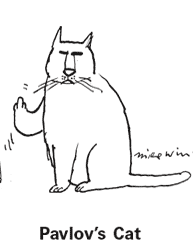
(I'm not the only one to spot the similarity - Andrew Sullivan got there first)

If only this film were real:
Here's my Autumn semester lecture programme in 3D. Click on the link for a higher definition version. Of course it looks better in the flesh on the big screen :-)
(The timeline was created in the rather clever program Timeline)
University of Dundee Design History, Theory and Practice lecture series from Jonathan Baldwin on Vimeo.
This is something I wrote for the study guide for my Design History, Theory and Practice (DHTP) module which starts next week. The first lecture asks "what's the point of DHTP?" and I try to head off the usual complaints about having to write and read and go to the library. I've found spending the first lecture on making the case for approaching design from an intellectual point of view not only saves time later, it tends to improve attendance and grades!
Plus, I happen to believe in it.
The 2008 Beijing Olympics offered a showcase not just of excellence in sport, but in design as well. Everything from the equipment being used to the garments being worn was designed. Ask the average person what we mean by this and they will undoubtedly talk about what things look like - the ‘style’ of the outfits, the shape of the bikes and so on.But to take a view like that is to miss what we might arguably call the ‘real’ design, the design that’s the product of years (if not decades) of intense research into textiles, alloys, aerodynamics, ergonomics and more. When people talk of the millions of pounds spent on sports in the UK, they may think that all gets spent on training. But it doesn’t. Chris Hoy’s bike, Rebbeca Adlington’s swimming costume, Charlotte Burgess’s bow, and Deborah Brennan’s wheelchair are all the result of investment worldwide in design research.
And then there are the games themselves - everything from the obvious opening and closing ceremonies to the transport networks, the global television feeds, the ticketing systems, the catering, even the queues — all designed.
Design history and theory are no longer simply endless slideshows of the great and the good; pictures of this designer and that piece. Over the next three years you’ll be exposed to, and encouraged to discover, not what’s gone before but what’s possible. DHTP is about the future as much as it’s about the past. It’s also about broadening your view of what design is, from the ‘man on the street’ idea of design as style to something a little more ambitious and all-encompassing. And it’s about encouraging you to pursue a role in the cutting edge through your own research.
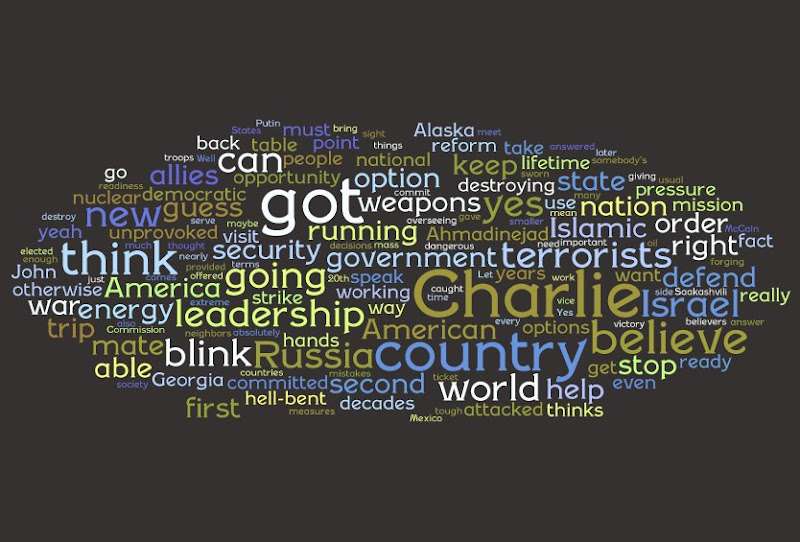
I ran Sarah Palin's Charles Gibson/ABC interview (part 1) through title="Wordle: Palin 1">Wordle and, as suspected, she uses "Charlie" like it's some sort of punctuation mark. A great bit of coaching by her handlers.
If you read the transcript and substitute your chosen expletive, it's a lot funnier. And God knows, reading it back, we need all the laughs we can get...
The parallels were amazing: in the wake of Hurricane Katrina thousands of Americans were huddled together in a sports centre wondering where their president was. And in the wake of Hurricane Gustav, thousands (just about) of Americans were huddled together asking the same question.
I was glad to see The Daily Show spot the irony. This is one of the funniest things I've seen in a long time. Enjoy:
The Guardian has a handy summary of changes to the school curriculum in England from today, including this summary of the new Diplomas:
Starting this term are the first five diplomas in engineering, construction, information technology, creative and media studies, and society, health and development. There will be 17 in place by 2011. [including product design - see this post for news of the announcement]
The new qualifications are intended to be an alternative to GCSEs and A-levels for 14- to 19-year-olds, blending hands-on learning and theory.
There are three different levels of diploma: foundation (level 1), higher (level 2) and advanced (level 3).
All are made up of three parts: principal learning; generic learning and additional specialist learning.
Principal learning is made up of qualifications, or units, specifically developed for the diploma subject and a project.
Generic learning includes 'functional skills' such as English, maths and ICT, alongside presentation, communication and teamworking skills.
Additional specialist learning involves more academic theory, an extended project and other qualifications, such as a GCSE or A-level, chosen from a catalogue of approved awards.
Diplomas will also involve 10 days' work experience, ideally in a field related to the diploma subject.
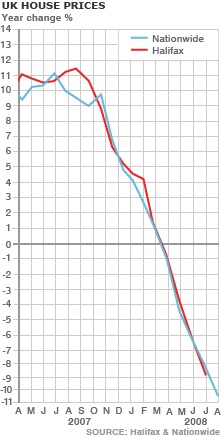
Take a look at this graph. It accompanies a story on the BBC News website about the property market and today's announcement of Government measures to boost flagging sales.
The government's qualifications regulator, Ofqual, has accredited five new diplomas that will be taught from September next year.
The diplomas will be in business, administration and finance, environmental and land-based studies, hospitality, and manufacturing and product design.
 Visual Communication: From Theory to Practice
(Winner of 'Best Higher Education Title' at the British Book Awards 2006)
by Jonathan Baldwin and Lucienne Roberts
Buy from Amazon.com
Buy from Amazon.co.uk
Visual Communication: From Theory to Practice
(Winner of 'Best Higher Education Title' at the British Book Awards 2006)
by Jonathan Baldwin and Lucienne Roberts
Buy from Amazon.com
Buy from Amazon.co.uk
 More Than A Name: An introduction to branding
by Melissa Davis and Jonathan Baldwin
Buy from Amazon.com
Buy from Amazon.co.uk
More Than A Name: An introduction to branding
by Melissa Davis and Jonathan Baldwin
Buy from Amazon.com
Buy from Amazon.co.uk