A blog about design, education and anything else that takes my fancy

Tuesday, March 28, 2006

My eyes! My eyes!


So I've been trying to prepare a long-planned end-of-term lecture on optical illusions with lots of fun things.
Only trouble is, every time I look at the examples I've got, I get a blinding headache. So now I'm going to have to improvise tomorrow because I don't want to risk what might happen when these things are projected 20ft across in a darkened room.

If you want to risk your own health, there's a great collection of illusions like the one above (along with explanations of how they work) at Micahel Bach's site. But be warned - I really am suffering ;-)

Bookmark and Share

Sunday, March 26, 2006

Undercover


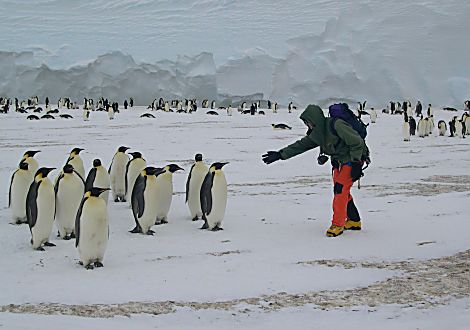
Do you reckon the follow-up to 'March of the Penguins' will be 'March of the Wildlife Film Crews'? Maybe that's what the animal kingdom watches when they're bored. I'd be pretty annoyed if I were a penguin. You get no peace these days if you're an animal, that's for sure.


The Antarctic isn't melting because of global warming - it's the bloody catering vans!

On a similar note, do you think the Queen's household is entirely staffed by undercover tabloid reporters? Judging from all the programmes on TV at the moment with undercover flight attendants, undercover estate agents, undercover university lecturers and undercover nurses, you have to ask yourself if anyone is actually qualified to do anything these days other than film things secretly through their buttonhole?

Which reminds me of the time I had to have a colonoscopy and the doctor showed me the tiny camera in a tube. "We can see everything with this little bugger" he said (a rather unfortunate choice of words, I thought at the time). "Mind you," he continued, "wait till the lighting crew gets in there!" I think they undergo years of training just in telling that joke...

Bookmark and Share

One Giant Leap for Advertising

This has to be an April Fool's joke (and a pretty good one at that). If not, well...


"Today I learned from a trusted source that Apple is poised to make history next Saturday when it unveils the worlds first advertisement that can be seen from space.

Apple had hoped to keep their creation secret until the grand unveiling, however, after I was tipped off, and with just a little bit of lateral digging, I was able to uncover enough background information to get a clue of the location."


(Via boakes.org.)


You can see it via this Google Maps link or in Google Earth

Bookmark and Share

Thursday, March 23, 2006

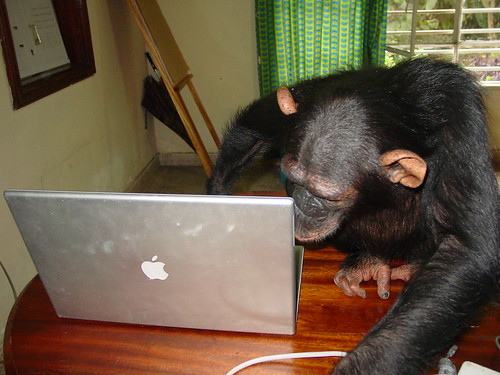
Mac Monkey


You see, they do exist...

Bookmark and Share

Closed minds to online learning

One of the reasons online learning hasn't taken off is made clear every time I sit in a meeting about it, or have a discussion with reluctant colleagues: intellectual property. People fear that putting their course notes online will in some way diminish them, or lead to people stealing their thoughts.

To me, that's a little like believing that a photograph steals a little bit of your soul (though I think some supermodels are quite good evidence that this particular myth has some element of truth). I wonder how this argument holds up when applied to books and articles? What is it about computer screens that makes them different?
I also get suspicious of any academic who thinks that sharing knowledge is a bad thing. I have visions of these people giving students handouts that fade after 24 hours so they can't be peddled on the internet, or make them sign a non-disclosure agreement. Why not just tie a bit of elastic to them and have done?

Another issue that arises in art and design in particular is the claim that these subjects cannot be taught online. So again, how do you account for the massive section in Borders that's full of books showing people how to print, produce layouts, prime canvases and so on? It demonstrates not only a lack of imagination (ironic considering the subject we're talking about) but a bizarre laziness in a refusal to put students' (and society's) needs before our own.

A couple of years ago I wrote an article for the Times Higher Educational Supplement and asked some students what they'd like to see online. Apart from wondering why their tutors were so far behind the times as not to even offer timetables and briefs online, or to use email to tell them of cancelled sessions instead of putting a notice on a locked door (great if you've just travelled for an hour on the train), several ideas were immediately offered that would be a doddle to set up: information on placements, experiences of past students and a way of keeping in touch with tutors and friends while away from uni for a few weeks.
I checked up again recently and found that their successors were still asking for, and still not being offered, exactly the same things.

In that article I focussed on a third reason why art and design in particular is slow to utilise new technology - every single discussion gets bogged down on what things should look like rather than what they should do. Without fail, people start talking about 3D animations, Flash intros and interactivity, but never about content. Yet look at the sites that students use day in day out and you'll notice they are content-rich and visually unappealing. That's because the internet is a socially-based medium, not a visually-based one. We just don't get it.

Universities exist to share knowledge, and that includes going beyond the university population. Staggeringly few higher education institutions in the UK offer public lectures or tell the local community they're welcome to come along and hear world-renowned experts talk about current issues. I listened to some of the Harvard podcasts on iTunes recently with a mixture of awe and envy. Why aren't we doing that? Why do we moan about the dumbing down of society and do little to contribute to counter it?

I found a brief mention of MIT's efforts in the area of online learning today. If you ever hear an academic tell you that putting what they know online will be the end of knowledge, point them to this:

How MIT's Open CourseWare is growing:

Mitopencourseware_1
We love to talk about the Massachusettes Institute of Technology's Open CourseWare project because it's a big idea meant to change the world. And change-the-world ideas inspire evangelism.


If you're not familiar with Open Courseware, back in 2001 MIT decided to make its entire curriculum -- 1,800 undergrad and graduate courses -- freely available on the Internet. That's a $104,000 value to a degreed student.


Why would one of the world's top learning institutions give away its intellectual property?


Because an institute committee tasked with studying the impact of the Internet in 1999 decided that the best way to advance an MIT-style education would be to widen access to information. By making access free, the widening of access would spread exponentially via word of mouth through multiple networks. An education virus, if you will.


Anne Margulies, who is the project's director, told an audience in Missouri last month that MIT has learned quite a lot by making its professors' course work freely available. Andy Carvin recorded her presentation and uploaded it to his blog as an MP3 file; I have compiled notes from listening to Andy's recording.


How it works

* MIT 'publishes' course materials twice per year, and 300 courses arrive in each publication; 1,265 courses are currently available.


* Each faculty member decides on the amount of content to share;
Margulies says her group finds it difficult to keep up with the growing
levels of content shared by faculty.


How it's used


* 80% of courses contain professors' lecture notes, which users say they value the most.


* The course materials have been voluntarily translated into 15 languages.


* More than one million people visit the Open Courseware site every month.


*' Educators from other institutions report they are using MIT's accessible courses as benchmarks and standards against which to measure their own courses.


* It's brought faculty closer: Two, 30-year MIT faculty members had never
met nor were they aware they were teaching work that was similar until the Courseware project led them to discover one another.


How it's valued


* MIT alumni hated the Open Courseware idea initially because they thought it would devalue their degree; that resistance changed because the project allows them free access to continuing education.


* Students who enroll formally at MIT are saying that Open Courseware was what first attracted them to the institution and gave them an idea of what to expect in intellectual rigor and homework. In other words, it turns out to be a great try-before-you-buy program.


One of the less-quantifiable aspects of MIT's project is the unprecedented expressions of enthusiasm of its fans. Indeed, Margulies says 'It's truly overwhelming to receive the amount of fan mail we receive every day (over 10,000 emails so far). Some 90 percent of the email we receive is to thank us for sharing MIT's content... and we respond to every single message.'


Anything of significant value, like MIT's intellectual property, is certain to spread quickly, especially if given away freely. In a future post, I'll explore ideas how businesses can apply the principles underlying Open Courseware as a marketing strategy.


(Via Church of the Customer Blog.)


Bookmark and Share

Wednesday, March 22, 2006

Dudley has a cross to bear

"A minister in Dudley wanted to erect a cross in the grounds of his new church building, and was told by the local council that this would cost £75 since, under legislation, a cross is categorised as an advertisement.

These sorts of stories come up quite often, and are usually followed, as soon as they reach the media, by a retraction, and the explanation that there has been a misunderstanding. But in an impressive display of bloody-mindedness, Dudley council is sticking to its guns, doggedly adhering to the letter of the Town and Country Planning Act, and ignoring the spirit. It is also trying to lay the blame at the deputy prime minister's door, since his office sets the £75 fee. One can only imagine the splutter over the cornflakes when Prescott read that this damaging PR run-in between church and state was all his fault."


Read the full article

(Via The Guardian.)

Bookmark and Share

Monday, March 20, 2006

Quark Rebranding (again)


Another day, another Quark logo...


"You might remember the Quark Logo Trouble a couple of months ago. It looks like they have decided to re-brand themselves once again. This time their logo looks similar to the Sony Ericcsson one. What is going on with Quark? It seems like they are having real difficulties with their image right now. They might as well go back to their original logo. What are your thoughts?"


My first reaction to this was it has to be a joke. But it's not April 1st so let's go with it. My second reaction was, as above, I used to have a phone with this logo on it.

It used to be the case that a rebrand was meant to last for years. What with Abbey National's short-lived rebrand a couple of years ago and now this, I'm beginning to wonder.

Some companies change their identities more frequently than I change my socks. No, seriously. My philosophy is, if you throw them against the wall and they don't stick, you can carry on wearing them.

(Via Advertising/Design Goodness.)

Bookmark and Share

Thursday, March 16, 2006

New word of the day

I was just reading through a draft of a student essay which is rather good, but contains the following line:

Carroll powerphrases MacDonald when he says, “mass art is going to have to aim at the generic or common denominator in terms of taste, sensitivity, and intelligence in its potential audiences”


I pointed out the error (which is an understandable one when you think that we gain a lot of our vocabulary aurally) but I actually quite like the word.

Powerphrase, verb: to use a choice quotation in order to win an argument without bothering to provide any actual evidence beyond the idea that if that person believes something to be true, it must be.

Bookmark and Share

Monday, March 06, 2006

5 places to avoid because of bird flu

1. Germany

A large country that manages to border just about every other country on the planet and so a magnet to any sick bird looking for a bit of comfort and understanding.
The incidence of bird flu in Germany has resulted in a shock shortage of wool, as farmers nation-wide are busily knitting little scarves and bobbly hats for their flocks and mixing industrial bucket-loads of Beechams powders.

Fetid feather alert level: Yellow

2. France

Oddly, and this is a little known fact, France has no indigenous bird population of its own, but instead merely serves as a staging post for several migratory breeds. This means that although France appears relatively safe on paper, it is in fact a hotbed of infection. In the same way that entire plane-loads of passengers will all come down with something nasty at the same time, so flocks of birds will instantly infect others simply by sneezing over any other feathered friends they happen to encounter. And with birds being the second most sociable creature on earth (after slugs), this is a clear and present danger.

France is currently investing in a large elasticated net which will cover major areas of civilisation and bounce any migrating birds back to Germany where they probably came from.

Fetid feather alert level: Yellow

3. The Far East

It's been the butt of jokes in the west for many years, and sensitive readers should look away now, but the rather disgusting habit of inhabitants of the Far East of actually eating dead birds is, some would argue, coming back to haunt them. Unlike the West, where we merely shape meat-based pink slurry into funny shapes and cover them in bread crumbs, your Chinese, Thais and Japanese like nothing more than to (and this is really gross) get real live birds, slaughter them, and then cook them thoroughly before serving up in a nice sauce or tasty and deceptively easy-to-prepare stir-fry.

Marco Polo was right. Other countries are nice places to visit, but you wouldn't really want to eat there.

Fetid feather alert level: Orange

4. The House Next Door to Mine

The old woman who lives in the house next to me has a habit of throwing a bowl of bread pieces on to the pavement at about 5pm every day. This causes the entire pigeon population of Brighton to descend on a couple of square meters in one go.
They're clever birds these - they start to congregate on neighbouring roofs about twenty minutes before-hand, sending my cat completely bonkers.

If she's late, a couple of pigeons and a seagull (big bugger) land on her window sill and start pecking at the glass. I think she must be putting cocaine in with the bread.

The noise is tremendous, what with the flapping and the coo-ing (or whatever it is pigeons do). A few minutes later, they're gone, leaving a pile of crumbs and a wide splatter of faeces. Oh it's lovely.

So if there's an outbreak of bird flu you can guarantee that it'll start next door to me.

Fetid feather alert level: Orange

5. The Canary Islands

The clue's in the name, folks!

Fetid feather alert level: Red

Bookmark and Share

Sunday, March 05, 2006

My life in diagrams part 1


I've been thinking about doing some sort of project mapping my life for a while now, trying to think of all the ways I can represent my experiences graphically.
I finally got round to taking the first step today: calculating how long I've lived in different parts of England. The resulting pie chart (courtesy of Apple's Keynote) is a tad boring but it's a place to start.
Now to get creative!

Don't hold your breath...

Bookmark and Share

Saturday, March 04, 2006

Another mystery about women

Why do women carry so much crap around with them?

A couple of summers ago a friend sent me a text asking if I wanted to take part in the local pub quiz?
"OK" I said.
"Meet me there in ten" she said.

(Now this is another annoyance in my life - people who expect you to drop everything at the last minute. Me, if I'm going out, I like to know the day before or at least several hours before. Knowing my friend, she must have decided several hours earlier she was going to go out - she is, after all, female and it takes that long to get ready. That's not sexist, it's just true. But she only asked me when she was ready. I hadn't shaved, or eaten, I had on an old shirt, crumpled jeans... my friend, incidentally, takes great pleasure in ruining any chance I have to attract anyone of the opposite sex).

So anyway, I got off the sofa, checked I had my wallet, my keys and my phone and walked out of the door. It was a beautiful summer's evening so no need for a coat.

She only lived a few streets away and by chance we met on the corner. She looked at me in amazement. "Where's all your stuff?" she said.

I patted my pockets. "Men are bizarre" she said, and turned towards the pub, swinging her bag around as she did and catching me in the stomach (I'm sure by accident). It was oddly heavy. "What have you got in there?" I asked.
"Purse, phone, keys." ... "Make up bag, holiday photos, address book, tissues, cotton wool..."

For a pub quiz. And she has a go at me for having a phone that's also a PDA.

We won the quiz, incidentally. And that's another thing that annoys me. I got most of the questions right, and was probably the reason we won (considering no one else seemed able to answer any) but what did I hear all the way back home? "I can't believe you thought the 1984 Olympics were in Barcelona"

Bookmark and Share

Yorkshire curd tart


I was telling my colleagues about one of my favourite treats from my Yorkshire days - curd tart. Our local baker, Thomas the Baker, who had branches around North Yorkshire and made some of the best pastries and breads you could ever hope to taste, sold curds in small single portions and in larger, more traditional sizes.
I'd often buy the smaller ones for lunch but a real Saturday treat was to buy the bigger ones, still warm, and enjoy them with a lovely strong cup of tea.

I haven't had one of these tarts for years and quite fancy one, but you can't seem to get them down here. A friend of mine is now married to a guy who own a big bakers in Yorkshire and I asked her to send me one in the post but she doesn't think it will survive the journey.

But anyway, my colleagues didn't believe me when I tried to describe the tart. It is, after all, made with what is effectively old milk and described like that I think it would be hard to get anyone to try it.
But here, in the interests of cultural understanding, is a recipe for curd tart (or 'Yorkshire Curd Tart' to give it its proper name). It takes a while to prepare, but if done properly it is beautiful served warm or cold. (There are much simpler versions of this recipe on the web if you search for them)

Once tried, never forgotten. They can be quite addictive - I was quite fat back in those days!

(Incidentally, Yorkshire Curd Tart is also known as Yorkshire Cheesecake and is reputed by some people to be the original source of the American Cheesecake.)

BBC - Food - Recipes - Yorkshire curd tart:

Preparation time overnight

Cooking time 30 mins to 1 hour


Ingredients

  1. 1.2 litres/2 pints full cream milk

  2. 2 tbsp rennet (curdled milk)

  3. 100g/4oz butter, softened

  4. 50g/2oz caster sugar

  5. 2 medium eggs, well beaten

  6. pinch of salt

  7. ¼ tsp ground allspice

  8. a little freshly grated nutmeg to taste

  9. 1 rounded tbsp fresh white breadcrumbs

  10. 100g/4oz plump, seedless raisins

  11. The tarts I remember had lemon in them as well, either juice or rind, so experiment

For the pastry case
  1. 12g/4oz plain flour

  2. pinch of salt

  3. 32g/1¼oz chilled butter, cut into pieces

  4. 32g/1¼oz chilled lard, cut into pieces

  5. ¾-1 tbsp cold water


Method
  1. To make the fresh curds, put the milk into a pan and bring it just up to blood heat - 37C/98F. Pour it into a bowl, stir in the rennet and set it aside somewhere cool, but not in the fridge, until set. Then break up the mixture a bit and tip it into a large, muslin-lined sieve set over a bowl. Cover and leave somewhere cool to drain for 8 hours or overnight, but again, do not refrigerate.


  2. To make the pastry, sift the flour and salt into a food processor or a mixing bowl. Add the pieces of chilled butter and lard and work together, either in the food processor or with your fingertips, until the mixture looks like fine breadcrumbs. Stir in the water with a round-bladed knife (or process finely) until it comes together into a ball, then turn out onto a lightly floured work surface and knead briefly until smooth.


  3. The next day, roll out the pastry on a lightly floured surface and use to line a 4cm/1½ inches deep, 20cm/8 inch loose-bottomed flan tin. Prick the base here and there with a fork and chill for 20 minutes. (And while you're chilling, put the pastry in the fridge...)
     

  4. Preheat the oven to 200C/400F/Gas 6. Line the pastry case with greaseproof paper and a thin layer of baking beans and bake for 15 minutes. Remove the paper and beans and return to the oven for 5 minutes until lightly golden.
     

  5. For the filling, tip the curds out of the muslin into the sieve and press through with a wooden spoon into a clean bowl. Cream the butter and sugar together in another bowl until pale and fluffy. Gradually beat in the curds, eggs, salt, spices and breadcrumbs. Stir in the raisins.
     

  6. Pour the mixture into the pastry case and bake for 20-30 minutes until the filling is set and lightly golden. Leave to cool, then remove from the tin and serve cut into wedges.
     

Bookmark and Share

Waste not, want not

Spotted recently:

English Food: "My good (American) friend is threatening to visit me soon, but one thing is worrying him...English food. In an attempt to convince himself that he wouldn't starve here, he did some research and then chatted about it to me. My attempts to put his mind at rest didn't exactly work...Much as I hate reproduced IM conversations (and I don't often post them because I NEVER keep logs of them) I HAVE to share this one. Because it is both amusing AND educational:

Bonobo: I really want to eat traditional English food when I'm in England but I'm nervous about that, because you guys have a reputation for serving up some real crap. I've been looking at a website with a list of the best English foods.They're listed in alphabetical order. I'm looking at B...What is Bread and Butter Pudding?

Me: Oh, it's lovely! And a good way to use up stale bread! It's like buttered bread, sultanas and sugar, all covered in an eggy type of custard and baked in the oven. Mmmm.

Bonobo: STALE bread? WTF? In America we don't eat stale food. We throw that shit out.

Me: Well, not ROTTEN bread, just dry, you know?

Bonobo: Not rotten? Oh great. Yeah. I have to say, you're not tempting me here....OK, what's Bread Pudding?

Me:That's delicious! My Mother used to make it when I was a kid. That's a mixture of bread, spices, dried fruit and sugar. It's baked again but it is firmer and cut into squares, like cake. It, um, it's a good way to use up dry bread, again...

Bonobo:WTF? In America we have a good way to use up dry bread...We call them DUCKS. Do you have ducks in England? Throw them the dry bread and stop using it in fucking 'puddings'! Jesus Christ. Here, try this...What is Black Pudding made with? That sounds hardcore.

Me: That's savoury, it's a sliced sausage, you fry it with bacon and eggs.

Bonobo: You call a sausage a 'pudding'? What kind of meat is that made of? Badger?

Me: No. Well, it's not exactly MEAT as such anyway...It's made with....Blood.

Bonobo: Holy fuck.

Me: Hahahaha! Stop it! It's very nice.

Bonobo: I feel sick. Black, fried blood. And that's a GOOD meal in your country? Like, it's something you BOAST about on websites? I hardly dare ask what Bubble and Squeak is...

Me: Oh god that's YUMMY. It's like Hash Browns but made with a lot of different vegetables and fried!

Bonobo: Different? There isn't one recipe?

Me: Well...It depends what cooked veg you've got left over from Sunday lunch...

Bonobo: LEFTOVERS? Again? Listen to me...THE WAR IS OVER! Seriously, you can buy new food now!

Me: Hahaha! You're not going to come here, are you?

Bonobo: I might. BUT I'M BRINGING MY OWN FOOD.


What is his PROBLEM? There is nothing wrong with English food! Nothing at ALL! Is there?"


(Via Screaming Without Raising My Voice.)


I'm not convinced this isn't known in the USA, considering the number of hits I got on Google. But for all you who have never tried this greatest of puddings (after anything with crumble on top), here's the recipe. Sod the ducks.

  1. 8 slices of bread

  2. 150 grams of sultana and raisins (75g +75[each])

  3. 1/2 jar of jam (strawberry or raspberry)

  4. 200 g butter/ spread

  5. 250 mls milk

  6. 2/3 eggs

  7. sugar (to sprinkle on top)


Serve with cream or custard for best flavour
Serves about four portions.

Preheat oven to about 180 C (350 F). Then, whilst you wait for it to heat you SHOULD have enough time to do the rest.

Get a suitable cooking dish (30x30 (cm) smear some butter on the bottom and sides of the dish).

Take four slices of (preferably semi stale, although it ultimately makes little difference) bread, and butter each on both sides; place them in the dish.

Now, add your raisins and sultanas, simply sprinkling them on top of the bread. Once you have spread the raisins and sultanas evenly over the bread, spread half a jar of (strawberry or raspberry) jam over the raisins and bread so that the jam absorbs the fuit and keeps it in a sort of stasis.

Next, take the other 4 pieces of bread and butter them (on both sides. Place the bread on top of the jam, raisins, etc. and then cut the four sandwich-like portions into halves or even quarters so that you will have smaller pieces.

Put milk into a mixing bowl and whisk in the eggs. When this becomes an almost-cream like colour (or just white with yellow parts), pour the mixture on top of the bread.

Sprinkle a small amount of sugar (optionally) and bake in the oven for about 45 mins.

Serve hot with custard or cream.

Then fall asleep in your favourite armchair, content with all the world has to throw at you..

Bookmark and Share

Friday, March 03, 2006

Comic Sans

designrants:: "I REALLY hate reading that studies show that children prefer comic sans on webpages. I don't want to use comic sans, even if it performs better with children's webpages.

Bleh. Bleeehhhhh. Stupid studies."


Okay, well I hate Comic Sans as much as the next person, but if you read the comment above, and the supporting ones it received, you'll see something that's wrong with so many graphic designers.

It's not what you like that's important. It's what the audience likes. Comic Sans is popular with children, they immediately feel that a site that uses the font is aimed at them. So make use of that because, as a designer, your job is to produce a design that appeals to the target audience.

Rather than rejecting the 'stupid study' (oh diddums, does it say something that you don't like? Aww... get over it!) we should learn from it. Basically it's saying children like sites that appear to be designed for them. Given a choice between Arial and Comic Sans, they'll go for Comic Sans. Does that mean we're forced to design our sites in that typeface? No.

What the study tells us (there's no link to it so I'm guessing here) is that designers need to stop designing for their own tastes and focus on their audience. Choice of colour, typeface, visual style etc...
We're not supposed to like most of the things we design because we're not the intended audience! A professional designer should always be happy with what they produce but because it does the job, not because they personally would use the thing they've designed.

Bookmark and Share

Academics on strike

As a member of the AUT, I'll be on strike on Tuesday; and from Tuesday onward there is an assessment boycott. This really has put a spring in the step of my esteemed colleague Prof Trickledare (yep, made-up name): 'YEA! No more marking! YEA!' But all that marking will pile up on our desks, waiting for us when the strike action ends. Already students are worrying, asking 'but who will mark our assignments?'


Yesterday I had to try to explain what a union was to an international student from Kuwait. I note with interest that the NUS (the students' union) still hasn't put it's usual message of support on its own website. With the increase in fees, the increase in overseas students who don't really 'get' the idea of unions, and the lack of support from the NUS; I'm not sure that the students support us on this one (unlike previous years).


I would just like to be paid more. Simple as that. I spent 6 years in education (degree, then PhD) without a salary. Teachers in schools earn more than university lecturers.
"


(Via University Challenged.)


I'm in several minds over the national strike by lecturers next Tuesday. I'm a member of NATFHE and have supported strikes in the past, though in a symbolic manner - staying at home and marking students' work, but telling my college I was on strike and taking the pay deduction on the chin. In fact if I remember correctly, that day was a rather sunny one and I ended up bumping in to my students in the local pub and having one of the best seminars I can remember in long time!

Truth is, I can't afford to strike this time round - my finances are so finely balanced that a day's salary deduction would cost me dear, with overdraft charges, credit card charges and possibly my rent payment bouncing. How ironic that I can't afford to strike in support of a pay claim. Says it all!

I happen to think a lot of academics are rather well paid, for what they do. The things I feel are bad are the number of lecturers who are on temporary, fixed-tem contracts or who are only paid hourly - no holiday entitlement, no sick pay, no job security. These need addressing more urgently. If I was on a full-time contract, I'd be okay, and I know the same is true of many colleagues nationally. We don't do this job for the money, but a little security would go a long way.

I also feel it is the mark of a seriously warped national sense of priority when people researching cures for cancer are treated like that and paid around £16,000 a year if they're lucky.

I got a bit depressed by the approach the union is taking locally in accusing senior management of bullying tactics, while doing pretty much the same itself (veiled threats about crossing picket lines etc).

While reading the Times Higher Educational Supplement today I saw that the AUT, the other academic union striking, is advising its members not to set or invigilate exams, with obvious consequences for students. A spokesperson said it wouldn't be long before students felt the impact.

But the problem is not with the students - that's what gets me.

I think I would have the support of my students in going on strike, but I wouldn't be doing it to hurt them. A day's strike wouldn't even begin to make up the hours I work beyond my contract anyway, so the impact would be minimal.

The other thing that occurred to me today was that it's odd that our unions aren't advising lecturers to do things like refuse to submit journal articles, attend conferences, write papers, or similar research-based activities. It's these things which would really hurt universities while minimising the effects for students.

Why aren't we refusing to participate in research? Because, of course, that would also affect our careers. It seems we're prepared to take action that could, potentially, have serious consequences for students - particularly those graduating this year - but none that would affect our own.

Pay in the academic sector is appalling. No other profession requires the majority of its members to fund their own training, live in poverty for six years, be paid less than the average graduate salary for the first five years of their careers and then pay them less than school teachers. It has to change, and it should - the money is there. Employers have to be faced down on this and made to realise and, sadly, it seems strike action is the only way to do it.

But threatening undergraduates is wrong, especially when a research boycott would be far more effective. I think the unions are showing a lack of imagination.

Bookmark and Share

Visit my 'official' site

www.jonathanbaldwin.co.uk
contains links to my articles and books.

Tags

Books by Jonathan Baldwin

Visual Communication: From Theory to Practice (Winner of 'Best Higher Education Title' at the British Book Awards 2006) by Jonathan Baldwin and Lucienne Roberts Buy from Amazon.com Buy from Amazon.co.uk

More Than A Name: An introduction to branding by Melissa Davis and Jonathan Baldwin Buy from Amazon.com Buy from Amazon.co.uk

Blog Archive

Followers