A blog about design, education and anything else that takes my fancy

Saturday, December 20, 2008

English Ways of Saying Goodbye

My friend Qin, who is Chinese, rang me the other night and after about 30 minutes the time came to say goodbye. I had to go do something (can't remember what - eat, I think) so I said so. "Okay, bye" she said.
I panicked. "What?"
"Bye" she said.

This was new to me. Normally when the English (I would say British but I don't know if it's true of the rest of the UK) say goodbye they enter into a protracted process of drawing things to a close. I first became aware of this when watching The West Wing, and then other US TV shows. In those, a telephone conversation would suddenly end, often without any form of goodbye at all. The last sentence would be spoken and bang the phone would be hung up.

How rude. How very un-English. But how efficient.

I think most of my hang-ups (no pun intended) about the telephone revolve around the whole process of starting up and winding down the conversation. It is almost entirely redundant but you start off with the "how are you?" stuff that takes up a few minutes before you get on to the meat of the conversation. If you're calling someone you've never spoken before you have to give your life story and explain who you are.

But it's the "good bye" that is particularly draining. We can't just say "bye" and hang up. When I told Qin I had to go eat I was telling the truth but I was signalling that I would shortly have to go and do this. I wasn't saying "go away I need to have food". To the English the signal is like the coda in a piece of music. It says "right, we're all done but let's bring things nicely to a halt". Saying "well I suppose I'd better go let the cat in" is just that - it's a polite signal that the conversation has run its course, you have nothing new to say and, much as you may love the person on the other end of the line, pretty soon all you'll be able to do is resort to a bit of heavy breathing cos you're all out of conversation. The signal is a way of politely saying you know you're both about to get to the end of the conversation and moving the discussion on to a roundabout way of acknowledging it.

When Qin said "okay, bye" it pulled the rug from under me. "What?" I said. "Bye" she repeated.

If she'd been English she'd have said "ok - what you having?" I'd have said "a ham sandwich" or something and she'd have told me what she'd had to eat, or was planning to eat. We may have riffed on that for a minute, swapped recipes, delighted in each other's preferences for mustard or mayonnaise, brown bread or white before gently bringing the conversation to a halt. "Okay, I'll let you get on" is often the preferred conclusion to the coda, the imperfect cadence, if you will, (to keep the music metaphor going) that leads to the final "good bye" and hang up.

It always has to be the person who made the call who "lets the other one go" - the receiver of the call can't do it.

I tried to explain to Qin the etiquette she was breaking by simply accepting that I had to go and hanging up but she couldn't get it.

There are similar things in English behaviour: we can't buy anything without saying thank you several times, for example. I seem to remember hearing a comedy routine on this years ago but can't remember. Basically it goes like this...
We take our goods to the counter and put them down. "Just those, thanks" we say. The cashier puts everything through and tells us how much. "£5.65, please". We hand over the cash. "Thanks" we say. We get our change. "Ta". We gather up the bag. "Cheers". We head off "See you later. Thanks" We may add another "Cheers, bye" and then we're off.
I count at least five or six instances of "thank you" or its variants.

It's hard work being English, sometimes.

Bookmark and Share

Thursday, November 13, 2008

The ultimate Christmas present

For the person who has everything, a customised Muppet for only $90

I tried to make one that looks like me but it came out looking a bit like Boris Johnson.

Muppets Comfirm at FAO Schwarz.jpg

Bookmark and Share

Tuesday, November 11, 2008

Hooray another design manifesto!

Bruce Nussbaum of Business Week (one of the few non-design publications to take design seriously, and arguably one of the few publications full stop to take it seriously) was at the World Economic Forum in Dubai, where design was discussed. The result? A new design manifesto:

Throughout history, design has been an agent of change. It helps us to understand the changes in the world around us, and to turn them to our advantage by translating them into things that can make our lives better. Now, at a time of crisis and unprecedented change in every area of our lives – economic, political, environmental, societal and in science and technology – design is more valuable than ever.

The crisis comes at a time when design has evolved. Once a tool of consumption chiefly involved in the production of objects and images, design is now also engaged with developing and building systems and
strategies, and in changing behaviour often in collaboration with different disciplines.

Design is being used to:
  • Gain insight about people’s needs and desires

  • Build strategic foresight to discover new opportunities

  • Generate creative possibilities

  • Invent, prototype and test novel solutions of value

  • Deliver solutions into the world as innovations adopted at scale


In the current climate, the biggest challenges for design and also its greatest opportunities are:

  • Well-being – Design can make an important contribution to the redefinition and delivery of social services by addressing acute problems such as ageing, youth crime, housing and health. Many designers are striving to enable people all over the world to lead their lives with dignity, especially the deprived majority of the global population - ‘the other 90%’ who have the greatest need of design innovation.

  • Sustainability – Designers can play a critical role in ensuring that products, systems and services are developed, produced, shipped, sold and will eventually be disposed of in an ethically and environmentally responsible manner. Thereby meeting - and surpassing - consumers’ expectations.

  • Learning – Design can help to rebuild the education system to ensure that it is fit for purpose in the 21st Century. Another challenge is to redefine or reorient the design education system at a time of unprecedented demand when thousands of new design schools are being built worldwide and design is increasingly being integrated into other curricula. Designers are also deploying their skill at communication and visualization to explain and interpret the overwhelming volume of extraordinary complex information.

  • Innovation – Designers are continuing to develop and deliver innovative new products at a turbulent time when consumer attitudes are changing dramatically thereby creating new and exciting entrepreneurial opportunities in the current crisis. They are increasingly using their expertise to innovate in new areas such as the creation of new business models and adoption of a strategic and systemic role in both the public and the private sector.


I don't disagree with any of this but call me an old cynic... I'm fed up with manifestos. I want action!

(Imagine the scenes from Life of Brian where the supposed revolutionaries are sitting round arguing about the wording of their demands. Then wonder what would have happened if, say, Barack had sat with Michelle and never got further than writing down things they'd like to do. Or if John Adams and Thomas Jefferson had been happy just to write and not to act?)

In a discussion on sustainability in design education today I got quite frustrated with colleagues who kept saying that changes to the curriculum need to happen slowly, over time, to help people adapt.
No, I said, they need to happen now. I've been hearing that line about gradual change for ten years.

"People don't like change. But make the change happen fast enough and you go from one type of normal to another."
(Terry Pratchett, Making Money)


We have a choice: we try to be nice about it, persuade people, get them to come around to our way of thinking, and then in 20 years time we can look back and see how far we've come. Which, if we look back 20 years to 1988 and think how far we've come along, won't be much.
Or we can say "look, we haven't got time to piss about. This is serious. If you're with us you're welcome. If you're not, then go off and tend your garden 'cos we've got some windmills to chop down". I appear to be mixing my literary allusions there but you get the point. Shirking the challenge isn't an option. We claim to be creative, radical, free thinking, revolutionary. It'd be nice to show that were true. (I happen to think at Dundee we're well placed to do that, and already are, with great results).

"The needs of the many outweigh the needs of the few. Or the one"
(Spock, The Wrath of Khan)


Manifestos don't work if all that happens is students write essays on them and critics celebrate them years later for what they said rather than what they did. Forty years on from the First Things First manifesto, what's happened? Oh we got an updated version in 2000 and that's about it. Forty years on from Victor Papanek's Design For The Real World, what's happened? It got reprinted for the anniversary.

What we need are not more manifestos which, by the way, are all saying pretty much the same thing. What we need are courses, institutions, industries and governments who say: "stop talking, and just do it".

As it happens, my colleagues and I are currently writing our own manifesto for our course but the key thing is it won't say "we should", or "we want", or "we envision" or even "we hope". It'll say "we will". And "we do". And "we have done". Essentially, the difference between a wish list and a real manifesto is the grammar.

Actions, not aspirations. That's my manifesto.

Bookmark and Share

Monday, November 10, 2008

Stephen Fry live blogging new film trip

They go up trees headfirst (naturally) but also down headfirs... on TwitPic The father. Males have white fur around the face. Worry, I ex... on TwitPic

Stephen Fry is currently off around the world filming a follow up to Douglas Adams's radio series "Last Chance To See" for the BBC and is not only Twittering the whole thing (with often hilarious results) but uploading his photos as he goes.

Check them out.

Bookmark and Share

Tuesday, November 04, 2008

National Novel Writing Month

I'm taking part in National Novel Writing Month in November - trying to balance it with my other commitments. I'm already a bit behind. :-(

A former student of mine is taking part too. The badge below shows our relative progress towards the 50,000 word target. At the time of writing this I was well behind her (I'm the top line).


Might catch up a bit today...

Bookmark and Share

Friday, October 31, 2008

Northumbria University Design School

I was invited to go down to Newcastle on Wednesday to give a talk at the University of Northumbria's School of Design, now situated in its rather spiffy new building (the one on the left in the second image below)

IMG_0212.JPG


IMG_0213.JPG


Northumbria is Jonathan Ive's old stomping ground. Like me, he got his first break designing for the toilet industry so it's almost like we're twins. Er...

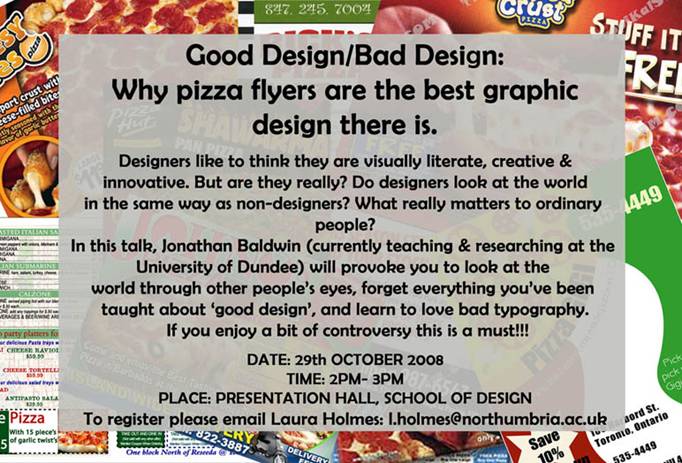
I was given an open brief which is always a bit tricky so I decided to do an amalgam of two talks, my annual "Good Design/Bad Design" lecture (where I challenge conventional wisdom on what 'good design' is) and the best bits of the keynote I gave in Texas in June (where I suggested university-based design education should be about making a difference in the world, not just churning out industry fodder).
When I arrived in Newcastle (I hadn't been there for a while and had forgotten how cold it can be, despite it being a few hundred miles south of where I live now) I was pleasantly surprised to see this sign:

IMG_0215.JPG


Resisting the urge to add the missing apostrophe and correct the spelling of my name (ahem) I quickly took a photo with my iPhone and emailed it to my boss. I've now decided to make similar notices and pin them up around my own uni to make me seem much more popular than I am.

The lecture theatre we were moved to unfortunately was a little lacking heat-wise which (and here's my excuse) led to me forgetting quite a few of the points I wanted to make, as did the fact that the head of design for Philips was in the room and I had planned on making quite a few criticisms of some of their products, including an electric shaver I was asked to review for Amazon.co.uk! (I must post that this weekend, in fact - suffice to say it doesn't get very good marks from me, largely because of the excessive packaging and use of proprietary chemicals for cleaning). Needless to say I hastily skipped all the slides relating to that but because I couldn't quite remember where they were I was keeping half an eye on my presenter display ready to click my remote furiously.
I was told later he'd have loved to have heard my take on things. Oh well.

It was, incidentally, a pleasant surprise to be greeted by a never-before seen sight: students voluntarily sitting on the front row:

IMG_0217.JPG


Despite the cold (the hats and scarfs above were a necessity) and having to skip through the last bits due to time constraints (top tip: when combining two different talks, both an hour long, you might want to chop half of it out if you still want to stick to 60 minutes) I think it went okay. I'm always a bit nervous about these things - as an outsider I'm able to be a bit more controversial than I could be normally and drop a few metaphorical bombs before leaving them to carry on the discussion, and I had planned a few zingers but was in the end a bit more restrained than usual, even skipping my traditional (half joking) rant about typography. Oh well.

I was also a bit down what with it being my birthday - enough to depress anyone the wrong side of 35.

Excuses, excuses.

I was really pleased to be asked and appreciated the audience's participation in some of the 'magic' tricks (one of which I tried on a colleague in the pub when I got back to Scotland that night and, much to my surprise, it worked). I won't tell you any more about it - if you want to see it you'll have to invite me to come and talk ;-)

My thanks of course to the students who found their way to the new venue and suffered through the cold (and my talk), to Jamie Steane, Head of Visual Communication and Interactive Media Design, for inviting me, and to Dr Joyce Yee for taking me to lunch and giving me a tour round the new building. Design is clearly a feather in Northumbria's cap and the university's investment in the building sends a clear signal about that. One that, I noticed on my way home, lights up for all in Newcastle to see at night:

IMG_0219.JPG

Bookmark and Share

Thursday, October 16, 2008

Vote McBlinky and Winky

C8B9FE2A-D551-4EB4-8806-8539550F1DF6.jpg


45D793AE-3814-4A18-A3DA-B161D446E838.jpg


According to Sarah Palin you can't blink. It's a sign of weakness.


But it's okay to wink


Mmm...


McBlinky & Winky 08

Bookmark and Share

Wednesday, October 15, 2008

Speaking in Newcastle later this month

I'm giving a talk at the University of Northumbria at Newcastle on 29th October - my birthday, as it happens!

image001.jpg

Bookmark and Share

Tuesday, October 07, 2008

Pickle the Hunter

I had a couple of friends over for dinner the other weekend and I got up early to make a Summer Pudding and tidy up (two women = very critical).
Having a break I heard the cat come in through the bedroom window (it was the last warm day of the year and I was taking advantage of it) accompanied by some muffled miaows.

I didn't think much of it and carried on watching Quincy. Then out of the corner of my eye I saw Pickle with what looked like a kitten hanging limply from her mouth. Except it wasn't a kitten. Oh no.

I think this was her contribution to the dinner party. I should say that a) I live on a harbour not a waste dump, b) it was very clean, c) while filming I'm also thinking how the hell I'm going to get rid of it and d) it was actually quite tasty in the end.

Bookmark and Share

Being too literal in logo design

Cross posted from my other blog:

In one of my lectures, on visual communication, I use a little exercise to illustrate an aspect of semiotics.

I give the students a brief: they are to design a logo for a law firm that specialises in family law, dealing with families who are facing some form of legal entanglement. I tell them they have two minutes to come up with an idea.
Two minutes later I stop them and ask them all to stand up. I then start eliminating them by saying things like "sit down if you drew a police badge". That usually gets rid of about half. A gavel gets rid of several more, as do jail bars, a law book, a police light and so on.
Before long we're down to the last few students and I can usually get rid of them too with 'hands' or 'cut out people'. I also eliminate anyone who used just words or initials (words aren't so bad of course, I'm just being mean, but initials for firms always bemuse me - IBM and a few others aside, of course).

If there's anyone left standing it's either because I've missed a really obvious one (last year it was a bird, this year it was a court house) or because they've done something quite abstract - this year it was a square with four circles around it. Nice one. We have a winner.

(Just remembered, Orlando Weeks now of The Maccabees, "won" this a few years ago when he did a logo of "a unicorn jumping over a rainbow". Mmm...)

The point I'm trying to make in that exercise, other than it being a bit of a break from them listening to me drone on, is that when faced with a quick challenge like that, students (everyone) tend to to think not in cliches (I happen to think cliches are good things - they're how we communicate) but in too literal a sense. The last thing, I say, someone who is facing juvenile court on a shoplifting charge wants to see is a logo for a lawyer that screams "you're going to jail!".
Look at supermarkets - how many of them have logos that show a basket of shopping? (I seem to be the only one who thinks the Lidl logo looks like someone pushing a trolley)

BE4D2667-9A33-42F8-B82D-D820A5871AB2.jpg


I came up with this little game (which makes more sense in the context of the lecture than it does here) a few years ago when some graphic design students at a previous job were asked by a local law firm to come up with a logo for a similar brief. The winner was a half open door with light coming through it. The tutor loved it, the clients loved it. I hated it. They thought it said "there is hope". I thought it said "you're doomed". But then, that's me for you.
It did, however, make me look anew at logos to try to find the overly literal. And while there are a few, they're pretty rare and almost universally poor. I won't link to any here - look for yourself you lazy git.

All of which brings me to something that amused me. A couple of years ago, after I'd done this exercise with them, some students came in to my office with something they'd found in the Yellow Pages. An ad for a law firm which fell in to exactly the trap I'd laid for them (click on the image for a larger version). I think this is a pretty amazing/bad piece of advertising - I'll have to add prison tattoos to my list for next year's lecture.

Lawyer ad.jpeg

Bookmark and Share

Thursday, September 25, 2008

Sarah Palin at the UN: The secret footage


(I'm not the only one to spot the similarity - Andrew Sullivan got there first)

Bookmark and Share

Argh! Make it stop!

If only this film were real:


Oh wait a minute. It is:


Watch CBS Videos Online

And in case you've still not scratched your eyes out of your head...

Bookmark and Share

Wednesday, September 24, 2008

Autumn lecture programme

Here's my Autumn semester lecture programme in 3D. Click on the link for a higher definition version. Of course it looks better in the flesh on the big screen :-)

(The timeline was created in the rather clever program Timeline)


University of Dundee Design History, Theory and Practice lecture series from Jonathan Baldwin on Vimeo.

Bookmark and Share

Monday, September 22, 2008

Funniest cartoon I've seen in ages

This cartoon was in the current edition of Private Eye. It's had me chuckling all weekend.

Pavlov.gif

Bookmark and Share

Friday, September 19, 2008

Designers win medals too

This is something I wrote for the study guide for my Design History, Theory and Practice (DHTP) module which starts next week. The first lecture asks "what's the point of DHTP?" and I try to head off the usual complaints about having to write and read and go to the library. I've found spending the first lecture on making the case for approaching design from an intellectual point of view not only saves time later, it tends to improve attendance and grades!

Plus, I happen to believe in it.

The 2008 Beijing Olympics offered a showcase not just of excellence in sport, but in design as well. Everything from the equipment being used to the garments being worn was designed. Ask the average person what we mean by this and they will undoubtedly talk about what things look like - the ‘style’ of the outfits, the shape of the bikes and so on.

brennan_sydney_main.jpgBut to take a view like that is to miss what we might arguably call the ‘real’ design, the design that’s the product of years (if not decades) of intense research into textiles, alloys, aerodynamics, ergonomics and more. When people talk of the millions of pounds spent on sports in the UK, they may think that all gets spent on training. But it doesn’t. Chris Hoy’s bike, Rebbeca Adlington’s swimming costume, Charlotte Burgess’s bow, and Deborah Brennan’s wheelchair are all the result of investment worldwide in design research.

And then there are the games themselves - everything from the obvious opening and closing ceremonies to the transport networks, the global television feeds, the ticketing systems, the catering, even the queues — all designed.

Design history and theory are no longer simply endless slideshows of the great and the good; pictures of this designer and that piece. Over the next three years you’ll be exposed to, and encouraged to discover, not what’s gone before but what’s possible. DHTP is about the future as much as it’s about the past. It’s also about broadening your view of what design is, from the ‘man on the street’ idea of design as style to something a little more ambitious and all-encompassing. And it’s about encouraging you to pursue a role in the cutting edge through your own research.


If I get the time, I'm going to do a video to go with it too...

Bookmark and Share

Saturday, September 13, 2008

Sarah Loves Charlie

I ran Sarah Palin's Charles Gibson/ABC interview (part 1) through title="Wordle: Palin 1">Wordle and, as suspected, she uses "Charlie" like it's some sort of punctuation mark. A great bit of coaching by her handlers.

If you read the transcript and substitute your chosen expletive, it's a lot funnier. And God knows, reading it back, we need all the laughs we can get...

Wordle - Palin 1.jpg


Quick summary: the woman knows nothing. Heaven help us all.

Bookmark and Share

Thursday, September 04, 2008

Americans left abandoned by Bush

The parallels were amazing: in the wake of Hurricane Katrina thousands of Americans were huddled together in a sports centre wondering where their president was. And in the wake of Hurricane Gustav, thousands (just about) of Americans were huddled together asking the same question.

I was glad to see The Daily Show spot the irony. This is one of the funniest things I've seen in a long time. Enjoy:

Bookmark and Share

Wednesday, September 03, 2008

Diplomas explained

The Guardian has a handy summary of changes to the school curriculum in England from today, including this summary of the new Diplomas:

Starting this term are the first five diplomas in engineering, construction, information technology, creative and media studies, and society, health and development. There will be 17 in place by 2011. [including product design - see this post for news of the announcement]

The new qualifications are intended to be an alternative to GCSEs and A-levels for 14- to 19-year-olds, blending hands-on learning and theory.
There are three different levels of diploma: foundation (level 1), higher (level 2) and advanced (level 3).

All are made up of three parts: principal learning; generic learning and additional specialist learning.

Principal learning is made up of qualifications, or units, specifically developed for the diploma subject and a project.

Generic learning includes 'functional skills' such as English, maths and ICT, alongside presentation, communication and teamworking skills.

Additional specialist learning involves more academic theory, an extended project and other qualifications, such as a GCSE or A-level, chosen from a catalogue of approved awards.

Diplomas will also involve 10 days' work experience, ideally in a field related to the diploma subject.


Remember, if you recruit English students to design courses at college or university, you need to know what's in the diplomas as they are intended as entry qualifications to FE and HE. They won't show up for a few years yet, but they will eventually. It would be worth finding out if a school near you is offering a diploma in your subject and getting in touch to make sure there's no mismatch between what's offered and what's needed, and maybe to offer some time to give a talk or demo.

Bookmark and Share

Tuesday, September 02, 2008

The problem with graphs

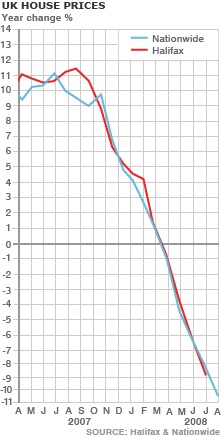
Take a look at this graph. It accompanies a story on the BBC News website about the property market and today's announcement of Government measures to boost flagging sales.

78A03079-0C51-4047-BE71-E169735DFE8A.jpg


The graph plots the change in house prices as measured by two banks, The Nationwide and The Halifax. On the face of it things look pretty dreadful.

Except that the graph is wrong*. The values it is plotting are 'rates of change', so it's a bit like plotting a car's speed by plotting its acceleration and deceleration. You wouldn't really do that as you can't use such a graph to say what the car's actual speed is at any one time, without making some tortuous calculations.

Let's give an example. The graph plots changing values from April 2007 to August 2008. But the individual points relate to the relative change in house prices during the year to that date. So if you look at the point for the Halifax figures in April 2007 you see approximately 11%. What that means is that a house bought in April 2006 for £100,000 (good luck finding one that cheap) was typically worth £110,000 in April 2007.
Now look at April 2008. The graph shows that house prices fell by 1% in the previous 12 months. So that house which was worth £110,000 is now worth £108,900 - so it's still 8.9% higher than it was two years previously.

What you can't do with this graph is look at the August 2008 part of the graph and say what the value of that house is now, because it wasn't bought in August 2007 - the figure is meaningless, therefore the graph is meaningless. (This is the same problem you get with monthly inflation figures - a figure of, say, 5% might be seen as high but it means prices went up 5% over the last 12 months, not in the last month. If prices stay at the same level, inflation will be 0% but that doesn't mean things are getting cheaper. It means they're staying just as expensive as before)

If I had bought that house in April 2006 I couldn't use these figures, or this graph, to predict what the house is 'worth' now. But that would still be irrelevant unless I was thinking of selling now. But house purchasers don't tend to buy and sell in a year, but after several years (often decades). A graph on that principle would show a steady and sustained increase in the value of houses. There's a lot of people worrying over nothing - if you're not thinking of selling your house then you have nothing to worry about, yet this graph is intended to make you worry.

(Let's say that house price inflation stood at -10% in April 2009, then I could calculate the value of my home. It would be £98,010 - a drop in value for sure but of £1,990. In other words my house would be worth 1.99% less than it was when I bought it, not 10% less. See how it works?)

The only conclusion I can draw from this graph is that whoever inserted it is attempting to make things look more dramatic than they really are.
Which leads to a suggestion: the best way to increase confidence in the property market would be to ban stupid measures of the market that plot relative values over 12 months. The housing market doesn't work on such small cycles.


(*Actually, 'wrong' is not the word, rather it's 'misleading', but it's so misleading it might as well be wrong)

Bookmark and Share

Monday, September 01, 2008

New design-related schools diploma - competition or support for product design degrees?

The Guardian reports that:

The government's qualifications regulator, Ofqual, has accredited five new diplomas that will be taught from September next year.

The diplomas will be in business, administration and finance, environmental and land-based studies, hospitality, and manufacturing and product design.


Whether this diverts potential design students straight in to industry rather than in to colleges or universities remains to be seen. And of course, whether that's a good thing or a bad thing also remains to be seen. But the immediate(ish) implications are clear: in the next few years product design courses will start to see applications from students with diplomas, not A-levels. That needs some preparation.

Bookmark and Share

Sunday, August 31, 2008

Ten Freedom Points if you guess where this happened

Guess where this happened:

Protesters here in [XX] have been targeted by a series of highly intimidating, sweeping police raids across the city, involving teams of 25-30 officers in riot gear, with semi-automatic weapons drawn, entering homes of those suspected of planning protests, handcuffing and forcing them to lay on the floor, while law enforcement officers searched the homes, seizing computers, journals, and political pamphlets. Last night, members of the [XX] police department and the [XX] handcuffed, photographed and detained dozens of people meeting at a public venue to plan a demonstration, charging them with no crime other than 'fire code violations,' and early this morning, the [XX] sent teams of officers into at least four [XX] area homes where suspected protesters were staying.


A: China

B: Russia

C: Cuba

D: Minneapolis, USA

E: Tibet

F: Iraq

Read this in full to see if you were right

Bookmark and Share

Friday, August 29, 2008

Being runner up in Miss Alaska is great practice for being runner up in November

A061F8D1-0606-41D2-A096-88FEA740F2F5.jpg


Apparently Sarah Palin, McCain's pick for Vice President, was a runner up in the Miss Alaska competition. (The swimsuit round must have been nippy, no pun intended - but go ahead if you spotted it).

Seeing as the female population of Alaska numbers around 260,000, that's not saying much. Given those odds, I reckon if I padded up and wore a dress I'd stand a pretty good chance.

On a more serious note, given that she is three years younger than Obama and has even less experience of government than he does, it seems inconsistent to argue that he's not ready to be President but that she is. Watching her next to McCain earlier just made him look even older and more wooden than usual. In a few weeks time I think the Republicans who thought this was a good idea will think again.

Bookmark and Share

MacUpdate Back to School promo

MacUpdate Promo - Big discounts on Mac software every day..jpg


MacUpdate have released their latest software bundle and it focuses on tools of use to students.

Among the titles of particular interest to anyone writing or researching essays and dissertations are DevonAgent, which is quite a useful tool for online research (I've found it great for finding links between different topics) and BookEnds which helps compile bibliographies.
A word processor, Mellel, offers an alternative to Word that promises to be helpful in compiling long documents with different sections.

As more bundles are sold, other programs get unlocked and MacJournal has just become available - another useful tool this time for keeping notes and ideas.

Highly recommended - all these titles would cost $600 (£300+) but are available for just $49.99 (£25+)

Click the ad below for more details or visit the MacUpdate promo page.


Bookmark and Share

Thursday, August 28, 2008

A moment in history

The BBC's Justin Webb on the nomination by acclamation of Obama:

It was stunning - a moment of brilliantly produced political theatre and a moment to cherish forever. Television conveys something but to be there, to see a death and a birth; that was something else.

What made it was the chaos, the crowd, the press of bodies, the tears, the consequence of it all. It reminded me of the British parliament at its best, rowdy and physical yet serious of purpose and aware of its potency: consequence.

People died years ago for America's right to be able to have these moments and their descendents have done them proud, though in a way most of the nation's founders would have found impossible to imagine.

The roll call went state by state (Hawaii happy, talk of sunshine, Michigan miserable, talk of lost jobs in the Bush years) and all was proceeding with that ceremonial and genteel decorum that America is so good at ('Guam, can you repeat your numbers please? Oh thank you Guam!') - and then came New York.

What made it was the physicality of the moment - she swept in from a tunnel, on to the crushed, cramped floor, arm-in-arm with the governor of the state and its other senator. When she took the microphone, it was not at a distant podium with music and autocue and clocks to time the start and the finish.

There on the floor Hillary Clinton uttered the words that she needed to utter, in slightly courtly language (reminders of the Brits again) but clearly and with awareness of their consequence.

Then Nancy Pelosi called for the seconder to the motion that Obama be selected, and the roar was surely felt down the years. She did not pause for those opposed - they were crushed too. That, too, is politics. A reminder that all this is the exercise of power, of one group of human beings forcing others to accept their dominance.

As people cried and hugged each other and the music blared, I thought of the little black children stolen from their parents, the daily cruelty and humiliation suffered by black people in this country for so long in what one historian calls 'America's Original Sin' and, to a lesser extent, the daily miseries they still endure. From slavery to the nomination of a black man as the leader of a major party. Sometimes it really does appear that our political evolution matches our physical progress...


(Via BBC NEWS | Justin Webb's America.)


It certainly looked dramatic. Up until then the DNC had made even British parties' annual conferences look like things of substance.

Bookmark and Share

Wednesday, August 27, 2008

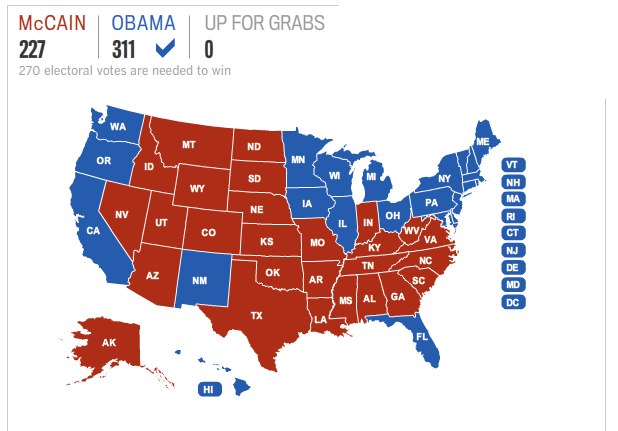
Prediction Obama 311-227 McCain

I watched Hillary's speech to the DNC on C-Span (via BBC Parliament) and I very nearly applied for citizenship there and then. Blimey she was good. And I got the feeling a lot of people in the crowd were thinking "what have we done?".
Too late, Hillary, too late. But Michelle Obama was good too - you get the sense she won't be the sort of First Lady who sits quietly and smiles on the official Christmas card.

Based on my extensive knowledge of US politics (I watched every season of West Wing at least twice and saw every episode of Commander in Chief before it was cancelled) here's my prediction.

2008 electoral vote map - Los Angeles Times-1.jpg


Mind you I got the last one wrong - I still remember sitting there with my pack of American Hard Gums waiting for the results to come in, and giving up in the early hours after Kerry's spokespeople started looking glum.

My rationale this time round is any state with a coast will likely go Democrat because there has to be a link between passport ownership and common sense; if the margin in the last election was within about 3% it will go Democrat; Florida and Ohio will not make the same mistake as last time. (Although I'm not sure about Alaska - both the people who live there tend to vote Republican if memory serves, but the latest poll had them down for Obama. But the whole Russia/Georgia thing might make them nervous enough to vote Republican) [Addendum - Sarah Palin makes it certain, I think. Alaska's going Republican]

I thought about giving any state where a candidate lives to that candidate, on the basis of home advantage, but given the current uncertainty over the number of homes McCain possesses (he can't remember how many he has, apparently) that might result in a clean sweep for the Republicans.

Having said all this, I'm just guessing. But then so are all the people on the US news channels. All I'll say is this: when McCain lambasts Obama for being loved by the rest of the world, just remember that when electing the self-proclaimed "leader of the free world" it's polite to consider who the rest of us think that should be.


Pollster.com currently puts Obama 10 EVs away from the winning post. It would be sweet if the national vote is close but the electoral vote gives it so clearly to Obama.

Bookmark and Share

Designers asked by UK Government to tackle MRSA

Design Week is reporting that five UK design consultancies are being sought by the Department of Health and the Design Council to collaboratte with scientists and healthcare professionals. They will be asked to develop "innovative design-led hospital furniture and equipment that could improve cleaning and reduce patients’ exposure to healthcare-acquired infections".

The programme, called "Design Bugs Out" starts with a briefing on 2 September and will focus on research in three hospitals, identifying key problem areas.

Having identified five key areas, each team will be asked to focus on one and given a £25,000 grant.
After the closing date for submissions on 10 October, final teams will be announced ten days later and given seven weeks to develop prototypes. Winning designs will be exhibited next summer.

Bookmark and Share

Tuesday, August 26, 2008

Art and design degrees 'need overhaul', say academics

The Guardian reports that:

A group of 50 academics have called for major changes to be made to the teaching of art and design at UK universities after a review concluded it was not fit for purpose.

The Group for Learning in Art and Design (Glad), a forum of academics who discuss learning in the sector, said teaching needed to better prepare students for work in a fast-paced, changing world.

[...]

Students should learn more than the bones of their own subject to reflect 'the multi-disciplinary nature of the creative industries', and work with different groups of people during their studies.

Prof Linda Drew, dean of academic development at the University of the Arts London and editor of the study, said: 'The creative industries have changed dramatically and so must we. Art education is at risk of becoming conservative – it is important that art and design remains at the cutting edge of higher education.'

Teaching staff should also be given extra training to improve the general quality of education, says the report.


The GLAD conference is taking place next week where I'm assuming this report will feature prominently.

This echoes much of what was discussed at New Views 2 in July (see this post, this one and this one).

So we're all agreed. Let's get on and do it, shall we?

Bookmark and Share

Monday, August 25, 2008

Chinese Cooking

After the Olympics closing ceremony yesterday, my friend Qin cooked me dinner - quite an honour! I thought I'd capture the moment so that anyone could follow along at home:


In case you're wondering, it tasted lovely. :-)

Bookmark and Share

Kermit on Visual Thinking


Via Qin Han

Bookmark and Share

Filling buckets

"Education is not the filling of a bucket, but the lighting of a fire."


WB Yeats

Bookmark and Share

Thursday, August 21, 2008

Happy as a pig in sh*t

4B9F0E32-A48E-4B22-A815-1217B202A53D.jpg


I spotted this poor chap today in the Grassmarket, Edinburgh. The worst thing about it was the fact that the pig seems to be smiling.

I find its slow disintegration from the back rather worrying too.

Looks bloody tasty, though...

Bookmark and Share

Saturday, August 16, 2008

"You have to scream"

Here's a clip from my recent trip to Brighton and a short ride on a fast machine.

I should explain that just before the thing got going, I felt my harness come undone. So I spent the whole half hour (in actual fact it was probably less than a minute) clinging on for dear life. So when my friend, Qin, says "you have to scream" I am in fact holding my breath in anticipation of being flung out to sea. Rest assured, you'd have heard me scream then...

Bookmark and Share

HSBC. The World's Dumbest Bank?

hsbc.jpg


Spotted this ad in Dundee today. A few points spring to mind. Firstly, it's a crap ad (sumo wrestlers do budge - it's the whole point of the sport. In fact they don't half get a wriggle on sometimes...)

But most importantly, given the strapline "The world's local bank" it should perhaps be pointed out to whoever at HSBC signed off on this space being hired that, erm, there is no HSBC branch in Dundee.

In fact, the 'local' branch is a half hour drive away in Perth. Might as well be in Japan - which is the only thing that might help this ad make some sort of sense.

Bookmark and Share

Monday, August 11, 2008

Rimer Cardillo

79BD453A-DA5D-4215-BEA5-BB060D57FFA6.jpg


I met Rimer Caardillo when I was in New Paltz, New York in April visiting State University New York. I was really impressed with his work and his approach to print-making which was reflected in his students' approach.

Rimer has an exhibition coming up shortly in Andes, NY so if you're in the area you should pop along. Check out his web site here.

Chace-Randall Gallery

Contemporary Fine Art

49 Main St, Andes, NY 13731

845-676-4901

August 15 - October 5, 2008


Reception: Saturday, August 16, 5-7pm

Bookmark and Share

Saturday, August 09, 2008

John Oliver analyses Fox News

I loved this when it was broadcast on The Daily Show. Take a look - as well as being extraordinarily funny, it's also pretty good analysis of an appalling "news" network.

Part 1


Part 2

Bookmark and Share

Monday, August 04, 2008

What design is versus what design was

Aaron at Product Behaviour contributes to an age-old discussion:

What is ‘design,’ anyway? Is it the ability to draw stuff? Is it the ability to cobble together a mechanism? Those may be part of it, but they miss the real point. Design is how you decide what to draw, and what to cobble together.

[...]

The project teams are made up of smart people with widely varying backgrounds. They’re capable of analyzing the situation in the field, coming up with solutions, building and testing prototypes. What they need help with, in the end, is making decisions: filtering the requirements; rating the criteria for a ‘good’ solution; knowing when to stay within the paradigm of current solutions to a problem and when to develop completely new technology.

Those are the things ‘professional’ designers really do. The technical skills are important, sure, but it’s decision-making that separates an OK solution to a problem from a great solution.


(Via Product Behavior.)


This ties in to previous posts here, and to the thinking at the New Views 2 conference. Design, at university certainly, shouldn't be focused solely on 'skills' as traditionally perceived (life drawing, typography, pattern cutting etc) but on 'higher skills' (strategy, decision making, analysis), and the design industry should be employing graduates in roles that use those higher skills.

Unfortunately, look at any issue of Design Week or Creative Review, or look at the D&AD student awards, and you see higher skills almost completely ignored in favour of technique and aesthetics. And this drives what design courses try to achieve, meaning that what design is, as defined above, gets shoved out in favour of what design was.

Bookmark and Share

Friday, August 01, 2008

"It’s a shame that the design industry looks to other places to do the groundwork and expect the finished article to turn up on the doorstep"

Great comment over atThe Serif where they're debating comments I made on internships in design companies:

"I graduated in 2006, and am currently working as a team secretary in an office, because I needed to pay my bills and survive basically. There’s two points I’d like to make. [...]

I started working at this office as a temp. (Paid well, I might add) I got taken on as an admin assisstant full time and within a couple of months I was being trained to become a team secretary. It’s a shame that the design industry looks to other places to do the groundwork and expect the finished article to turn up on the doorstep (the majority anyway). The main point here is that, yes, taking on a graduate is a gamble for companies, but that is no excuse not to pay someone while you make your minds up. 3 month contracts will do. Then there’s an option at the end, the person gets paid in the meantime."

Bookmark and Share

Wednesday, July 30, 2008

work+play: Notes from New Views

Laura Chessin's thoughts on the New Views conference:

I was challenged by the view that ‘Graphic Design is in Crisis’. I developed a conviction that graphic design is undergoing an evolution and it is those who operated under previously–accepted assumptions and systems who are in crisis themselves.


I think she's right here, and this is an important way of looking at it. To amend my earlier post, it's not graphic design that's dead, it's the old way of looking at it that should be put to rest.

Bookmark and Share

Thursday, July 24, 2008

Does design education work against 'Indie Fever'?

As Michiel van Meeteren points out in 'Indie Fever', one of the hallmarks of the independent programming community on the Mac is their willingness and desire to share tips and discoveries. Will Shipley is a good example of this - he blogs code, sets puzzles, and twitters. John Gruber of Daring Fireball is another example of what Gladwell would call a 'connector' - indeed it was via him that I found Michiel's paper.

I said in my last post that I thought this paper has implications beyond the programming community, and that this sharing of knowledge is typical of design in general. But then I wondered if this is true. While I can think of many examples of designers who blog, and who run workshops for others, or who meet up socially to discuss what they do, I can also think of many more who guard their knowledge jealously.
This even happens among design teachers - I once worked with someone who told his students "I'm not going to tell you how to do this because you might be a competitor one day", which half the class actually thought was entirely reasonable!

Design education is horribly individualising. We set students briefs and then set them against each other, making it all a competition to see who is better than everyone else. The 'critique' or 'crit' is a great example of the sort of judgemental, competitive element we've built in to how we teach what we teach.

Of course, most programmes include 'group work' which, as a colleague and I tried to explain to others recently, is not really the same as 'team work'. I'll let you try to figure out the semantics of that one.
But team work isn't really 'taught' - we just put students in a group, tell them to get on with it, then punish or reward them for producing something at the end based on whether they got on. Teamwork needs to be taught, not just assumed to be a natural talent.

Whatever, team work is pretty much a 'tick box' exercise, something programmes include because it's on the list of key skills, but it's not something students enjoy or see a value in doing (because what happens if they're in a 'bad' team?) and I haven't met many teachers who are particularly good at it (either teaching it or, let's face it, doing it themselves)

But team working, or rather collaborative working (another important distinction, see below), needs to be part of the culture of design education, not the focus of a single project, because it is the culture of design practice.
There are many who do this, or encourage this. In my own teaching I've encouraged students to collaborate in 'tutorless tutorials', peer mentoring and chats over coffee (or even beer), and though it's unscientific I suspect there's a direct link between students' desire to talk about stuff socially and their grade.

But there is a proven link between collaboration and success: Angela McRobbie's study of fashion graduates from Central St Martins makes it clear that success is not a measure of the skills you're taught at university, but the social and cultural capital you acquire just by being there (something that the 'skills agenda' being driven by industry at the moment completely misses). Every time I think of that I think this is what university should be about. Not the accumulation of skills but the accumulation of social and cultural capital. Without this, you stop learning the moment you stop being in class. With it, you never stop learning.

And so my programme for second years next year is based around collaborative 'design quests' that are all about developing this sense of shared knowledge-finding and out-of-hours discussion. And in the past few months we've launched a book group, a sustainable design group, and a documentary film club to get this culture of sharing going. (Some people reading this will no doubt have been doing things like this for a long time, or their students will).

The future of design practice depends on collaboration, not just at the client/designer level, or even designer/end user level (co-design) but more fundamentally between designers for continuing development and research. The indie developers Michiel writes about are working for themselves, by themselves. Yet they still collaborate and this definition of 'collaborative working', as opposed to 'group work' or 'team work' is not something we encourage in design education.

It's something we need to make a core aspect of what and how we teach.

---

Two quotes worth sharing. A jewellery student complained to me about having to work with others. "It's a waste of time, I don't need to learn that. I'm going to be a jeweller, I'll never work with other people".

So wrong on so many levels, but do you see how a culture of 'collaboration' rather than 'team work' might have helped here?

And my favourite (told to me by a colleague) from a computing student: "I'm not very good at working in teams, but that's okay because I'm going to be an academic".

Bookmark and Share

Indie Fever

Michiel van Meeteren (University of Amsterdam) has published a study of the Macintosh independent programming community as a PDF. It looks like it might be interesting to anyone involved in programming, but also has wider implications for the studies of communities of practice and how people share knowledge to improve their own skills - in other words 'design thinking' in general.

Excerpted from Michiel's website: "
 

‘Indie Fever’ is the first result of a multi-year human geography research program to investigate the social and economical world of so-called ‘Indie’ developers on the Macintosh platform.  ‘Indie’ is the self-chosen nickname of software developers that serve worldwide markets from the Internet, hold their artistic values in high esteem and celebrate their ability to make high quality software as small companies.  [...]

Indies have organized themselves informally but strongly in a virtual community.  Although they are scattered over several continents, they continuously interact over the Internet, share rumors and code, and discuss business and private interests as if they were coworkers while –technically– they are competitors.  They share a common culture which is intertwined with the history of the platform they develop for and the Cocoa programming environment in particular. [...] it analyses how Indies sustain and reproduce their particular culture primarily through online means, something that is argued to be rather difficult in the social-scientific discourse.

Almost 50 hours of interviews were recorded for Indie Fever.  These interviews were combined with the results of extensive data mining of blogs and other online resources.  The resulting thesis focusses on both the cultural and economical aspects of the Mac Indie world and the ways these reinforce each other by applying theories of, amongst others, Pierre Bourdieu, Michael Porter, Norbert Elias, Chris Anderson and Malcolm Gladwell."


Bourdieu and Gladwell, eh? That's basically my reading list for my first years...


Check out the site for a link to the PDF (I would link here but I suspect Michiel would like to track numbers). There's also a blog related to the research project.

Coincidentally, at the same time I heard about this I also read several reports about a new website launched by developers of iPhone apps for whom the Non-disclosure agreement they effectively signed with Apple means they are forbidden from sharing knowledge and tips - precisely one of the things that defines the indie culture. When you see the title of the site you'll see they're not best pleased with the restriction. According to a publisher (I forget the link, sorry) the NDA is also holding up publication of books on iPhone programming.

Bookmark and Share

Tuesday, July 22, 2008

Fun with fonts

Bookmark and Share

Proof that McDonald's beverages are undrinkable

A story in The Guardian that Fox News channels in the USA have started selling McDonald's the opportunity to have their iced coffee on morning programmes comes with this interesting bit of info:

Two cups of coffee, their cubes of ice glinting in the studio lights, now daily stand before the channel's morning presenters. The presenters conspicuously do not drink from the cups, which is just as well – the cups contain a bogus fluid and fake ice to prevent the cubes melting.


From my recollection, in the UK McDonald's tea has always contained an undrinkable fluid so it's nice to see some consistency.

Bookmark and Share

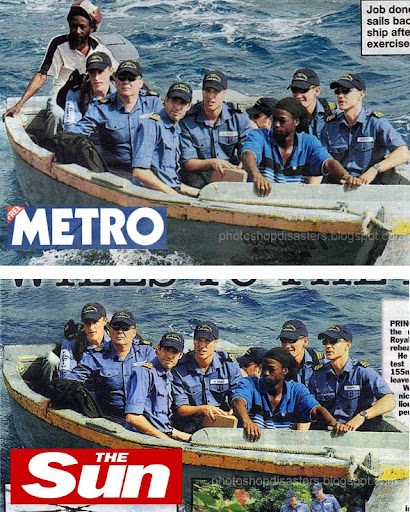
Spot the difference


(Via http://photoshopdisasters.blogspot.com/feeds/posts/default.)


Yes, that's right. There's a disembodied knee in the bottom picture.

Bookmark and Share

Sunday, July 20, 2008

TV adverts to be quieter. Still annoying, though

Hurrah!

According to the Guardian:

after decades of receiving complaints about TV adverts sounding louder than the programmes, the Advertising Standards Authority (ASA) has finally acted: as of this month, commercial breaks may be no louder than the transmissions in which they appear.


I can't remember the last TV ad I saw. I don't watch live TV anymore except on rare occasions and if I ever watch a commercial channel I pause it, then wait 15 minutes before beginning just so I can fast forward through the bloody things.
Mainly because they're just too loud.

Interestingly, however, despite fast forwarding through ads I can still tell you about the different campaigns. I think they've cottoned on to people like me and are deliberately making them so they're as easily understood at x32 speed as they are at normal rates.

Except perfume ads. They'll always be unintelligible no matter what speed you play them.

Bookmark and Share

Saturday, July 19, 2008

Like-ability does not equal ability

Jamison Fraser on why the US media's obsession with politicians' "like-ability" is a bad thing


Voting for president based on who seems the most likable -- or, in the media's favorite shorthand, based on who you would rather have a beer with -- is a spectacularly bad idea, what with the almost total lack of similarity between talking about the Knicks over a bottle of Bud and running the world's most powerful nation.

It requires very little judgment or analytical skills to determine that the Knicks stink. Deciding whether to send Americans off to die in a foreign land is (or should be) a little different.


(Via Media Matters for America.)

Bookmark and Share

What replaces oil?

This is one of those questions that keeps me up at night. I don't mean 'what are the alternatives to oil' but something far more puzzling...

All these billions of barrels of oil that have been sucked out of the ocean bed and deep beneath the ground must leave holes behind, right?

So what do they fill the holes with?


There... that's stumped you, hasn't it?

Bookmark and Share

Thursday, July 17, 2008

Nice to see the US media focusing on the real issues in the election

5E451606-932D-4863-B2BE-D466CDBFBE40.jpg


Good grief

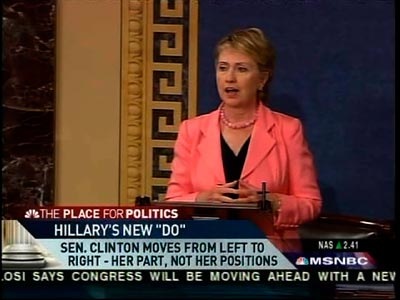
During the 10 a.m. ET hour of the July 16 broadcast of MSNBC Live, host Monica Novotny devoted a segment to discussing Sen. Hillary Clinton's 'new look,' specifically the 'short[ness]' of Clinton's hair and the fact that Clinton 'shifted her part from the left side to the right side.'

At the beginning of the segment, Novotny contrasted a video of Clinton's July 15 speech on the floor of the Senate with her official publicity photo in order to illustrate the difference, stating, 'All right, if fashion -- as far as hairdos go -- isn't your forte, Clinton's hair is apparently shorter than it used to be, and she's shifted her part from the left side to the right side.'

Novotny asked MSNBC congressional correspondent Mike Viqueira, 'So, it's Hillary's part that's shifted to the right? Not her political positions?' Viquiera replied: 'Monica, all I can say is, I'm not really crazy about standing here talking about a senator's hair, especially Senator Clinton's hair, but I'll just say this: When it comes to senatorial hair, she's way ahead of the game. I mean, we've got some combovers around here that are engineering marvels, modern engineering marvels, I tell you. And look, I mean, you know the price of Grecian Formula these days -- I could use -- I could use a raise for that, and some Rogaine.'

Novotny later stated: 'Look, I'm just going to say this: I mean, you remember there have been some other reports where people were focused on other things, so I say, better the coif than the cleavage. That's just me.'

As Media Matters for America documented, on July 30, 2007, MSNBC devoted a total of 23 minutes and 42 seconds to segments discussing Clinton's (D-NY) 'cleavage' between the hours of 9 a.m. and 5 p.m. ET.


Better the coif than the cleavage... oh yes, I get your point. We wouldn't want people focusing on other things in this election, would we?

(Via Media Matters for America.)

Bookmark and Share

Wednesday, July 16, 2008

New Views discussion


It's an hour or so long but if you really want to listen in on the (at times rambling) final conversation of the Responsive Curricula group at New Views 2 feel free.

Bear in mind some of the trains of thought relate back to two full-on days of discussion so may not make sense. Oh, and because I was holding the camera, my voice is the loudest...

Apologies for the jumpy video - something wrong with the encoding, not sure what, but the audio's fine.

(If you were involved in the discussion, or want to add comments, use the (+) button to type your thoughts, bookmark important points or clarify anything that needs it)

Bookmark and Share

Double standards from the design industry


Design Week carried a story last week about some reaction to Kingston Council (outskirts of London) asking potential design companies to take part in a free pitching process. The story continues today:

The Design Business Association and the Chartered Society of Designers have both responded vociferously to free pitching, following the recent revelations reported in Design Week.

Transport for London is currently running an open competition to design a new bus for London. While the top three ideas will receive prize money totalling £45 000, none of the other entrants will be paid for their work.

‘Designers will want the prestige of having their name attached to the new iconic bus for London,’ TfL director of surface transport David Brown told Design Week by way of justification at the launch of the competition on 4 July.

The DBA says it wrote to the Mayor of London Boris Johnson ‘on this issue’ last week. ‘The Mayor has been illadvised on this,’ says DBA chief executive Deborah Dawton. ‘Both the DBA and CSD have extensive experience in running competitions that meet industry requirements.

This one is so far off the mark we’d have to go back to the starting grid. Prize money of £25 000 goes nowhere near covering the design investment.’ She continues, ‘I think we'd all rather travel on a bus that was designed by someone qualified to do it.’
[...]

CSD chief executive Frank Peters is calling on the Design Council to take a lead in stamping out malpractice. In a letter published in this week’s Design Week (see page 11), he urges the Design Council to ‘educate clients away from such practice. As a Government body, they should be wellplaced to ensure that no Government department adopts this practice [of free pitching]’. Meanwhile, Kingston Council has received at least two letters of complaint from designers angered by its unpaid tender to fill its graphics roster.

The latest, from Watershed Design managing director Paul Widdup, argues, ‘If you are tendering for accountancy services you would not ask them for an audit to prove their credibility.’ Kingston Council wrote back to Widdup, claiming that, ‘The council is not seeking “free” design work. To identify the most suitable candidates we need to be able to establish the quality of services that potential partners can provide and the value for money they can offer taxpayers. Our experience of procurement is that businesses are well versed with tender processes and see it as an opportunity to win work and develop their client base.’

Dawton believes that getting public bodies to observe best practice would be a major achievement.

‘A commitment from Government to drive up best practice in [its] procurement of design would benefit the whole country in one fell swoop,’ she says, adding, ‘Why should small commercial businesses subsidise it in this way?’ The DBA intends to start showcasing examples of best practice on its website. ‘We hadn’t thought about doing that before now,’ says Dawton.


Now think about this for a moment. The design industry is opposed to free pitching. Paul Widdup makes the very good point that accountancy firms are not asked to carry out a free audit before being given work.

So why does the very same industry allow many of its members to ask graduates to work for free before offering them a job? It's variously called 'work experience' (I call it 'work' just without pay, so not really the full 'experience' wouldn't you say?) or an Internship, which seems to give it a bit more credibility. This is an industry which claims to contribute billions to the UK economy, but thinks it acceptable not to pay its own staff. They may say that they need to do this so that they can employ 'experienced' staff but you know what, other jobs pay you while you gain your experience.
Imagine if every other industry operated like this - doctors not being paid until they'd done a series of two-month placements at different hospitals; policemen not being paid until they'd arrested 100 villains; teachers not being paid until they'd seen three whole classes through their SATs.

I heard a story the other week about a graduate who's been doing the internship round for so long he's currently on his second stint at a rather well-known agency, working on real briefs for real clients, but for no money. How does he live? On income support (i.e. the taxpayer) and his parents' re-mortgaged house. Since when was advertising a state subsidised industry?

Asking someone to carry out creative work for no pay is wrong. So long as it's called free pitching. But call it an internship and everything's okay.

Double standards.

Why isn't the Chartered Society of Designers doing something about this? And why isn't Design Week reporting it with as much concern as a bloody meaningless 'design a bus' competition?

This US comment from Graphic Design Rants (20/4/07) sums things up pretty neatly, if somewhat ineloquently:

But the current trend where and INTERNSHIP is your first real job out of school instead of a Summer job. Rather SUCKS with your degree, $80,000 in Student loans, dropped $10,000 on Computer gear and Pro-class $oftware, and paying rent in NYC with four psycho roommates. And entry level salaries have slipped back to less than what a decent receptionist makes with a GED and a push-up bra.So I rather have an issue with our profession being not-so-gently-hammered down to working class.

Bookmark and Share

Valuing design graduates and academics


Skillfast 1.jpeg


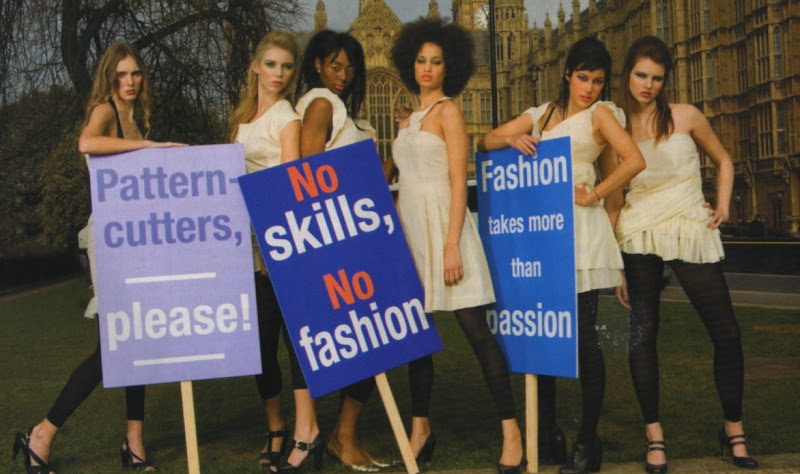
On February 11, during London Fashion Week, Skillfast-UK staged a mock protest outside the Houses of Parliament in which models dressed in toiles (the technical mock-up of a garment) waved placards calling for, among other things, ‘pattern cutters, please!’ A press release sent out to the media entitled “Research Warns: Lack Of Technical Skills Threatens London Fashion Week” gave more detail:
“Today MPs including Skills Minister David Lammy threw their weight behind a new campaign “No skills, no fashion,” launched by Skillfast-UK, the Sector Skills Council for the fashion and textile sectors. The campaign aims to encourage fashion colleges and universities to put more focus on pattern-cutting, garment construction and other technical fashion skills.”

Lammy was quoted as saying “The Government is committed to increasing the level of skills training and advice available to employers, as well as encouraging colleges and universities to form partnerships with local companies to ensure young people are equipped with the specific skills they need to succeed”

The campaign has so far gone unchallenged. But they contain a series of assumptions and misconceptions, as well as signalling a somewhat dangerous approach to the concept of ‘skills’ that is more of a threat to London Fashion Week than anything Skillfast-UK have identified.
At a very basic level, the questions we need to ask are these: if the fashion industry needs pattern cutters, why doesn’t it train some? Why does it expect degree programmes to do it? And why is the fashion industry recruiting graduates to be pattern cutters anyway? This is like asking history courses to award degrees to students who can colour in pictures of the Battle of Hastings without going over the lines.
In medieval times the trades and crafts established guilds, in part to retain independence from the role of the church in education. Taking control of who could practice, and what standards they had to achieve in order to do so, was vital to not only maintain quality, but to control demand, respect and prices.

Membership of the guild required the completion of a period of apprenticeship, resulting in an apprentice piece demonstrating the apprentice’s abilities. Successful completion of this period would result in entry to the profession, but starting at the bottom and undertaking another, higher level, apprenticeship.

Over time this responsibility for training, which involved broader in loco parentis roles, was passed to technical schools and colleges. The ‘contract’ between employer and college was that the latter was now taking on responsibility for training potential entrants to the profession to an accepted standard.

As educational provision expanded, and as courses began to develop in to degrees, the nature of this relationship changed. Degrees are not intended to train people for specific jobs but for a range of possible futures. And the number of students on such courses expanded to suit demand, destroying any link between the ‘need’ for new workers and the ‘supply’.

Meanwhile demand from students for vocational qualifications dropped in relation to degrees, and so the supply of the sort of entry-level worker began to dry up. But as degrees became more popular, they began to be seen as the basic requirement for entry to the profession and, as a consequence, a mismatch developed between what employers assumed degrees were for (apprenticeships) and what they provided (a liberal education).
The end result is that the ‘guilds’ are seeking to reclaim their authority over the ‘church’ (academia). But they are doing this not solely by developing an alternative (a new apprenticeship) but by simultaneously demanding that degrees become apprenticeships, imposing a set of standards on them that weaken any distinction between a degree and a vocational training-based qualification.

The danger is that degrees seeking approval from the trades will no longer offer broad liberal qualifications, and will restrict their numbers closing the study of design to anyone except would-be designers. Apart from the fact this would call in to question their status as degrees, it also flatly contradicts the need identified in the Cox Review for ‘design thinkers’ to populate all aspects and levels of society and industry.

The obvious solution to industry’s ‘need’ for core, basic and entry-level technical skills is for industry to initiate a new form of qualification - which they appear to be doing via the Creative Apprenticeship - and allow degree-level provision to remain independent, looking forwards and educating free-thinking and independent graduates who can transform the industry quickly, rather than entry-level employees who might take 5-10 years to emerge in to management roles.
According to Skillfast-UK “In the UK, approximately 3,000 students graduate from fashion courses each year – yet top designers and clothing brands say they struggle to employ quality staff, because new recruits lack the technical skills and production knowledge to turn their creative ideas into achievable designs”

On the face of it this sounds rather damning. But stop for a moment and think through this logically. 3,000 fashion graduates every year? According to Skillfast, (http://www.canucutit.co.uk/top-tips.cfm) “the supply of fashion design graduates outstrips industry demand by about 600%” (which means that there are only around 500 jobs each year, something that sounds unlikely, but let’s take their word for it). That means there are six candidates for every job. And out of those six, some employers are unable to find people with the right skills? How hard are they looking?

This is plainly rubbish, but sadly pointing out the obvious isn’t enough so let me try to explain through logic (if not in fact, as this requires more research) why I’m sure that Skillfast-UK are wrong in their assertions, and their strategy. And as a matter of convenience I’ll also try to show why the whole design industry seems to be getting things wrong when it comes to graduate recruitment.

Pop along to Careersbox.co.uk and you’ll see an interview with Linda Florance, head of Skillfast-UK. It contains some revealing information: http://www.careersbox.co.uk/video/skillfast.wvx

My interpretation of it is this: the fashion and textiles industry is in need of bright, talented, ‘young’ people from a range of disciplines. It requires people skilled in marketing, in technology, in chemistry and so on. Some of these people will develop new products and markets, and take British fashion and textiles in to new markets.

Oh and they also need ‘creative’ people to make things that look nice.
In other words, this is an industry that values and craves graduates in all sorts of disciplines, but undervalues fashion and textiles graduates, seeing them in very narrow terms.

Part of this relates to the problem that the design industry in general simply hasn’t grasped yet what the value of a design degree is. Evidence for this can be found on the canucutit.co.uk site, where potential employees are told “you are highly unlikely to walk straight into your dream job therefore show that you are willing to start at the bottom, will listen to others, are not afraid of hard-work and will be dedicated to the job.” This ‘start at the bottom’ attitude is typical of the design industry but what’s most disturbing is that this is the advice given to Masters graduates!

The salary new entrants are tempted by, for this ‘start at the bottom’ opportunity is just £12,000. Compare this with Arcadia, Britain’s biggest fashion retailer where graduates are offered £20,000 and a structured, fast track training scheme leading to a management position within a year. Next, the retail fashion chain, offers pretty much the same along with share options and health insurance. Not bad.
Given a choice between working in fashion as a buyer for £20,000 or being expected to ‘work your way up’ from cutter for £12,000 a year, what do you think a lot of graduates will say? Could this be why “top designers and clothing brands say they struggle to employ quality staff, because new recruits lack the technical skills and production knowledge to turn their creative ideas into achievable designs”. It’s nothing to do with the skills or the quality of the graduate, it’s more to do with the attitude of the employers, still stuck in 19th century ways of doing things and seeing ‘production’ as the least important part of the business and - worse - design graduates as shop floor fodder.
An industry that rapidly promotes graduates is likely to be one that develops quickly and stays ahead of the competion.

And industry that hides its graduates away until they emerge after years of working their way up is likely to be one that is overtaken by the competition. And this is exactly what is happening with the design industry, according to their own predictions. But apparently it’s all the fault of universities…

The design industry doesn’t value design graduates. There are glowing exceptions but these do rather prove the rule. It should also be remembered that the big fashion houses we talk about are actually not representative of the industry as a whole which is not the modern, high class vision we tend to see promoted in the media.

Design graduates are seen as entry-level employees because, among other things, a lot of design courses see their role as producing entry-level employees. Too many degree courses turning out graduates who are trained to very narrow ideas of what a design graduate is for.

It could be argued this is not restricted to design, and that the general ‘oversupply’ of graduates is a universal problem wherein “Many graduates are doing fairly menial jobs for which they do not need a degree (or anything like it)” (Fantasy Island p. 78) But a quick overview of destination figures for graduates from UK universities shows that those who study non-design subjects are more likely to enter graduate-level employment than those in design subjects. Even the usual claim that many undertake part-time work while developing their practice appears not to be borne out by longitudinal data and, anyway, surely a graduate could undertake a graduate-level job while doing this instead of working full time behind the counter in a chemist?

Perhaps the answer is that we are either not equipping our graduates with truly graduate-level skills (a skill that can only be exchanged within a closed system is not really a skill at all but an ability) or we are producing graduates who think, rightly or wrongly, that they are only qualified to work as designers, or failing that as shop assistants.
In this sense we need to ask what a design degree is for. What do four years at university offer that couldn’t be gained on the job? On the face of it the only attractions are the social life and the debt.
There must be something more distinctive about a degree.

Charles Handy in The Elephant and the Flea describes how his classics degree landed him a job in an oil company where he quickly became an economist. He realised then that his degree wasn’t so much a license to practice, but a license to learn.

Angela McRobbie in British Fashion Design: Rag Trade or Image Industry? notes that graduates from London fashion courses who were most successful achieved their success not by using skills learnt in college but by using the cultural and social capital they had developed incidentally. This use of social and cultural capital was also identified as a key factor in the cultural industries by the French sociologist Pierre Bourdieu.

Even outside design, the most valuable contribution university makes to a person’s future has long been recognised as the network it gives you - it’s not what you know, it’s who you know. Of course, with the expansion of higher education and the focus on skills, the one thing that has clearly disappeared from university life is the time to build this important capital investment - another contributor perhaps to the decline in ‘quality’ graduates, perhaps. Too skilled, not enough nous.
But all these ‘incidental’ or even ‘accidental’ benefits aside, why else would someone go to university? I’ll come to that question later because it’s becoming even more urgent.

Skillfast-UK’s cognate sector skills council is Creative and Cultural Skills which covers many of the other design disciplines and the industries that use them. It has been working with The Design Council (too closely, some would suggest) and in 2007 published High-level skills for higher value, a policy document outlining some issues and strategies for developing skills in the design sector.
The document outlines that the design industry needs to develop its base of knowledge (not ‘skills’ - a key differentiator I’ll come to later) in cultural awareness, global awareness and business awareness. These are undeniably important.

But the report cancels this presience out by going on to say that university courses need to focus on technical skills and on business skills such as accounting and business planning. To explain why this is a little odd, imagine if accountancy degrees suddenly had to teach students typography…

Go back to what I said about ‘global awareness’ and ‘business awareness’. This is about understanding how design impacts on different cultures and how it is itself affected. It’s about understanding the effects of globalisation and the threats and opportunities it offers. We could teach that on design degrees - in fact we’d love to. But when it comes to teaching ‘business skills’ we actually focus on showing students how to use Microsoft Excel and how to write a business letter. Or we do to those who bother to turn up because, even though we’re accused of not teaching these things, the sad truth is we do, but students vote with their feet and don’t come. Don’t blame us, blame students!

But is this really what the design industry needs from graduates? People who can create a simple spreadsheet but don’t know why they’d need one? Especially if their job has been taken by someone from abroad who thinks business is a little more complicated in today’s world than just working out how to create a macro?

The design industry does need higher level skills, and degrees are exactly the place to develop them. But where’s the incentive when our graduates are being taken in to such crappy jobs and when we’re brow beaten in to dumbing down our courses into a check list of low level ‘skills’ like pattern cutting in fashion and its equivalent in other disciplines?

The content of a ‘core curriculum’ is a tricky one. My first job interview was for a job as a layout assistant for a small design firm in Harrogate. I went along with my portfolio containing the sort of thing they did - a series of two-colour leaflets I’d done for my local MP’s constituency office.

The only trouble was, I’d done them using Pagemaker on a Mac Plus. This was 1989 and the technology was still very new. The owner of the business gave me a long lecture about how I’d wasted my time learning how to do it on a computer, and that he needed someone who knew how to use Cow Gum. (For those who don’t know these things, graphic design included the ‘paste up’ process where artwork was cut up into pieces and laid out on paper or board using a type of glue that kept things in place but allowed you to reposition things and peel them off again).
In fact I’d been taught (or rather, as is often the way of things, left to find out) how to use Cow Gum and was not bad at the job. It’s just that I wasn’t overly bothered with it, given as I’d seen ‘the future’ as it were and could think of much easier ways to do the job. But for this guy, there would always be a need for people with traditional skills that would never die out.

I meet people like that all the time but over the years they’ve gone from protesting about the need to learn how to stick things down with glue to learning how to process film, how to program in Lingo, how to use Pagemaker, how to… you get the picture. For every profession there’s someone who thinks the way they do things is the only way, and always will be. Some people are simply sad that traditional crafts will disappear, and I can understand that, and sympathise, but the role of higher education is not really to keep ancient technologies on life support but to advance things. We won’t lose the skills, they’ll be reborn and rediscovered.

Let’s go back to Skillfast-UK and their Westminster protest. This is what they had to say about it: “To make it to the top in this competitive business, you need the skills to turn a great idea into a practical garment that can be produced and sold.”
Let’s rephrase that. To make it to the top in the old days, you had to not only design it but make it too. Maybe that’s not the ideal way of doing things? It’s certainly not the way things are done in the countries that are apparently about to drain the lifeblood out of our fashion industry. Employing someone to design and make clothes makes one wonder if the fashion industry ever heard of Adam Smith and his peculiar obsession with pins.

But let’s get one thing clear. I’m not suggesting that a fashion designer doesn’t need to understand how clothes are made, and I can imagine how a designer who makes the clothes will have a deeper understanding of the process than one who doesn’t. (Although I don’t think it’s a given). But it may help to take a slight diversion in to the world of architecture for a moment.

Some time ago I was discussing this issue with some Masters students, one of whom was a graduate in architecture. “You were taught how walls are constructed, weren’t you?” I asked her. “Yes,” she said. “And about load bearing, stresses, and different materials?” “Yes”.
“But you weren’t taught how to lay bricks, were you?” “Of course not”, she replied.

And there’s my point. There’s a difference between an architect - a designer - and a brickie. You don’t go to university for four years (more, in fact, for architecture) to learn to lay bricks, and if the construction industry stopped training brickies and instead waited for them to graduate, there’d be no construction industry. And if it recruited architects and put them to work laying walls, the same thing would happen: bye bye construction industry.
So why does the fashion industry expect its architects to be brickies? It makes no sense.

Maybe though design education does have a lot to feel guilty about. Industry thinks architects should be brickies first, and so do we.
We construct courses based around the idea of an apprenticeship and the linear accumulation of knowledge. There are certain things it’s essential to know before you can move on and learn the next thing. And then when you’ve done if you’re lucky you can go into industry and start at the bottom and work your way up.

That’s how it was for us, and that’s how it will be for you. And then if you ever become a teacher that’s how you’ll do it because that’s the way of things.

Except it isn’t. Or it shouldn’t be.

The design industry is vibrant but it’s under threat. And the reason it’s under threat is not because of a lack of technical skill, it’s because all these wonderful thinkers are recruited in to firms that then put them to work in beginners jobs. They’re lost, and their knowledge is wasted because - well maybe because the old timers who worked their way to the top feel threatened?

Design educators need to educate employers about the true potential a design graduate can bring a firm. We need to stop training employees who then undergo yet another apprenticeship and instead start educating game-changers who’ll transform the industry and take it forwards.
And if we don’t do this because philosophically we know it’s the right thing to do, then we’re going to have to do it because we ourselves are under threat. There are some new boys on the block and they make four year degrees look like a complete waste of time.

There have always been alternatives to degrees. In fact, the design degree is relatively new on the scene. You don’t need a degree to be a designer: I was a successful graphic designer for ten years and my degree is in history.

But over the last few decades the design industry has begun to see degrees as a key entry requirement.

This is changing. The Foundation Degree was launched in the early part of this decade and has replaced the old Higher National Diploma (HND) in England, and is likely to do the same in Scotland. The HND was a good old fashioned vocational qualification (whereas the BA is supposed to be an academic qualification). Its purpose was to train people to work in certain industries. There’d be an academic element but many courses paid little attention to that. After all, why do you need to write an essay if you’re going to be a designer?

The Foundation Degree (FdA) is a slightly different beast. For one thing the academic aspect is more heavily emphasised, on paper at least. It incorporates formal work-based learning, and it is designed to be studied part time by people working in the industry they’re learning about. In that sense, it’s a lot like the old ‘sandwich courses’ people used to do, working three days a week and then going to college to learn the trade for two days a week. Finally, it’s two years instead of three or four for a degree.

Despite a lot of criticism, the FdA has been very successful and there are thousands on offer around England, many of them in creative disciplines.

As an alternative to a degree it scores on several points. Firstly, it’s work-based. Secondly, it’s two years in length. Thirdly, and perhaps most importantly, it offers exactly the same curriculum as a four year degree.

I’ll say that again: there is nothing to distinguish a Foundation Degree from an Honours Degree. But there should be.

A former colleague of mine once described a degree as an HND with a bit more writing, the purpose of the extra year being to get a bit more practice and a bigger portfolio for job interviews. That view is entirely wrong, however it’s not uncommon for people to see the extra year or two spent on a degree as a chance to refine skills rather than extend knowledge and understanding.

It’s the fact that we can’t seem to explain what it is that doing a degree offers over a Foundation Degree that poses the biggest threat to our recruitment - and to the employment of our graduates. Ignoring the cultural and social capital, which most of us do anyway, what does an honours graduate have that an FdA graduate doesn’t, apart from a bigger overdraft?

It’s not just the FdA that poses a threat. In the last few years the ancient concept of the apprenticeship has been reborn (as the ‘modern apprenticeship’) and marketed to kids who don’t want to, or wouldn’t be able to, study at college. An apprentice goes to work with a firm where they are trained, and that training is accredited leading to a qualification.

At the moment there are apprenticeships in areas that overlap with design subjects, including graphics, jewellery and textiles.
But in the creative disciplines the apprenticeship is about to be replaced by: the Creative Apprenticeship.

The Creative Apprenticeship has been developed by industry and is backed by some big names including Aardman Animations and the BBC. Within graphic design and advertising there will be apprenticeships that give young people the opportunity to leave school and start work - paid work - with a leading company, being trained on the job.

While the plain old apprenticeship is perhaps aimed at those who might be perfectly competent, it’s likely the Creative Apprenticeship will attract ‘high flyers’ - exactly the sort of people design courses used to prefer. After all, if you’ve got the choice of going away to university to study design, or going to work in the BBC’s graphics or scenery departments, which would you choose?

The UK Government announced (22 February 2008) there would be 5,000 apprenticeships of this kind available at first - that’s a significant figure when compared with the number of applications to study design at university.

So with FdAs being aimed at vocationally-minded students, Creative Apprenticeships being aimed at vocationally- but not study-minded young people, and modern apprenticeships being aimed at the educationally ‘disaffected’, what does that leave for design degrees?

Well if we do nothing, it leaves us in a mess. But if we do something it leaves us with an opportunity.

And this to me is what was so exciting about some of the outcomes of the New Views 2 conference - a large gathering of academics and practitioners in London that really seemed to conclude that something has to change, that degree-level and postgraduate design education has to resist the political push to follow industry, to see its role as training workers and instead do what they do in other disciplines: lead, innovate, transform. The British design industry makes big claims about its contribution to the economy and says this gives it rights to demand things of universities and colleges. But the UK higher education sector takes every £1 of taxpayers' money and turns it in to £5 - it contributes far more to the economy than design does. If this were a pissing contest then it should be the design industry asking universities how they can help rather than the other way round. But this isn't a pissing contest. So let's stop the sort of language that permeates the websites and publications from Skillfast and Creative and Cultural Skills.

An industry that says it is under threat from external competition and poor skills firstly needs to put its own house in order: start paying decent salaries (in fact, just start paying salaries - asking design graduates to work for free is criminal), and start offering decent career paths with proper training. Start recruiting talented graduates into graduate-level roles instead of letting them disappear into entry-level jobs. And start doing what other industries do: treat universities with respect instead of disdain and recognise that what they have to offer is not an endless supply of pattern cutters and Mac monkeys but innovation and understanding. You don't see the biomedical industries demanding that universities churn out lab technicians; you see them encouraging research into cures for cancer, and lapping up graduates taught within that culture of research-led, not industry-led, teaching.

Imagine for a second what a design industry with that sort of relationship with universities could be like. Then stop imagining and get on with it.

Bookmark and Share

Visit my 'official' site

www.jonathanbaldwin.co.uk
contains links to my articles and books.

Tags

Books by Jonathan Baldwin

Visual Communication: From Theory to Practice (Winner of 'Best Higher Education Title' at the British Book Awards 2006) by Jonathan Baldwin and Lucienne Roberts Buy from Amazon.com Buy from Amazon.co.uk

More Than A Name: An introduction to branding by Melissa Davis and Jonathan Baldwin Buy from Amazon.com Buy from Amazon.co.uk

Blog Archive

Followers