A blog about design, education and anything else that takes my fancy

Showing posts with label dundee. Show all posts

Sunday, July 26, 2009

Accidental bike ride


I went for a bike ride the other day and decided that instead of the usual ride to Tentsmuir Sands through the forest near where I live that I'd head on to Leuchars. But when I got to Leuchars it felt too easy so I decided to carry on - to St Andrews (home of golf!)

The weather was pleasant and warm, I had plenty of water with me and even thought I'd never cycled that far, or that way, before I reasoned that as I was on part of the national cycle network I couldn't really go wrong (plus I had my iPhone with me so if I got lost I could locate myself on Google Maps).

It was a fairly easy ride through a couple of small Scottish towns. After Tentsmuir Forest it is, for the most part, a mix of small suburban districts and cycling alongside a small motorway - not much to see really until you get to just outside St Andrews when you once more begin to see the coast.

What was odd was that even though I'd cycled quite a long way, all I'd done was cycle inland a bit, following the estuary, cross the bridge and then cycle east again, which meant that just as I was reaching the outskirts of St Andrews I could easily see RAF Leuchars across the water, which made my achievement much less impressive!
(Cycling near the RAF base is quite impressive as aircraft regularly come in to land. Last week at the beach I'd seen about four or five come in to land in close formation, sweeping out across the North Sea and back in again. On this ride two flew just a few hundred meters - if that - above my head - again in close formation. RAF Leuchars lost a plane a couple of weeks ago when it flew into a mountain near Glasgow and even though it looks like they're going slowly from the ground, it must be a case of split-second timing inside the cockpit).

Anyway, just as I was reaching St Andrews I could see dark clouds looming from the south and realised why all the cows had suddenly started lying down when I was cycling through the fields just outside Leuchars. It began spitting at first but as I got in to St Andrews a steady drizzle started. Fortunately I'd packed my raincoat and went off to find a café to have lunch and a sandwich.
St Andrews isn't short of nice independent cafes but of course I ended up in Starbucks! As it turned out, I was served by one of my own students! Small world...
I could see outside that the rain was now quite bad so I went back to the bike and got my waterproof(ish) trousers out, intending to change out of my shorts. Which meant finding another café...

The cycle back was in the rain which didn't feel so bad but when I got back to the forest I took a wrong turn and ended up getting a bit lost, finding a small group of houses and following a minor road/track figuring it must end up in civilisation. I stumbled upon a bridge standing in the middle of a clearing. It didn't connect to anything, just an old brick bridge on its own. Turns out it used to be part of the railway line that led from Edinburgh to Tayport, back when it was called Ferryport-on-Craig and was the main route to the north. Before the Tay rail bridge was built you had to get a ferry (while still on the train). After the bridge was built the line became less important (until the bridge fell down, of course) and eventually it disappeared, leaving just the bridge standing alone in the forest. I'll go back and take a picture next week maybe - it's very strange.
It turns out I'd ended up in a nature reserve and in better weather I'd have gone looking for deer and highland cattle, but as it was I was now feeling rather wet and despite it only being about 4pm the light was very poor. So I kept cycling and found a row of telegraph poles and cycled under them for a while, coming out at a farm and onto the road just south of Tayport. Home at last.

When I got in I realised quite how wet I was - absolutely soaked to the skin. But feeling quite good. A few minutes later, after a shower and a change of clothes, though, I sat on the sofa and my body caught up with what had just happened...

45km or 28 miles. That's nothing to some cyclists, of course but considering my longest ride up to that point was about 18km, it's quite a leap. Three hours, excluding the rest at St Andrews.

So, a somewhat unplanned adventure but a good one - fairly flat and easy. I intend to do it again when the weather improves (we've had a week of sun and showers after a couple of weeks of hot sunshine when, of course, I mainly sat around). But I also fancy trying a few other local rides. The Salmon Run goes from Dundee to Dunkeld via Perth, following the Tay and the route the famous Tay salmon take. There's also a ride from here to Arbroath where the Smokies are produced (I could follow that route up to Aberdeen and then on either to John O'Groats or take a ferry to Orkney, but I think that would be a bit too much!). And the route to St Andrews carries on to Edinburgh and beyond in to England. You can see all the routes in the National Cycle Network at Sustrans's website. But all those routes are trickier, over hills and a mix of on- and off-road.

I had planned to use my holidays for this but they seem to have flown by with little achieved - which is of course the point of a break. But there's still plenty of summer left so time to do a few of these rides yet.

Bookmark and Share

Saturday, May 23, 2009

Overgate Scene #1: On Seeing A Fat Girl In Bright Yellow Lycra

A poem I wrote while waiting for my friend in Dundee's Overgate shopping mall.

A rather large girl and her friend walked by, inspiring me to verse.

It's not anti-fat, it's anti Lycra and skin-tight jeans.

You're a great big yellow idol
To the north of Gregg's and O2,
And you made me lose my appetite
When you lumbered in to view.

I wonder what you're thinking
When you dress yourself each day.
You clearly do not worry
What others have to say.

You waddle by oblivious
To your sin against good taste,
As you dig in to your pasty
Letting nothing go to waste.

It's not so much the rolls of fat
Like some gross lemon jelly;
It's the way the cloth rides up your side
Showing off your fearsome belly.

And I see you have a skinny friend
Who's no oil painting either.
But she stands a chance of pulling guys
With a slug like you beside her.

As you pass your ass strains at the seams
Of your skin-tight denim trousers,
And I wonder if you really think
That your taste in fashion wows us.

May he who invented Lycra
Burn forever in hell's fires
For the crimes it's since committed
On girls' fat round spare tyres.

Bookmark and Share

Thursday, February 26, 2009

The Studio Unbound: Social Networking in Design Education


The Studio Unbound: Social Networking and Design Education from Jonathan Baldwin on Vimeo.

University of Dundee Master of Design student Lauren Currie, and design writer Kate Andrews explore the power of online social networking, and demonstrate the tools students they use to move ideas forward, form networks with practitioners around the world, and build a reputation before and after graduation.

“For the designer to become a producer, she must have the skills to begin directing content, by critically navigating the social, aesthetic, and technological systems across which communications flow.” (Ellen Lupton, 1998).


In highlighting the creative people all over the world using social networking to their advantage, Lauren discusses the dynamic, conversational value of online networking and shows how ideas of teaching and learning need to move away from the confines of the studio towards other, often ad-hoc and virtual, venues.

Joining from London via video conferencing, Kate Andrews, design writer and networker extraordinaire, shares her own insights into the potential offered by new technology.

Focusing on the new possibilities and opportunities the digital world presents, this talk will demonstrate that the world has changed and is changing, and that design courses must change with it if they are to stay relevant.

Bookmark and Share

Thursday, January 15, 2009

Design versus innovation

I've posted a long (and typically, I hope, controversial) entry over at Design Cultures on the debate between design and innovation. I'm experimenting to see if a more provocative approach to that student-oriented blog will get them more involved rather than passive readers.

We'll see...

Here's a choice extract for you:

"Why do we still see the ability to draw a naked woman as the primary qualification to be a designer?"

Head over to see the rest and please add your comments!

Bookmark and Share

Tuesday, October 07, 2008

Pickle the Hunter

I had a couple of friends over for dinner the other weekend and I got up early to make a Summer Pudding and tidy up (two women = very critical).
Having a break I heard the cat come in through the bedroom window (it was the last warm day of the year and I was taking advantage of it) accompanied by some muffled miaows.

I didn't think much of it and carried on watching Quincy. Then out of the corner of my eye I saw Pickle with what looked like a kitten hanging limply from her mouth. Except it wasn't a kitten. Oh no.

I think this was her contribution to the dinner party. I should say that a) I live on a harbour not a waste dump, b) it was very clean, c) while filming I'm also thinking how the hell I'm going to get rid of it and d) it was actually quite tasty in the end.

Bookmark and Share

Wednesday, September 24, 2008

Autumn lecture programme

Here's my Autumn semester lecture programme in 3D. Click on the link for a higher definition version. Of course it looks better in the flesh on the big screen :-)

(The timeline was created in the rather clever program Timeline)


University of Dundee Design History, Theory and Practice lecture series from Jonathan Baldwin on Vimeo.

Bookmark and Share

Friday, September 19, 2008

Designers win medals too

This is something I wrote for the study guide for my Design History, Theory and Practice (DHTP) module which starts next week. The first lecture asks "what's the point of DHTP?" and I try to head off the usual complaints about having to write and read and go to the library. I've found spending the first lecture on making the case for approaching design from an intellectual point of view not only saves time later, it tends to improve attendance and grades!

Plus, I happen to believe in it.

The 2008 Beijing Olympics offered a showcase not just of excellence in sport, but in design as well. Everything from the equipment being used to the garments being worn was designed. Ask the average person what we mean by this and they will undoubtedly talk about what things look like - the ‘style’ of the outfits, the shape of the bikes and so on.

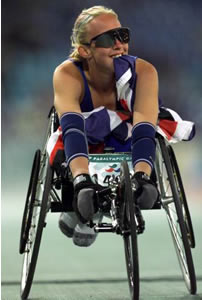
brennan_sydney_main.jpgBut to take a view like that is to miss what we might arguably call the ‘real’ design, the design that’s the product of years (if not decades) of intense research into textiles, alloys, aerodynamics, ergonomics and more. When people talk of the millions of pounds spent on sports in the UK, they may think that all gets spent on training. But it doesn’t. Chris Hoy’s bike, Rebbeca Adlington’s swimming costume, Charlotte Burgess’s bow, and Deborah Brennan’s wheelchair are all the result of investment worldwide in design research.
And then there are the games themselves - everything from the obvious opening and closing ceremonies to the transport networks, the global television feeds, the ticketing systems, the catering, even the queues — all designed.

Design history and theory are no longer simply endless slideshows of the great and the good; pictures of this designer and that piece. Over the next three years you’ll be exposed to, and encouraged to discover, not what’s gone before but what’s possible. DHTP is about the future as much as it’s about the past. It’s also about broadening your view of what design is, from the ‘man on the street’ idea of design as style to something a little more ambitious and all-encompassing. And it’s about encouraging you to pursue a role in the cutting edge through your own research.


If I get the time, I'm going to do a video to go with it too...

Bookmark and Share

Monday, August 25, 2008

Chinese Cooking

After the Olympics closing ceremony yesterday, my friend Qin cooked me dinner - quite an honour! I thought I'd capture the moment so that anyone could follow along at home:


In case you're wondering, it tasted lovely. :-)

Bookmark and Share

Saturday, August 16, 2008

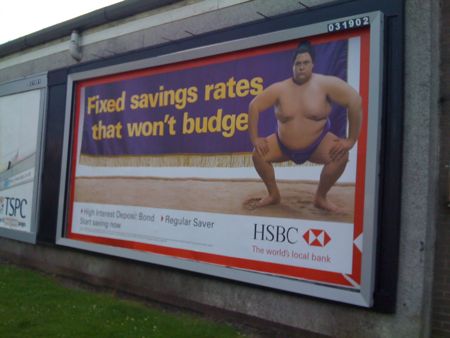
HSBC. The World's Dumbest Bank?

hsbc.jpg


Spotted this ad in Dundee today. A few points spring to mind. Firstly, it's a crap ad (sumo wrestlers do budge - it's the whole point of the sport. In fact they don't half get a wriggle on sometimes...)

But most importantly, given the strapline "The world's local bank" it should perhaps be pointed out to whoever at HSBC signed off on this space being hired that, erm, there is no HSBC branch in Dundee.

In fact, the 'local' branch is a half hour drive away in Perth. Might as well be in Japan - which is the only thing that might help this ad make some sort of sense.

Bookmark and Share

Sunday, April 13, 2008

Creativity

In New Paltz, New York last week I gave a presentation to senior students there on the Master of Design programme at the University of Dundee. One of the core philosophies of the course is its concern with 'design for a changing world'.

I illustrated this by showing a satellite image of the campus, courtesy of Google Earth, showing the proximity of the University's life sciences building to my own office in the College of Art and Design.
On the image I placed two labels, one saying 'Anti-cancer gene discovered here', the other saying 'my office'.

The point I was trying to make was that when it comes to the word 'creative', surely it's the people who work on cures for cancer, among other things, who are engaged in true creativity? Designing logos and leaflets doesn't really compare at all.

It was interesting to note the vigourous nodding of heads at this. I felt like someone explaining this new thing called fire to a group of people bathed in electric light.

At the start of the academic year I asked my new undergrad students to choose a term from a grid I presented on the screen - terms such as 'ageing', 'poverty', 'ethics', and 'disability' - and consider how their own disciplines were affected, or could affect, that particular area.
After a few minutes I asked what people had written.

"What do you study?" I asked one.
"Graphic Design".
"And what did you choose from the grid?"
"Disability"
"So how can graphic design intersect with disability?"
"Well graphic designers can design the signs that go on toilet doors so you know which one is for the disabled".

Now it's easy to laugh at that, and to dismiss the student, but remember this is someone starting out and, to be honest, that's how graphic design represents itself. In the last lecture of the year I ask students to return to that exercise and ask themselves if their ideas have changed - if they have, I've done my job properly.

To a lot of people,'creativity' and 'creative thinking' means exactly what that student said: coming up with good-looking ways to communicate a fact. You're disabled, you want to know which toilet is for you, here you go.

What I think we're trying to do in Dundee (and I'm speaking entirely for myself here) is to change that idea: creativity and creative thinking are about changing attitudes to disability, not designing ways to describe it; about designing the world in such a way that a disability is simply a physical condition, not a way of life or an obstacle.

Can graphic design do that? That's an interesting question - one that makes it ripe for that type of study. The Masters programme is more interested in the question-asking than the answering (although if the questions are answered, that's great of course) and this makes it an exciting course to work on.
Being in Dundee means we're well-placed to interact and work with other disciplines: medicine, law, economics, education, computing, engineering. And in doing so we've in part got rid of the one thing that stops interdisciplinarity happening: disciplines.
So although we occasionally describe a Masters student by the discipline they studied at undergraduate level (graphic designer, textile designer, architect, weaver etc) we don't ask them to identify a problem and say "How can I, as a graphic designer, tackle this?" We ask them to say "How can we, as designers, help tackle this?"
Because designers shouldn't be constrained by disciplinary boundaries, they shouldn't work alone, and they shouldn't claim to know better than anyone else.

Personally I think it's a shame this level of thinking has to wait till Masters, but until the creative disciplines start being creative about their own practice, I don't think that's going to happen anytime soon.

When I was a child I used to be taken to Mass and week after week read the words on the order of service. The longest of sections was the Credo ("I believe"). It wasn't until I was about 13 or so I realised this thing actually consisted of words and sentences, rather than just sounds (Vatican II really not working in my case), and I began to wonder if I actually did believe in these things at all. When I started teaching design I found colleagues telling me how they taught and assessed. Unlike them I'd never gone through 'art school' and so my first reaction was to think "why on earth do you do it like that?" They were reciting the credo, enacting the rituals, despite the fact that the world had moved on and it was clear that few of the methods worked anymore (if they ever did).

While at New Paltz I met the inspirational head of the print-making course. He was lamenting the burden of tradition within his own discipline. I asked him if he knew anything of the English Reformation. At the time, crowds of people went through the medieval churches, cathedrals and abbeys ripping out and smashing statues, icons, stained glass and anything that smelt of Popery. It is widely held to be one of the biggest acts of cultural vandalism the world has seen, and something that set it aside from the more general reformation happening on the continent. Yet it also meant that as far as English crafts were concerned, everything had to start again - there were no models to work from, no statues to copy or paintings to emulate.
This, in part (and until European methods of teaching art and craft invaded our shores) explains why English craft, thought and science developed the way they did. Unburdened by tradition, without the constraints of paying deference to all that had come before, the English Reformation, for all its evils (and there were many) paved the way for innovations we take for granted.

(An historian of the period would no doubt go ashen faced at my summation here but, hey, I'm being 'creative'!)

Design education needs that reformation, a bold sweeping away of tradition. It needs to stop being so disciplined and learn to embrace the mess of fuzzy logic, intuition and sheer creativity that comes from letting go of the past. Whatever was true of design in the 19th and 20th centuries is no longer so true today. We are no longer the 'creative disciplines' because we like tradition too much, and see skills as rituals rather than a grammar - like people intoning a Mass without understanding the meaning of the words they're saying. Or teaching in a certain way without wondering if it does more harm than good.

We can't wait for a Martin Luther or Henry VIII to turn up and change things. We can do better.
Subject area aside there is one thing that separates the 'creative disciplines' from the truly creative disciplines: they eat their own young. By which I mean they identify their best students and they keep them. They continue teaching them, they let them do research, they show them how to teach. And then they let them loose on students and start it all over again.
In design, we identify our best students, spend ages on them so they can win an award or two, help them get jobs at prestigious firms and then either get them in every so often to give guest talks and praise us (after all, we must be good cos look what happened to them) or we wait thirty years until they're burnt out and then ask them to come and teach when they repeat the rituals they went through (after all, they must be good cos, etc etc).

This myth, that only practitioners can teach, has to be ended.
Our Martin Luther is sitting in our courses right now. And there's more than one...

Bookmark and Share

Sunday, March 30, 2008

New York visit

Just a quick update to say I'll be visiting Pratt in New York City on 7 April and State University of New York at New Paltz on 8 and 9 April, when (among other things) I'm hoping to speak to final year design students about Masters study here at Dundee.

Bookmark and Share

Monday, January 14, 2008

A Walk Up The Fife Coast

This VoiceThread tells the tale of a walk I made last summer

Bookmark and Share

Wednesday, September 19, 2007

Mother dies on the same date she was born, engaged and married

The Scotsman - Scotland - Dundee - Mother dies on the same date she was born, engaged and married:

"A woman who got engaged and married on her birthday has died on the same date.

Moira Brodie was born on 16 September, 1938. She got engaged on 16 September, 1959, married husband Peter exactly two years later and died on 16 September, 2007."


As one of the commenters on this article points out, there's nothing supernatural about it. You have a one in 365 chance of dying on your birthday, all things being equal, while the engagement and wedding are deliberate acts, so take those out of the equation and it's no longer quite so spooky and instead just a 'nice' (if sad) story.

Bookmark and Share

Friday, August 17, 2007

Dog exercise is among police FOI requests

The Scotsman reports that my local police service*:

"yesterday revealed some of the more unusual requests made to them in the past two years.

Tayside Police showed under Freedom of Information (FOI) legislation that officers were asked if police dogs used treadmills or exercise machines to stop them becoming overweight, what a beggar's average daily income is and how many parking tickets are given to foreign nationals.

Other bizarre questions submitted to the force included a request for information about an incident in which a flowerpot was 'criminally damaged'.

Another was for details of how many Dundee taxi drivers accessed internet paedophilia sites between the hours of 4am and 7am.

The force was also asked whether it employed psychics to help with the work it carries out. A spokeswoman confirmed they did not.

The health of police dogs seemed a particular cause for concern. As well as being quizzed over their exercise regime, the force was also asked whether the animals became travel-sick, and if so, how they overcame it.

A Tayside Police spokeswoman said: 'All the police dog handlers exercise their dogs several times a day in the normal fashion - by taking them for a walk'."


I'm going to make a request under the act to find out how much time and money is being wasted by people asking such stupid bloody questions.

(* The Scotsman calls it a 'police force' but the corrct term these days is 'police service'. I learnt that watching 'Hot Fuzz' at the weekend - one of the funniest films I've ever seen).

(Via The Scotsman.)

Bookmark and Share

Sunday, August 12, 2007

I fought the Law...


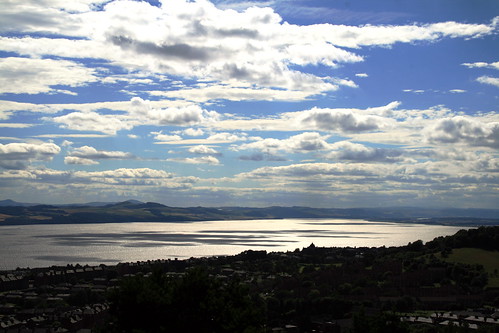
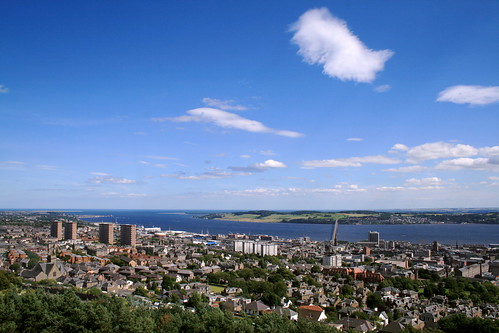
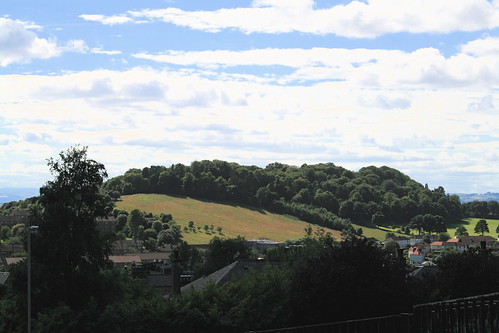
Dundee is dominated by a massive hill (the photo above doesn't tell the whole story - I took it when I was nearly at the top) called the Law (it means 'hill'), formed by the plug of an ancient volcano. A smaller one forms Balgay Hill which is just up the road from me and is home to Britain's only public observatory.


(Balgay Hill, above)

After a year of promising myself I'd do it, I finally got round to walking up the Law the other week and it was well worth the effort. The views from the top are stunning.


The photo above is the view across the Tay (known as the Silvery Tay for obvious reasons) to the Kingdom of Fife.


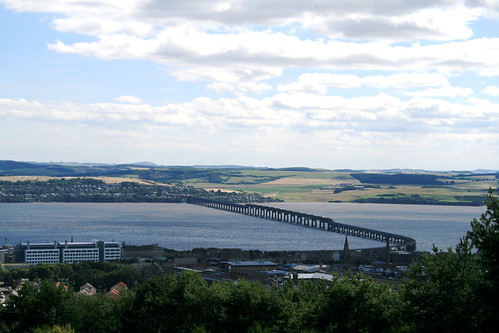
This photo shows the Tay Rail Bridge. The first one collapsed famously one New Year's Eve just over 100 years ago, killing everyone on the train. Spookily, you can still see the original piles next to the current bridge. At the time it was the longest rail bridge in the world and is still the longest in Europe, apparently.
The white building in the bottom left corner is the life sciences building at the university. My office is just behind it.


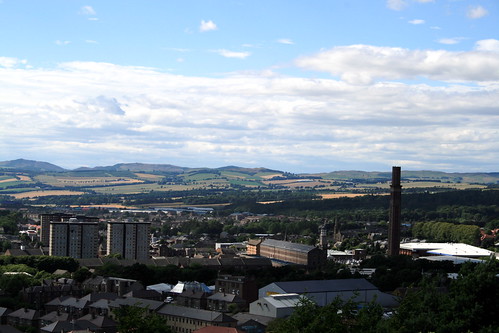
To the north you can see all the way to the Sidlaw Hills, but between here and there are relics of Dundee's industrial heritage. Several of the old textile mills, some of them massive, remain and even where they've been knocked down some of the chimneys remain. Its shipping heritage (Dundee was home to ship builders and Britain's whaling fleet until relatively recently) can be seen in the east of the city.


At the top of the Law is a large war memorial that towers over you, and over the city. The lamp is lit on a few occasions each year, in particular Remembrance Sunday, and can be seen for quite some distance. This photo doesn't do justice to the scale of the thing.


When youreach the summit you can see over towards the east and the mouth of the Tay where it meets the sea. In the distance you can see Broughty Ferry and its castle on the left, and Tayport and its large sandy beach on the right. Just past Broughty Ferry is Carnoustie where this year's Open golf tournament was held.

At the moment a large pod of bottlenosed dolphins is making this part of the Tay its home, as it does each summer.
The bridge in the distance is the Tay Road Bridge that replaced the ancient ferry service connecting Angus to Fife.

You can see all the photos I took here, or as a slideshow.

Bookmark and Share

Thursday, August 09, 2007

Everything's an experience these days

At Dundee airport the other week I stopped at the little coffee cart (it's a tiny airport) and asked for a hot chocolate. Except they don't sell hot chocolate.

No, what they sell is a "hot frothed milk and chocolate experience". Or words to that effect.

Whatever, most of it ended up down the sink because my flight was called (needlessly early as it turned out) and you're not allowed to take hot chocolate, or indeed a "hot frothed milk and chocolate experience", through security in case you're a terrorist.

I suppose it could be a weapon, though hardly a weapon of choice. You could throw it in the face of a member of the cabin crew ("Experience this!" you would shout, presumably) but then you're stuffed. It's all gone and there's still a plane full of passengers, another member of the cabin crew, and a locked door to get through before you reach the pilot.

As it turned out, the flight was uneventful, except for one slightly worrying moment. I was sat next to the emergency exit which, every time that happens, comes with the phrase 'at least it means you can stretch your legs' but for some reason reminds me of those dreams where you're at school naked. (Everyone can see!)

As the plane took off (small plane so very noisy and bumpy) the little plastic cover that goes over the door-pull fell in to my lap. I jumped a bit, as you can imagine. Staring down, and calming down, I noticed it was normally attached via Velcro (which wasn't particularly reassuring, though I suppose it makes sense). All through take-off I kept looking at the now-exposed emergency door release fighting the urge to see how easy it would be to pull it. I mean, that has to be one of the least-tested parts of any plane, doesn't it?

After the plane levelled out I thought about sticking it back on again but had visions of being wrestled to the ground by an over-keen Harrison Ford wannabe who might have mistaken me for, well, a terrorist. So I did something I always wanted to do... I pressed the little button that calls a member of the crew. She appeared instantly (small plane, you see) and looked a bit puzzled (in a sort of 'here we go again' way) when I pointed at my lap. 'It fell off' I said, sheepishly, and she picked it up and stuck it deftly but firmly back on the patch of Velcro before returning to her duties (primarily, it later turned out, stewing the tea - must be why they used to be called stewardesses, I suppose).

Bookmark and Share

Tuesday, August 07, 2007

My feet hurt


I just got back from an 8 mile walk round Dundee using part of the 'Green Circular' route. (Click the image above for a bigger view. The numbers are mileposts - I walked clockwise from my home, down to the Tay, past the airport, up to Invergowrie, then north to Camperdown Park, up to Camperdown House, then south back home. A mix of country path, suburban cycle dirt track, pavement and concrete).

I planned it using a site called 'Map My Walk' which if you do a lot of walking might be worth a visit. There's also 'Map My Run' and 'Map My Ride' for cyclists. It's a nice mashup using Google Maps - I visited it last year when it was in beta and it's come on a long way. Well worth a look.

You can convert your route in to a Goggle Earth file so you can see your seemingly long walk on a global scale. If you're planning a round the world trip this could be just your thing. Here's my walk as a Google Earth file...

Bookmark and Share

Proof that design is important

Dundee University in the news again. And this time it backs up what I was saying about how design at university should be so much more than just producing Mac monkeys, even at undergraduate level.

(I saw some of these images earlier this year and they're a bit 'odd' (I can't think of the word I want - 'odd' isn't right) - they make serious illnesses look almost beautiful...)

(Click here to watch a video)


"Doctors are turning to graphic artists to help patients better understand their illness and course of treatment.

The artists turn medical images from 3D anatomical scans into less formidable forms, suitable for patients.

Trials of the system have shown it can aid understanding and deepen dialogue between patients and their care givers.

The system is also being used as part of a project to raise awareness among diabetics of some of the most serious side-effects of their condition.

'Doctors talk shop, which can be difficult for patients to penetrate,' said John McGhee, a PhD student and 3D computer artist from the University of Dundee, who helped to direct the visualisation project.

The tools and methods used to pass on information about illnesses and cures were as various as the doctors themselves, Mr McGhee said.

'None are that great,' he said.

But, by producing simplified images from detailed MRI scans, for example, patients can get a far better grasp of what is happening inside them, how it came about, and what is being done about it, he said.


(image of cancer cells)

The effect of the images has been used in a study of 18 patients suffering from arteriosclerosis, an illness that causes hardening of the arteries which can, over time, lead to heart attacks and stroke.

Initially, Mr McGhee said, the trial was all about whether the patients - average age 71 - could understand what the images depicted.

But, he said, it proved its effectiveness in other ways too.

'It was about imparting information but more importantly about getting a dialogue going on to help to get the patient discussing what is going on,' he said.

Exposure to the images also helped in subsequent discussions, said Mr McGhee.

'When they talk to health professionals and go armed with better questions and knowledge of their anatomy,' he said.

In a related project, computer graphics derived from medical images are being used in a bid to prompt diabetics to keep an eye on their health.

Run by PhD student Emma Fyfe, also from the University of Dundee, the project has produced a five minute film that explores the effect diabetes has on the retina.

In some cases diabetes can cause abnormalities in the blood vessels serving the retina and make sight deteriorate.

It was important for diabetics to have regular scans to catch the side effects of diabetes at the earliest opportunity, she said.

'If they catch it early they can stop it,' said Ms Fyfe. 'But they cannot go backwards; they cannot cure it.'

The film has been shown to the Scottish Diabetes Group and there are plans to show it to other groups around the UK.

The research was shown off at the Siggraph computer graphics convention being held in San Diego, US from 5-9 August."

Bookmark and Share

Monday, August 06, 2007

Dundee 'most cost-effective place to study in Scotland'

The BBC is reporting that according to the Royal Bank of Scotland

"Dundee is the most cost-effective place in Scotland to study, according to a survey of students' spending habits.

The city came top in a value-for-money comparison, ahead of Glasgow, St Andrews, Aberdeen and Edinburgh.

The research from the Royal Bank of Scotland (RBS) found Dundee had lower living costs and higher wages for part-time jobs.

The report said students in Dundee could be more than £1,100 a year better off than those in the Scottish capital.

The survey found that the average Dundee student would spend £134 on rent and bills, and earn £113 in one week."


So now I know what to say about any complaints from students when we ask them to buy the occasional book...

Bookmark and Share

Saturday, August 04, 2007

Dandy comic ditched


When I moved up to Dundee, one of the things that gave me a thrill was the fact it was home to The Beano and The Dandy amongst others, and I often walk past the printing works and take in the smell of the presses...


But according to the BBC:

"The world's longest running comic, The Dandy, has ceased to exist in its traditional format.
The weekly title has been changed to a fortnightly magazine called Dandy Xtreme.

Dundee-based publisher DC Thomson confirmed the comic had been given a major facelift in its 70th anniversary year.

It said favourite characters such as Desperate Dan would still feature in the central pull-out, Dandy Comix.

DC Thomson said the format of the publication had been updated because of feedback from readers.

Dandy editor Craig Graham said: 'Following extensive research, we discovered The Dandy readers were struggling to schedule a weekly comic into their hectic lives. They just didn't have enough time.

'They're too busy gaming, surfing the net or watching TV, movies and DVDs.'"


It's a sad day indeed.


Especially as they seem to have spelt 'Comics' as 'Comix'...

Video here

Bookmark and Share

Visit my 'official' site

www.jonathanbaldwin.co.uk
contains links to my articles and books.

Tags

Books by Jonathan Baldwin

Visual Communication: From Theory to Practice (Winner of 'Best Higher Education Title' at the British Book Awards 2006) by Jonathan Baldwin and Lucienne Roberts Buy from Amazon.com Buy from Amazon.co.uk

More Than A Name: An introduction to branding by Melissa Davis and Jonathan Baldwin Buy from Amazon.com Buy from Amazon.co.uk

Followers