If you love Helvetica this much, here's a screensaver for you...

Just a quick update to say I'll be visiting Pratt in New York City on 7 April and State University of New York at New Paltz on 8 and 9 April, when (among other things) I'm hoping to speak to final year design students about Masters study here at Dundee.
Marvellously, The Apprentice brings with it a welcome return of moronic businessisms, as candidates trot out trite examples of things that sound fine in brightly coloured motivational books, but idiotic when tumbling out of mouths.
A favourite is the search for the highest percentage. You may have thought that the highest percentage would be 100, but that would be naive and non-managerial.
For some time, it has not been enough to give 100 per cent effort. To impress, nothing less than 110 per cent is necessary. Or 150 per cent. Or 200 per cent. Percentage wars have broken out and 1,000 per cent is bandied about.
At this point, the notion of percentage flies out of the window and the contestants find themselves stuck in a 'who can think of the biggest number' competition. These are, apparently, some of the best new business minds in the country. Which terrifies me 38,476 per cent.
When Heathrow Airport's terminal 5 opened it was hailed as a marvel of engineering and design. Now that it's all descending in to disaster, everyone seems to be blaming British Airways and the British Airport Authority. Why not the designers?
Take a look at this excerpt from The Guardian:
The overnight BA inquest looked at how luggage was loaded on and off the airplanes - one of the biggest failures in Thursday's fiasco.
According to airport sources, the baggage hold-ups were caused by handling teams being in the wrong place to pick up checked-in bags, which had been delivered down chutes from the main conveyor belts.
If those bags are not picked up and loaded on to planes, the sources added, the chutes become full and the conveyor belt overloads.
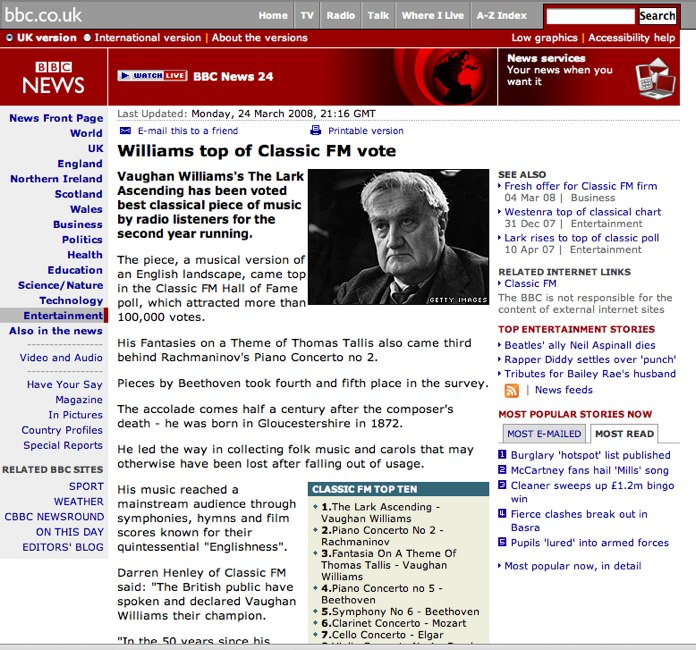
The BBC is reporting that The Lark Ascending is once more the 'best classical piece of music' for Classic FM listeners. Not sure about the best but it's certainly a great piece. In fact, I might just have to play it right now...
But look at the headline: Williams top of Classic FM vote. Never heard of him.
I just emailed the web site editor to correct it (9.35am) and will now refresh the page every minute to see how long it takes to change it...
UPDATE: It worked:
The number of school leavers is expected to plummet over the next 10 years, leaving 70,000 university places unfilled - the equivalent of nearly six universities.
Universities will have to compete harder, target more mature students and those from outside the EU to fill seats in lecture halls as a historic dip in the birth rate translates into fewer student numbers, vice-chancellors said.

I started writing a post on this subject and it got to a 1000 words. Then I thought a picture would do so cobbled this together. It sums up my thinking far more concisely.
Click the image for a larger version.

'I honestly don't feel I have learned much. It's too much theory and not enough practice. I'm learning about out-of-date technologies.'
John, 22, loathes his degree, a BSc in network computing. He says his main reason for applying to do the course was that it would lead to a good job.
Tom, 22, wasn't thinking about jobs when he decided on a BA in 3D design and materials at Brighton University. 'It's the best course ever,' he says. 'I think about it all the time. I came to university not to get a piece of paper that proved I had a degree, but because my subject seemed like the right thing for me to do.'
Which student is more typical of undergraduates today - the one who chooses their degree for the love of it or the one who's thinking about job prospects? It's the latter, vice-chancellors and lecturers told Education Guardian this week.
They say undergraduates these days do not necessarily expect to love their subject the way they did a decade or more ago.
Professor Patricia Broadfoot, head of Gloucestershire University, and Professor Michael Thorne, head of Anglia Ruskin University, admit their evidence comes from talking to students, not hard data.
They give three main reasons why student attitudes have changed:
· Students have taken on board the government's message that a degree is a passport to the world of work;
· A ceaseless concentration on exams and coursework in school stops pupils cultivating a love for a subject;
· Tuition fees have led some students to think exclusively about the financial return on the cost of their degree.
Of course, a lot of students do feel passionate about their degree subjects, as Tom does, the vice-chancellors say. 'Many do PhDs, and that is proof of real love for a subject,' says Thorne. 'But the majority are now there to work within the confines of the course, and aren't prepared to go outside them.
'Students arrive at university focusing on jobs; that is the most important thing to them. We are seeing more and more of an attitude of 'if it's not in the exam or coursework, I'm not doing it'. You can't expect students to read around a subject for the love of it any more.'
(Via Read the rest....)
According to the BBC "A quarter of adults have difficulties with mental arithmetic, a survey suggests."

 Visual Communication: From Theory to Practice
(Winner of 'Best Higher Education Title' at the British Book Awards 2006)
by Jonathan Baldwin and Lucienne Roberts
Buy from Amazon.com
Buy from Amazon.co.uk
Visual Communication: From Theory to Practice
(Winner of 'Best Higher Education Title' at the British Book Awards 2006)
by Jonathan Baldwin and Lucienne Roberts
Buy from Amazon.com
Buy from Amazon.co.uk


