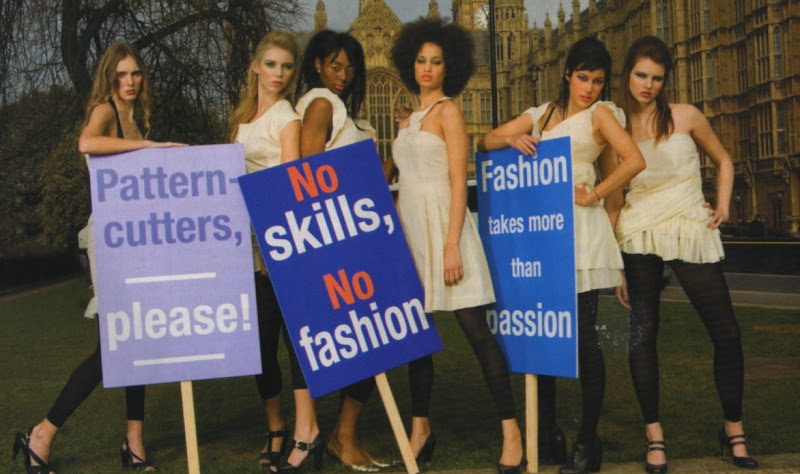
On February 11, during London Fashion Week, Skillfast-UK staged a mock protest outside the Houses of Parliament in which models dressed in toiles (the technical mock-up of a garment) waved placards calling for, among other things, ‘pattern cutters, please!’ A press release sent out to the media entitled “Research Warns: Lack Of Technical Skills Threatens London Fashion Week” gave more detail:
“Today MPs including Skills Minister David Lammy threw their weight behind a new campaign “No skills, no fashion,” launched by Skillfast-UK, the Sector Skills Council for the fashion and textile sectors. The campaign aims to encourage fashion colleges and universities to put more focus on pattern-cutting, garment construction and other technical fashion skills.”
Lammy was quoted as saying “The Government is committed to increasing the level of skills training and advice available to employers, as well as encouraging colleges and universities to form partnerships with local companies to ensure young people are equipped with the specific skills they need to succeed”
The campaign has so far gone unchallenged. But they contain a series of assumptions and misconceptions, as well as signalling a somewhat dangerous approach to the concept of ‘skills’ that is more of a threat to London Fashion Week than anything Skillfast-UK have identified.
At a very basic level, the questions we need to ask are these: if the fashion industry needs pattern cutters, why doesn’t it train some? Why does it expect degree programmes to do it? And why is the fashion industry recruiting graduates to be pattern cutters anyway? This is like asking history courses to award degrees to students who can colour in pictures of the Battle of Hastings without going over the lines.
In medieval times the trades and crafts established guilds, in part to retain independence from the role of the church in education. Taking control of who could practice, and what standards they had to achieve in order to do so, was vital to not only maintain quality, but to control demand, respect and prices.
Membership of the guild required the completion of a period of apprenticeship, resulting in an apprentice piece demonstrating the apprentice’s abilities. Successful completion of this period would result in entry to the profession, but starting at the bottom and undertaking another, higher level, apprenticeship.
Over time this responsibility for training, which involved broader in loco parentis roles, was passed to technical schools and colleges. The ‘contract’ between employer and college was that the latter was now taking on responsibility for training potential entrants to the profession to an accepted standard.
As educational provision expanded, and as courses began to develop in to degrees, the nature of this relationship changed. Degrees are not intended to train people for specific jobs but for a range of possible futures. And the number of students on such courses expanded to suit demand, destroying any link between the ‘need’ for new workers and the ‘supply’.
Meanwhile demand from students for vocational qualifications dropped in relation to degrees, and so the supply of the sort of entry-level worker began to dry up. But as degrees became more popular, they began to be seen as the basic requirement for entry to the profession and, as a consequence, a mismatch developed between what employers assumed degrees were for (apprenticeships) and what they provided (a liberal education).
The end result is that the ‘guilds’ are seeking to reclaim their authority over the ‘church’ (academia). But they are doing this not solely by developing an alternative (a new apprenticeship) but by simultaneously demanding that degrees become apprenticeships, imposing a set of standards on them that weaken any distinction between a degree and a vocational training-based qualification.
The danger is that degrees seeking approval from the trades will no longer offer broad liberal qualifications, and will restrict their numbers closing the study of design to anyone except would-be designers. Apart from the fact this would call in to question their status as degrees, it also flatly contradicts the need identified in the Cox Review for ‘design thinkers’ to populate all aspects and levels of society and industry.
The obvious solution to industry’s ‘need’ for core, basic and entry-level technical skills is for industry to initiate a new form of qualification - which they appear to be doing via the Creative Apprenticeship - and allow degree-level provision to remain independent, looking forwards and educating free-thinking and independent graduates who can transform the industry quickly, rather than entry-level employees who might take 5-10 years to emerge in to management roles.
According to Skillfast-UK “In the UK, approximately 3,000 students graduate from fashion courses each year – yet top designers and clothing brands say they struggle to employ quality staff, because new recruits lack the technical skills and production knowledge to turn their creative ideas into achievable designs”
On the face of it this sounds rather damning. But stop for a moment and think through this logically. 3,000 fashion graduates every year? According to Skillfast, (
http://www.canucutit.co.uk/top-tips.cfm) “the supply of fashion design graduates outstrips industry demand by about 600%” (which means that there are only around 500 jobs each year, something that sounds unlikely, but let’s take their word for it). That means there are six candidates for every job. And out of those six, some employers are unable to find people with the right skills? How hard are they looking?
This is plainly rubbish, but sadly pointing out the obvious isn’t enough so let me try to explain through logic (if not in fact, as this requires more research) why I’m sure that Skillfast-UK are wrong in their assertions, and their strategy. And as a matter of convenience I’ll also try to show why the whole design industry seems to be getting things wrong when it comes to graduate recruitment.
Pop along to
Careersbox.co.uk and you’ll see an interview with Linda Florance, head of Skillfast-UK. It contains some revealing information:
http://www.careersbox.co.uk/video/skillfast.wvxMy interpretation of it is this: the fashion and textiles industry is in need of bright, talented, ‘young’ people from a range of disciplines. It requires people skilled in marketing, in technology, in chemistry and so on. Some of these people will develop new products and markets, and take British fashion and textiles in to new markets.
Oh and they also need ‘creative’ people to make things that look nice.
In other words, this is an industry that values and craves graduates in all sorts of disciplines, but undervalues fashion and textiles graduates, seeing them in very narrow terms.
Part of this relates to the problem that the design industry in general simply hasn’t grasped yet what the value of a design degree is. Evidence for this can be found on the canucutit.co.uk site, where potential employees are told “you are highly unlikely to walk straight into your dream job therefore show that you are willing to start at the bottom, will listen to others, are not afraid of hard-work and will be dedicated to the job.” This ‘start at the bottom’ attitude is typical of the design industry but what’s most disturbing is that this is the advice given to Masters graduates!
The salary new entrants are tempted by, for this ‘start at the bottom’ opportunity is just £12,000. Compare this with Arcadia, Britain’s biggest fashion retailer where graduates are offered £20,000 and a structured, fast track training scheme leading to a management position within a year. Next, the retail fashion chain, offers pretty much the same along with share options and health insurance. Not bad.
Given a choice between working in fashion as a buyer for £20,000 or being expected to ‘work your way up’ from cutter for £12,000 a year, what do you think a lot of graduates will say? Could this be why “top designers and clothing brands say they struggle to employ quality staff, because new recruits lack the technical skills and production knowledge to turn their creative ideas into achievable designs”. It’s nothing to do with the skills or the quality of the graduate, it’s more to do with the attitude of the employers, still stuck in 19th century ways of doing things and seeing ‘production’ as the least important part of the business and - worse - design graduates as shop floor fodder.
An industry that rapidly promotes graduates is likely to be one that develops quickly and stays ahead of the competion.
And industry that hides its graduates away until they emerge after years of working their way up is likely to be one that is overtaken by the competition. And this is exactly what is happening with the design industry, according to their own predictions. But apparently it’s all the fault of universities…
The design industry doesn’t value design graduates. There are glowing exceptions but these do rather prove the rule. It should also be remembered that the big fashion houses we talk about are actually not representative of the industry as a whole which is not the modern, high class vision we tend to see promoted in the media.
Design graduates are seen as entry-level employees because, among other things, a lot of design courses see their role as producing entry-level employees. Too many degree courses turning out graduates who are trained to very narrow ideas of what a design graduate is for.
It could be argued this is not restricted to design, and that the general ‘oversupply’ of graduates is a universal problem wherein “Many graduates are doing fairly menial jobs for which they do not need a degree (or anything like it)” (Fantasy Island p. 78) But a quick overview of destination figures for graduates from UK universities shows that those who study non-design subjects are more likely to enter graduate-level employment than those in design subjects. Even the usual claim that many undertake part-time work while developing their practice appears not to be borne out by longitudinal data and, anyway, surely a graduate could undertake a graduate-level job while doing this instead of working full time behind the counter in a chemist?
Perhaps the answer is that we are either not equipping our graduates with truly graduate-level skills (a skill that can only be exchanged within a closed system is not really a skill at all but an ability) or we are producing graduates who think, rightly or wrongly, that they are only qualified to work as designers, or failing that as shop assistants.
In this sense we need to ask what a design degree is for. What do four years at university offer that couldn’t be gained on the job? On the face of it the only attractions are the social life and the debt.
There must be something more distinctive about a degree.
Charles Handy in
The Elephant and the Flea describes how his classics degree landed him a job in an oil company where he quickly became an economist. He realised then that his degree wasn’t so much a license to practice, but a license to learn.
Angela McRobbie in
British Fashion Design: Rag Trade or Image Industry? notes that graduates from London fashion courses who were most successful achieved their success not by using skills learnt in college but by using the cultural and social capital they had developed incidentally. This use of social and cultural capital was also identified as a key factor in the cultural industries by the French sociologist Pierre Bourdieu.
Even outside design, the most valuable contribution university makes to a person’s future has long been recognised as the network it gives you - it’s not what you know, it’s who you know. Of course, with the expansion of higher education and the focus on skills, the one thing that has clearly disappeared from university life is the time to build this important capital investment - another contributor perhaps to the decline in ‘quality’ graduates, perhaps. Too skilled, not enough nous.
But all these ‘incidental’ or even ‘accidental’ benefits aside, why else would someone go to university? I’ll come to that question later because it’s becoming even more urgent.
Skillfast-UK’s cognate sector skills council is Creative and Cultural Skills which covers many of the other design disciplines and the industries that use them. It has been working with The Design Council (too closely, some would suggest) and in 2007 published High-level skills for higher value, a policy document outlining some issues and strategies for developing skills in the design sector.
The document outlines that the design industry needs to develop its base of knowledge (not ‘skills’ - a key differentiator I’ll come to later) in cultural awareness, global awareness and business awareness. These are undeniably important.
But the report cancels this presience out by going on to say that university courses need to focus on technical skills and on business skills such as accounting and business planning. To explain why this is a little odd, imagine if accountancy degrees suddenly had to teach students typography…
Go back to what I said about ‘global awareness’ and ‘business awareness’. This is about understanding how design impacts on different cultures and how it is itself affected. It’s about understanding the effects of globalisation and the threats and opportunities it offers. We could teach that on design degrees - in fact we’d love to. But when it comes to teaching ‘business skills’ we actually focus on showing students how to use Microsoft Excel and how to write a business letter. Or we do to those who bother to turn up because, even though we’re accused of not teaching these things, the sad truth is we do, but students vote with their feet and don’t come. Don’t blame us, blame students!
But is this really what the design industry needs from graduates? People who can create a simple spreadsheet but don’t know why they’d need one? Especially if their job has been taken by someone from abroad who thinks business is a little more complicated in today’s world than just working out how to create a macro?
The design industry does need higher level skills, and degrees are exactly the place to develop them. But where’s the incentive when our graduates are being taken in to such crappy jobs and when we’re brow beaten in to dumbing down our courses into a check list of low level ‘skills’ like pattern cutting in fashion and its equivalent in other disciplines?
The content of a ‘core curriculum’ is a tricky one. My first job interview was for a job as a layout assistant for a small design firm in Harrogate. I went along with my portfolio containing the sort of thing they did - a series of two-colour leaflets I’d done for my local MP’s constituency office.
The only trouble was, I’d done them using Pagemaker on a Mac Plus. This was 1989 and the technology was still very new. The owner of the business gave me a long lecture about how I’d wasted my time learning how to do it on a computer, and that he needed someone who knew how to use Cow Gum. (For those who don’t know these things, graphic design included the ‘paste up’ process where artwork was cut up into pieces and laid out on paper or board using a type of glue that kept things in place but allowed you to reposition things and peel them off again).
In fact I’d been taught (or rather, as is often the way of things, left to find out) how to use Cow Gum and was not bad at the job. It’s just that I wasn’t overly bothered with it, given as I’d seen ‘the future’ as it were and could think of much easier ways to do the job. But for this guy, there would always be a need for people with traditional skills that would never die out.
I meet people like that all the time but over the years they’ve gone from protesting about the need to learn how to stick things down with glue to learning how to process film, how to program in Lingo, how to use Pagemaker, how to… you get the picture. For every profession there’s someone who thinks the way they do things is the only way, and always will be. Some people are simply sad that traditional crafts will disappear, and I can understand that, and sympathise, but the role of higher education is not really to keep ancient technologies on life support but to advance things. We won’t lose the skills, they’ll be reborn and rediscovered.
Let’s go back to Skillfast-UK and their Westminster protest. This is what they had to say about it: “To make it to the top in this competitive business, you need the skills to turn a great idea into a practical garment that can be produced and sold.”
Let’s rephrase that. To make it to the top in the old days, you had to not only design it but make it too. Maybe that’s not the ideal way of doing things? It’s certainly not the way things are done in the countries that are apparently about to drain the lifeblood out of our fashion industry. Employing someone to design and make clothes makes one wonder if the fashion industry ever heard of Adam Smith and his peculiar obsession with pins.
But let’s get one thing clear. I’m not suggesting that a fashion designer doesn’t need to understand how clothes are made, and I can imagine how a designer who makes the clothes will have a deeper understanding of the process than one who doesn’t. (Although I don’t think it’s a given). But it may help to take a slight diversion in to the world of architecture for a moment.
Some time ago I was discussing this issue with some Masters students, one of whom was a graduate in architecture. “You were taught how walls are constructed, weren’t you?” I asked her. “Yes,” she said. “And about load bearing, stresses, and different materials?” “Yes”.
“But you weren’t taught how to lay bricks, were you?” “Of course not”, she replied.
And there’s my point. There’s a difference between an architect - a designer - and a brickie. You don’t go to university for four years (more, in fact, for architecture) to learn to lay bricks, and if the construction industry stopped training brickies and instead waited for them to graduate, there’d be no construction industry. And if it recruited architects and put them to work laying walls, the same thing would happen: bye bye construction industry.
So why does the fashion industry expect its architects to be brickies? It makes no sense.
Maybe though design education does have a lot to feel guilty about. Industry thinks architects should be brickies first, and so do we.
We construct courses based around the idea of an apprenticeship and the linear accumulation of knowledge. There are certain things it’s essential to know before you can move on and learn the next thing. And then when you’ve done if you’re lucky you can go into industry and start at the bottom and work your way up.
That’s how it was for us, and that’s how it will be for you. And then if you ever become a teacher that’s how you’ll do it because that’s the way of things.
Except it isn’t. Or it shouldn’t be.
The design industry is vibrant but it’s under threat. And the reason it’s under threat is not because of a lack of technical skill, it’s because all these wonderful thinkers are recruited in to firms that then put them to work in beginners jobs. They’re lost, and their knowledge is wasted because - well maybe because the old timers who worked their way to the top feel threatened?
Design educators need to educate employers about the true potential a design graduate can bring a firm. We need to stop training employees who then undergo yet another apprenticeship and instead start educating game-changers who’ll transform the industry and take it forwards.
And if we don’t do this because philosophically we know it’s the right thing to do, then we’re going to have to do it because we ourselves are under threat. There are some new boys on the block and they make four year degrees look like a complete waste of time.
There have always been alternatives to degrees. In fact, the design degree is relatively new on the scene. You don’t need a degree to be a designer: I was a successful graphic designer for ten years and my degree is in history.
But over the last few decades the design industry has begun to see degrees as a key entry requirement.
This is changing. The Foundation Degree was launched in the early part of this decade and has replaced the old Higher National Diploma (HND) in England, and is likely to do the same in Scotland. The HND was a good old fashioned vocational qualification (whereas the BA is supposed to be an academic qualification). Its purpose was to train people to work in certain industries. There’d be an academic element but many courses paid little attention to that. After all, why do you need to write an essay if you’re going to be a designer?
The Foundation Degree (FdA) is a slightly different beast. For one thing the academic aspect is more heavily emphasised, on paper at least. It incorporates formal work-based learning, and it is designed to be studied part time by people working in the industry they’re learning about. In that sense, it’s a lot like the old ‘sandwich courses’ people used to do, working three days a week and then going to college to learn the trade for two days a week. Finally, it’s two years instead of three or four for a degree.
Despite a lot of criticism, the FdA has been very successful and there are thousands on offer around England, many of them in creative disciplines.
As an alternative to a degree it scores on several points. Firstly, it’s work-based. Secondly, it’s two years in length. Thirdly, and perhaps most importantly, it offers exactly the same curriculum as a four year degree.
I’ll say that again:
there is nothing to distinguish a Foundation Degree from an Honours Degree. But there should be.
A former colleague of mine once described a degree as an HND with a bit more writing, the purpose of the extra year being to get a bit more practice and a bigger portfolio for job interviews. That view is entirely wrong, however it’s not uncommon for people to see the extra year or two spent on a degree as a chance to refine skills rather than extend knowledge and understanding.
It’s the fact that we can’t seem to explain what it is that doing a degree offers over a Foundation Degree that poses the biggest threat to our recruitment - and to the employment of our graduates. Ignoring the cultural and social capital, which most of us do anyway, what does an honours graduate have that an FdA graduate doesn’t, apart from a bigger overdraft?
It’s not just the FdA that poses a threat. In the last few years the ancient concept of the apprenticeship has been reborn (as the ‘modern apprenticeship’) and marketed to kids who don’t want to, or wouldn’t be able to, study at college. An apprentice goes to work with a firm where they are trained, and that training is accredited leading to a qualification.
At the moment there are apprenticeships in areas that overlap with design subjects, including graphics, jewellery and textiles.
But in the creative disciplines the apprenticeship is about to be replaced by: the Creative Apprenticeship.
The Creative Apprenticeship has been developed by industry and is backed by some big names including Aardman Animations and the BBC. Within graphic design and advertising there will be apprenticeships that give young people the opportunity to leave school and start work - paid work - with a leading company, being trained on the job.
While the plain old apprenticeship is perhaps aimed at those who might be perfectly competent, it’s likely the Creative Apprenticeship will attract ‘high flyers’ - exactly the sort of people design courses used to prefer. After all, if you’ve got the choice of going away to university to study design, or going to work in the BBC’s graphics or scenery departments, which would you choose?
The UK Government announced (22 February 2008) there would be 5,000 apprenticeships of this kind available at first - that’s a significant figure when compared with the number of applications to study design at university.
So with FdAs being aimed at vocationally-minded students, Creative Apprenticeships being aimed at vocationally- but not study-minded young people, and modern apprenticeships being aimed at the educationally ‘disaffected’, what does that leave for design degrees?
Well if we do nothing, it leaves us in a mess. But if we do something it leaves us with an opportunity.
And this to me is what was so exciting about
some of the outcomes of the New Views 2 conference - a large gathering of academics and practitioners in London that really seemed to conclude that something has to change, that degree-level and postgraduate design education has to resist the political push to follow industry, to see its role as training workers and instead do what they do in other disciplines: lead, innovate, transform. The British design industry makes big claims about its contribution to the economy and says this gives it rights to demand things of universities and colleges. But the UK higher education sector takes every £1 of taxpayers' money and turns it in to £5 - it contributes far more to the economy than design does. If this were a pissing contest then it should be the design industry asking universities how they can help rather than the other way round. But this
isn't a pissing contest. So let's stop the sort of language that permeates the websites and publications from Skillfast and Creative and Cultural Skills.
An industry that says it is under threat from external competition and poor skills firstly needs to put its own house in order: start paying decent salaries (in fact, just start paying salaries - asking design graduates to work for free is criminal), and start offering decent career paths with proper training. Start recruiting talented graduates into graduate-level roles instead of letting them disappear into entry-level jobs. And start doing what other industries do: treat universities with respect instead of disdain and recognise that what they have to offer is not an endless supply of pattern cutters and Mac monkeys but innovation and understanding. You don't see the biomedical industries demanding that universities churn out lab technicians; you see them encouraging research into cures for cancer, and lapping up graduates taught within that culture of research-led, not industry-led, teaching.
Imagine for a second what a design industry with that sort of relationship with universities could be like. Then stop imagining and get on with it.




 Visual Communication: From Theory to Practice
(Winner of 'Best Higher Education Title' at the British Book Awards 2006)
by Jonathan Baldwin and Lucienne Roberts
Visual Communication: From Theory to Practice
(Winner of 'Best Higher Education Title' at the British Book Awards 2006)
by Jonathan Baldwin and Lucienne Roberts
 More Than A Name: An introduction to branding
by Melissa Davis and Jonathan Baldwin
More Than A Name: An introduction to branding
by Melissa Davis and Jonathan Baldwin