A blog about design, education and anything else that takes my fancy

Monday, January 14, 2008

"Graphic design? That's for students who are thick!"

According to The Guardian:

Schools will be ordered to offer impartial careers guidance to pupils amid concerns that teachers' 'sexist' attitudes are promoting hairdressing courses to girls and construction apprenticeships to boys.
The education bill due to be debated in parliament today will also force schools to promote all qualifications to pupils equally - including the new diplomas which ministers hope will eventually replace A-levels.

The moves are part of a drive to improve careers advice before the school leaving age is raised to 18 in 2015 under the central proposal of the education bill.

The children's secretary, Ed Balls, said: 'I'd like to see all young people considering a range of options before they decide what career path to go down. I want more young women being encouraged and supported to have a career in engineering and more young men being encouraged to have a career in childcare.'


I wonder if this will have an impact on design? Does it need to?
At the moment I guess product and graphic design have a 50/50 split between male and female students (at my last university there were more female students studying graphics than male IIRC). But more craft-based subjects are still dominated by women.
I'd be interested to know if this is a result of careers advice at school, peer pressure, or selection procedures at colleges.

Yet in the graphic design industry, it does seem that despite the even split at university, the 'girls' disappear so maybe it's not school careers advice that's the problem?

Having said that, gender issues aside, it would be nice just to get careers advisors to understand design a little better - but that's not their fault, it's the industry's.

Attitudes can be changed quite easily. A few years ago I gave a talk to an open day audience of potential students for a graphic design degree. Most of the questions, of course, came from the parents who weren't entirely convinced their kids were making a wise choice.
In my talk I bigged up the intellectual aspects of studying design, to make it sound less 'dumbed down'.

At the end, as everyone was leaving, a woman stayed behind. She introduced herself as being from the local schools career service. "Thank you for that talk, it was really interesting" she said. "Up until now I'd assumed graphic design was for students who were thick!".

Bookmark and Share

Saturday, January 12, 2008

Selecting versus recruiting in the design industry

Kevin Stolarick points out something I've been wondering about for a while over at Creativity Exchange:

Employers want the employees and the skills they provide ... but don't have any real understanding of what they really want.  Failing to develop that understanding means retention is an issue.


This chimes with my guess that when employers claim that graduates aren't as good as they could be (something that drives Creative and Cultural Skills's agenda to replace academics with practitioners in design education) what is really happening is that their recruitment policies are at fault. (If you recruit someone and they're not very good, look at your recruitment procedure before you blame the teachers).

Hiring graduates without firstly thinking what you're going to offer them beyond a job you think they should feel lucky to get is not a way to recruit talent, and I can't help feeling that people who complain there's a lack of quality graduates only have themselves to blame - those quality graduates do exist but are giving them a wide berth.

Certainly I've known a few former students of mine turn down 'opportunities' (read 'unpaid work experience with no guarantee of a job at the end of it') at supposedly 'good' agencies in return for jobs that offer decent money, responsibility and - most importantly - a life.

In universities there is a difference between a 'selecting' course (one which has more applicants than places and can filter through to get the most promising students) and a 'recruiting' course (one which has to offer more places than there really are in order to fill it because a certain proportion will turn them down).
I wonder if this is what's happening in industry? It's not a lack of talent, and therefore the fault of courses and teachers, but a lack of appreciation of what it takes to get and keep quality employees. And a lot of businesses aren't used to making the switch from the filtering and selecting method of finding staff to that of active recruitment and retention.

Bookmark and Share

Thursday, January 10, 2008

Wednesday, January 09, 2008

Helicopter parents

I like the term "helicopter parents" for those who hover over their children while at university - it's something we're getting used to, especially at open days and interviews. But this Guardian article suggests that they're now popping up at recruitment fairs and negotiation with employers on their offspring's behalf:

It's the hectoring call that university tutors have learned to dread: 'Now, about my son's/daughter's latest assessment - that B grade clearly can't be right.'
They've been at their student children's open days, interfered with the Ucas form and swooped in to challenge anything from essay marks to college accommodation.

Meet the helicopter parents, so-called because they hover over their children, interfering and directing their lives in a way that would probably have embarrassed standard pushy parents.

A phenomenon already established in the US, British universities are now beginning to suffer at the hands of the new breed, particularly at careers fairs.

Helicopter parents oversee their child's first graduate job application, prep them for tests and interviews - and have even tried to renegotiate starting salaries.

Paul Redmond, head of careers at Liverpool University, said their arrival was evident at careers fairs across the country last year, and that some students had been barged aside. 'In future we will have to be more open and say it doesn't look particularly impressive to have your parents with you at a fair,' said Redmond.

'Several high-profile graduate recruiters have reported incidents where parents have contacted them to negotiate a starting salary. Others have had parents contact them to complain about a 'child' who has been overlooked for promotion,' he writes on EducationGuardian.co.uk.

Companies have also complained that recent graduates have had everything done for them by their parents - to the point where they cannot get to a meeting. 'One senior investment banker told me how recruits in her firm were unreliable when it came to attending off-site meetings,' said Redmond. 'Despite picking up salaries well in excess of £30,000, their attendance could never be guaranteed.'


(Read in full)

Bookmark and Share

Headteachers' views on the new 14-19 diplomas | Schools special reports | EducationGuardian.co.uk

A worrying report from The Guardian for the 14-19 Diplomas due to launch this year, one of which is aimed at the creative industries. Seems that heads are either lacking in knowledge of the qualification, or highly sceptical of it. I suspect the same is true of employers and universities, although they at least have three or four years before they'll start to see applicants with the qualification. Schools, however, are a different matter as they're supposed to be offering this to pupils in a few months.

The response from the government in the article seems somewhat blasé.

The government has a long way to go to convince secondary headteachers that their new, and much trumpeted, diplomas for 14- to 19-year-olds will be a success. This was one of the findings of a survey, published for the first time today, of 803 UK primary and secondary heads' views.
The study, which quizzed heads on diplomas, social services, school trips and other topics in November and December, was carried out by Education Guardian and educational consultants EdComs, and administered by ICM.

It reveals that the majority of heads are cautious at best when it comes to the new diplomas, which will be offered from September. None of the secondary heads told pollsters they would definitely recommend the qualification to a student aspiring to go to university.

While the government's chief qualifications and curriculum adviser, Ken Boston, has described diplomas as 'the biggest development in examinations anywhere in the world', heads are playing it safe before diving in.

More than a third of heads (35%) said they had not entered into a consortium of schools, further education colleges, businesses and other organisations to work together to deliver the diplomas. This is despite the fact that by 2013, a quarter of all 14- to 19-year-olds are expected to be sitting the qualification, and that five types of diploma begin next academic year.

Ninety-three per cent of heads told pollsters that parents and pupils were 'not knowledgeable' about the new qualifications. In fact, 19% said they themselves were 'not very knowledgeable' about it. Two-thirds said teaching staff at their schools were 'not knowledgeable' about them and 79% said the same for local employers.

This might be one of the reasons why 58% of heads said they had failed to garner support for the diplomas from local employers and were 'unsatisfied' by the interest businesses had shown in them.

And, worryingly, almost a third of secondary heads (31%) are in the dark about what diplomas actually are. They described them as 'a vocational qualification, leading straight into employment'. In fact, they have been designed as a cross between the vocational and the academic. The most advanced diploma carries a higher score for university entry than three As at A-level.

Just 24% of secondary heads thought they would provide the academic rigour for progression to university.

When asked what the two biggest challenges for the diplomas were, the most frequent responses were getting university endorsement (46%) and getting parental endorsement (31%).

Mike Best, head of Beaminster secondary school, a mixed comprehensive in Dorset, took part in the survey. He says its results show 'the future of the diploma is not clear as far as heads are concerned'.

Bookmark and Share

Sunday, January 06, 2008

"one thing you learn is how to bullshit and talk in intellectual sounding ways when describing your work"

From 2blowhards.com: Art School Confidential:

I really dont understand the point of art schools anymore because according to most art professors and critics, art is solely about creativity. you cant learn creativity. professors are therefore completely useless and actually a hinderence because if they give input in the design process then they take away your creativity and make it theirs. and so as a result they throw their students an assignment, the students work on their own and then the professor comes back in a week or two and 'critiques' the student's work. they always have with them a few of their art/arch/design world friends in tow. this allows the professors to show off their contacts, builds loyalty between the professor and their guests and also allows the professor to show off and try to act real intellectual in front of their friends so that they invite them to their critiques. i know this because i study architecture at an art school.

one thing you learn but again on your own is how to bullshit and talk in intellectual sounding ways when describing your work

if you want to learn art avoid art college and find a weekend classical art course.

Bookmark and Share

Design skills need to be expanded

The Logic+Emotion blog has an interesting analysis of Nike's online strategy which is well worth reading especially if you are interested in social networking. Towards the end of the article, it reiterates what a lot of people have been saying for quite some time (since the early days of the web, in fact, if memory serves): being a designer isn't just about creating the look or the structure, but about much more besides, and companies like Nike or the agencies that work for them need to be investing in different design skills:

In 2008—if you think this is a direction you want to invest in, here are a handful of skills/people you may want to look for.  Keep in mind, these are not actual titles, they are more skill sets.

Digital Information Designers

Not all designers know how to design lots of content in the online space.  One you get into scrolling pages with lots of content, multimedia and features—you need people who know understand the art and science of information design.  More specifically, you need good digital information designers—there's a difference.

Content Analysts/Architects

Content-rich sites require content analysts who can organize and categorize large amounts of content in their sleep. While flashy micro-sites relied heavily on talented flash designers—content sites rely on content analysts putting some deep thought into the best ways to display, distribute and serve up content (think multiple devices, feeds etc.).  These individuals will also understand how to integrate and aggregate content that may be coming from the 'outside' also known as 'user generated content'.

Community Facilitators/Curators

People who understand the nuances, cultures and social etiquettes of online communities will be in high demand.  Those who can moderate, facilitate, create and maintain conversations will be critical to adding life to site experiences like this.  In addition, people with skills in this area understand how to reach out to existing communities and can help extend brands into this space without being too heavy handed or contrived. 

Niche Editors

Going up against content-rich providers on the internet such as Web MD is probably a waste of time, however the internet thrives on highly specialized niche content.  People who understand how to edit and serve up this specialized content—making it both valuable and convenient will be in demand.


There's a vast range of skills here but in summary the article is saying interactive media design needs people who understand society and culture, who are able to tap in to diverse networks (often outside their own areas of interest that they will need to respect), know where the experts are (a key journalistic skill), and the information organisational skills of a librarian.

In other words, more than just what I think most people think a 'designer' needs to be taught.

There is of course another argument - that projects like socially-based websites need to stop relying on jack-of-all-trades designers (and expecting courses to produce them) and instead start recruiting journalists, subject specialists and librarians. But to do that we have to stop building little fences around 'design' and start attracting people from other professions and disciplines in to the field.

This has to start with truly interdisciplinary courses - in education we have to stop using 'the portfolio' as the entrance requirement (especially at postgraduate level) because that will stop the scientists, medics, athletes, lawyers, accountants and so on studying design. We also have to reassess what we consider to be 'core' skills for a designer.
I think there's a fear that opening up our gene pool to others will produce unpredictable mutants, and that there'll be a loss of the 'traditional' designer.

That's actually the point.

(Via Logic+Emotion.)

Bookmark and Share

Saturday, January 05, 2008

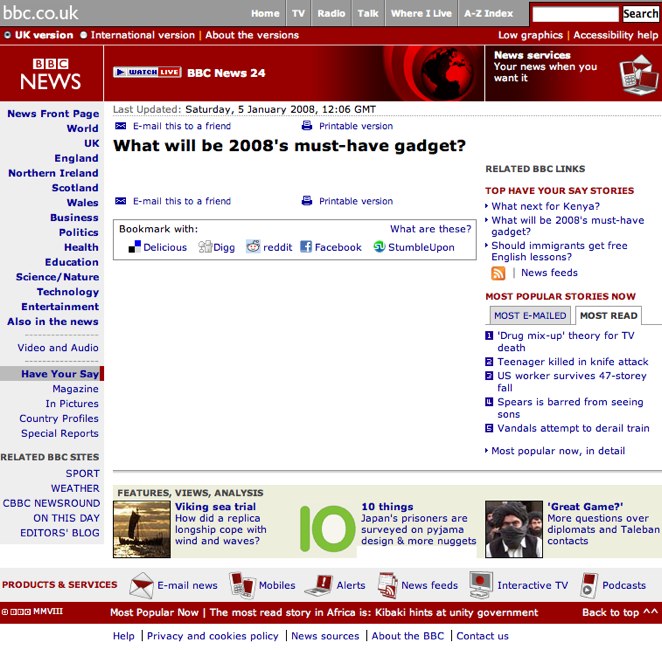
Insightful article from the BBC

BBC NEWS | Have Your Say | What will be 2008_s must-have gadget?.jpg

Glad to see my license fee producing in-depth analysis from the BBC

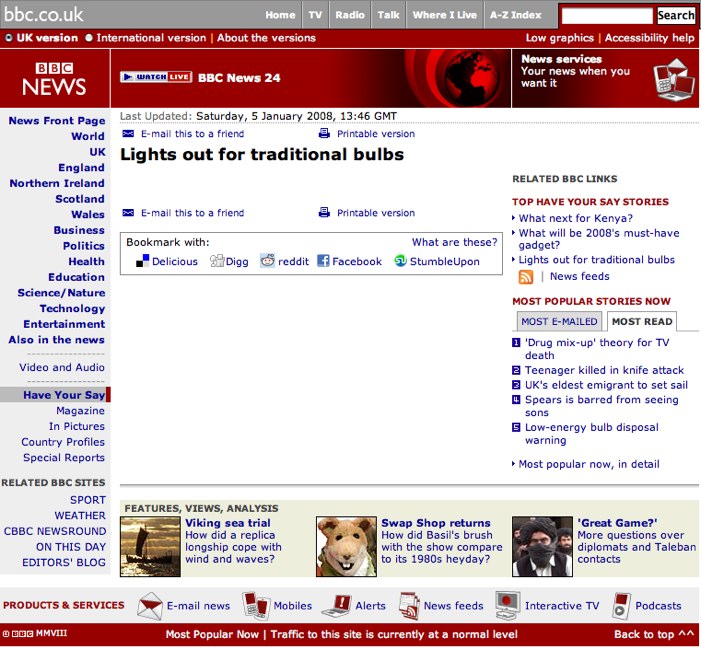
Update: here's another one. What's going on?
The URL for the story below is odd: http://news.bbc.co.uk/1/hi/world/africa/7173051.stm

Seems to me that a few stories are being posted in the wrong place, or the wrong links are going up. Whatever, it's all very strange.

BBC NEWS | Have Your Say | Lights out for traditional bulbs.jpg

Bookmark and Share

Visit my 'official' site

www.jonathanbaldwin.co.uk
contains links to my articles and books.

Tags

Books by Jonathan Baldwin

Visual Communication: From Theory to Practice (Winner of 'Best Higher Education Title' at the British Book Awards 2006) by Jonathan Baldwin and Lucienne Roberts Buy from Amazon.com Buy from Amazon.co.uk

More Than A Name: An introduction to branding by Melissa Davis and Jonathan Baldwin Buy from Amazon.com Buy from Amazon.co.uk

Followers