A blog about design, education and anything else that takes my fancy

Tuesday, October 04, 2005

Speed Reading... not

I was having a conversation with a student today and Tony Buzan's 'Mind Mapping' book came up. 'I've got his 'Speed Reading' book from the library.' she said, writing something in her note book. 'I've renewed it eight times.'

(Beat. Eye contact. Fits of laughter from us both as we realise what she's said.)

Funniest thing I've heard in weeks.

Bookmark and Share

Fork Handles


There are a few ways to make me smile: saying 'Fork Handles' or 'G-Granville, f-fetch a cloth' are just two.

Ronnie Barker, one of my all time heroes, has died. It's the sort of news that immediately sends you back to your childhood.

A friend and I used to have a competition to see who could let the other one know about a celebrity death first. It was a little sick but it stemmed from the fact that she and I both defined our lives in terms of the TV programmes and catch-phrases we grew up with.

Over the past few years more and more of the familiar faces have been passing away and apart from anything else it makes you feel old, nostalgic and mortal.

I don't know how well Ronnie Barker is known internationally - certainly he's very well known in Australia and New Zealand and I don't doubt his shows (The Two Ronnies, Porridge, Open All Hours) are on endless loop on PBS in the USA. Barker appeared with John Cleese on the Frost Report before Monty Python, and was a radio actor before that, appearing with Jon Pertwee (among others) in 'The Navy Lark'.

Apart from being one of our greatest comedy actors he was also one of the most talented writers around. Famously, the Two Ronnies show used to receive scripts from an anonymous writer (Gerald Wiley?) who was eventually persuaded to turn up for an end-of-series dinner. Turned out it was Barker - he didn't want his work to be accepted simply because it was by him.

He retired at the top years ago leaving us wanting more, and citing the examples of Eric Morecambe and Tommy Cooper - both of whom died of heart attacks on stage (I remember seeing Tommy Cooper collapse) - as the way he didn't want to go. Barker received a lifetime achievement award from BAFTA last year - as he put it, a 'get 'em before they die' award. It was clear he wasn't well and he had himself, and us, in tears as he accepted it.

Last year a poll of British TV viewers for the favourite comedy sketch of all time came up with 'The Hardware Shop' (or 'Fork Handles' as it's more commonly known). You have to see this sketch performed by the Two Ronnies - it is so much funnier than reading it. But if you can't (Amazon have DVDs) then here it is:

In a hardware shop. Ronnie Corbett is behind the counter, wearing a warehouse jacket. He has just finished serving a customer.

CORBETT (muttering): There you are. Mind how you go.

(Ronnie Barker enters the shop, wearing a scruffy tank-top and beanie)

BARKER: Four Candles!

CORBETT: Four Candles?

BARKER: Four Candles.

(Ronnie Corbett makes for a box, and gets out four candles. He places them on the counter)

BARKER: No, four candles!

CORBETT (confused): Well there you are, four candles!

BARKER: No, fork 'andles! 'Andles for forks!

(Ronnie Corbett puts the candles away, and goes to get a fork handle. He places it onto the counter)

CORBETT (muttering): Fork handles. Thought you said 'four candles!' (more clearly) Next?

BARKER: Got any plugs?

CORBETT: Plugs. What kind of plugs?

BARKER: A rubber one, bathroom.

(Ronnie Corbett gets out a box of bath plugs, and places it on the counter)

CORBETT (pulling out two different sized plugs): What size?

BARKER: Thirteen amp!

CORBETT (muttering): It's electric bathroom plugs, we call them, in the trade. Electric bathroom plugs!

(He puts the box away, gets out another box, and places on the counter an electric plug, then puts the box away)

BARKER: Saw tips!

CORBETT: Sore tips? (he doesn't know what he means) What d'you want? Ointment, or something like that?

BARKER: No, saw tips for covering saws.

CORBETT: Oh, haven't got any, haven't got any. (he mutters) Comin' in, but we haven' got any. Next?

BARKER: 'O's!

CORBETT: 'O's?

BARKER: 'O's.

(He goes to get a hoe, and places it on the counter)

BARKER: No, 'O's!

CORBETT: 'O's! I thought you said 'O! (he takes the hose back, and gets a hose, whilst muttering) When you said 'O's, I thought you said 'O! 'O's!

(He places the hose onto the counter)
BARKER: No, 'O's!

CORBETT (confused for a moment): O's? Oh, you mean panty 'o's, panty 'o's! (he picks up a pair of tights from beside him)

BARKER: No, no, 'O's! 'O's for the gate. Mon repose! 'O's! Letter O's!

CORBETT (finally realising): Letter O's! (muttering) You had me going there!

(He climbs up a stepladder, gets a box down, puts the ladder away, and takes the box to the counter, and searches through it for letter O's)

CORBETT: How many d'you want?

BARKER: Two.

(Ronnie Corbett leaves two letter O's on the counter, then takes the box back, gets the ladder out again, puts the box away, climbs down the ladder, and puts the ladder away, then returns to the counter)

CORBETT: Yes, next?

BARKER: Got any P's?

CORBETT (fed up): For Gawd' sake, why didn' you bleedin' tell me that while I was up there then? I'm up and down the shop already, it's up and down the bleedin' shop all the time. (He gets the ladder out, climbs up and gets the box of letters down, then puts the ladder away) Honestly, I've got all this shop, I ain't got any help, it's worth it we plan things. (He puts the box on the counter, and gets out some letter P's) How many d'you want?

BARKER: No! Tins of peas. Three tins of peas!

CORBETT: You're 'avin' me on, ain't ya, yer 'avin' me on?

BARKER: I'm not!

(Ronnie Corbett dumps the box under the counter, and gets three tins of peas)

CORBETT (placing the tins on the counter): Next?

BARKER: Got any pumps?

CORBETT (getting really fed up): 'And pumps, foot pumps? Come on!

BARKER (surprised he has to ask): Foot pumps!

CORBETT (muttering, as he goes down the shop): Foot pumps. See a foot pump? (He sees one, and picks it up) Tidy up in 'ere.
(He puts the pump down on the counter)

BARKER: No, pumps fer ya feet! Brown pump, size nine!

CORBETT (almost at breaking point): You are 'avin' me on, you are definitely 'avin' me on!

BARKER (not taking much notice of Corbett's mood): I'm not!

CORBETT: You are 'avin' me on! (He takes back the pump, and gets a pair of brown foot pumps out of a drawer, and places them on the counter) Next?

BARKER: Washers!

CORBETT (really close to breaking point): What, dishwashers, floor washers, car washers, windscreen washers, back scrubbers, lavatory cleaners? Floor washers?

BARKER: 'Alf inch washers!

CORBETT: Oh, tap washers, tap washers? (He finally breaks, and makes to confiscate his list) Look, I've had just about enough of this, give us that list. (He mutters) I'll get it all myself! (Reading through the list) What's this? What's that? Oh that does it! That just about does it! I have just about had it! (calling through to the back) Mr. Jones! You come out and serve this customer please, I have just about had enough of 'im. (Mr. Jones comes out, and Ronnie Corbett shows him the list) Look what 'e's got on there! Look what 'e's got on there!

JONES (who goes to a drawer with a towel hanging out of it, and opens it): Right! How many would ya like? One or two?

(He removes the towel to reveal the label on the drawer - 'Bill hooks'!)

Bookmark and Share

Ah, clients...

The Design Rants site is well worth a visit - I've subscribed to the RSS feed. Basically designers post their stories about the bizarre behaviour of their clients, and they're all too familiar.
Of course, a lot of the problems could easily be solved with better communication between designer and client: things we see as odd or unreasonable on the part of the client are completely ratonal to them, and if we started involving ourselves in their business we'd be sure to sound just as daft.

But don't let rationality get in the way of a good rant - or laugh.

This story was posted today and, like many others, it's one I lived through almost word for word:

So, the client (a small sporting goods store) draws up their little schematic of the ad that they want. In one spot they want a coupon, and they have sketched out an example of what they want: the whole coupon in reverse, with a white box in the middle of it with black type advertising their sale price on whatever, beneath that white box is the name of the store in reverse, and then beneath that, in another white box, they've sketched in this weird...thing. It just looks like a bunch of vertical lines. Then, they've drawn an arrow, pointing at the box with lines. Next to the arrow it says: "bar code."

Right. Must be they're gonna supply that later. So, compose the ad, send it out to the accout manager, who calls back: "They're sending the bar code over to you now."

Me: "Okay, great, are they emailing it or sending hard copy?"

Account manager: "No, faxing it."

Me: *headdesk*

It gets better. So what do you think the client faxes over? A BARCODE FOR A COMPLETELY DIFFERENT ITEM SOLD AT A COMPLETELY DIFFERENT STORE. A national department store, in fact. Client's coupon is for athletic shoes, department store's barcode is for sheets. Not to mention the fact that they want me to SCAN a freaking BARCODE.

I call back the account manager, and ask, in politer terms of course, what the hell is going on here. His explanation: "Oh, the client just likes how the barcode looks in the ad. He thinks it makes it look more official."

As it finally turns out, the client doesn't even use barcodes.

Bookmark and Share

Sunday, October 02, 2005

What is Design History?

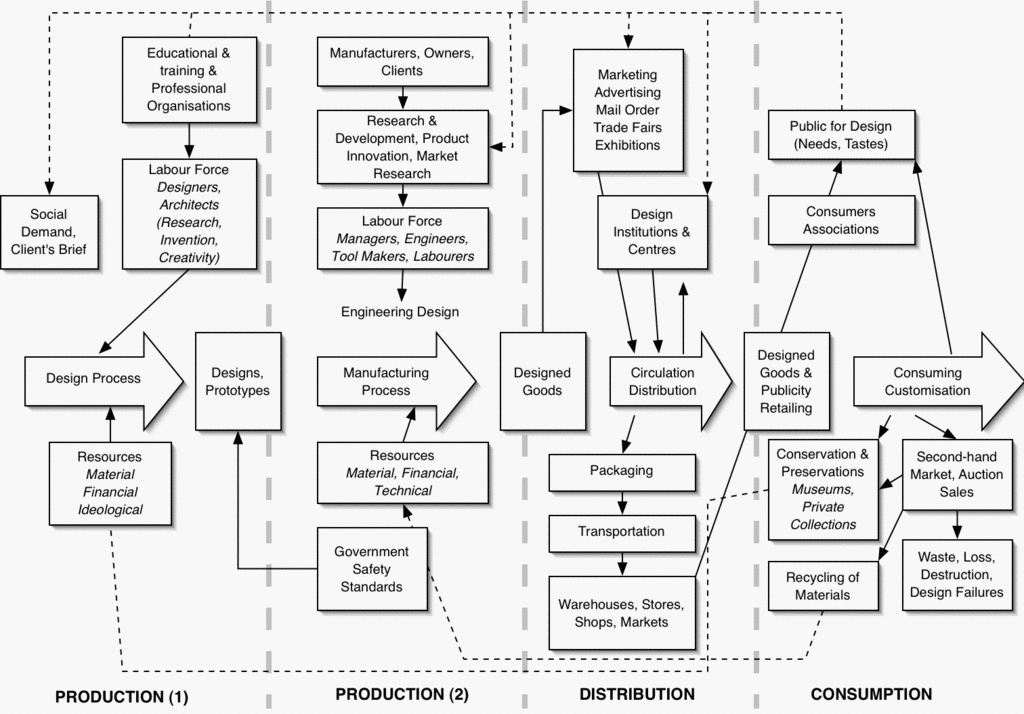
I've been working on the diagram I posted last week to try to present it in a more aesthetically pleasing way (I think the old one's a little confusing) and to make it more immediately relevant to my own students. I've also added in some elements that are covered in the course I teach - government regulation, the recycling of ideas and the role of 'heroes' or 'stars' in the design process. I haven't added globalisation in there yet - it seems to belong in every section both as a positive and a negative.

The amended diagram as it stands today is below. Click for a bigger version (the colours are a bit washed out in the GIF reduction). Any suggestions on changes/additions greatly received. (If you want a version for your own use, let me know and I'll take the text out from the top).

I'm also working on a model of my own but for now the Walker model (or my version of it) will do. I'm hoping to get colour versions printed up for the first session with the first years next week in which we ask them to say what they think the course will cover. I think they'll be surprised to find that 'design history' consists of very little 'history' - at least in the traditional sense.


All this leads me to answering a question I was asked last week: how would you approach introducing historical and critical studies to a new group of students, most of whom aren't British and most of whom probably have the idea that it has little, if anything, to do with learning graphic design.

Well first I'd ask them the question: what is 'historical and critical studies'? Let the students offer up their ideas about what the phrase means. Typical responses I've had in the past range from simply ‘theory’, to ‘how design works’. A large number of responses revolve around ‘teaching us how to be critical’ and ‘learning about who the best designers were’ – this being an interesting misinterpretation of the phrase ‘critical studies’.

Asked why they think they are ‘made’ to study H&CS, responses in the past have included ‘to make the course a degree’ and ‘to make us more employable’.

Recent research in the UK* offers a useful set of categories with which to view student responses. It derives four hierarchical categories of student conception with the highest (category A) being students who see an almost unquestionable link between ‘theory’ and practice – to such an extent that the interrelationship is difficult to articulate.

The next category sees a clear relationship, and finds theory interesting, but sees no integration. I'd suggest that this is the fault of the separated design curriculum, which often allows for no integration between the two aspects of history/theory and practice, resulting in the predominance of category B responses that could so easily be category A.

Category C students see a value for theory, but only in terms of adding academic legitimacy (‘it makes the course a proper degree’ being a typical response to my question, distinguishing it from a ‘cutting, sticking, gluing, painting sort of degree’ as one of the respondents to the research put it) or to employability (as another one put it: ‘instead of saying oh you make dresses don’t you? Oh it’s a fashion designer we think, with the honours, the dissertation, she can read and write as well … that little extra academic cherry on the top of the cake’).

The lowest order of response (Category D) sees theory as a distraction from practice, failing to see any value in it whatsoever, and criticising the amount of time spent on it that could be spent on practical work.

An important question arises from this, one I think we're avoiding: why do students who see no value in H&CS sign up for degrees in the first place? This is not a criticism of the students, but of the system that either signs them up to courses they are likely to be immensely dissatisfied with, or that fails to provide alternatives. Category D students may excel in other areas, but are likely to present themselves to H&CS staff as ‘poor’ or ‘bad’ students, and suffer accordingly. Accepting students on to a course they are likely to fail, or be disaffected with, seems somewhat irresponsible and it would be interesting to look at how courses are marketed and whether H&CS is seen as important enough to be a consideration in offering a place. It's noticeable that few, if any, design courses seem to involve H&CS staff in the selection process. If courses don't take H&CS seriously, (even 'nodding through' students that fail it) it's hardly surprising some students don't either.

This latter point came up in a meeting I had last week with representatives from the AV media industries. They're planning on 'validating' media degrees in the UK that meet industry-stipulated standards in terms of the skills and knowledge given to students. Now, I can hear the complaints from academia already - it's industry's job to train its employees, not the tax-payers, and it's shortsighted of industry not to see the value of academic approaches to the critique and study of its own practices. In other industries, medicine, physics, geography, earth sciences, law etc, it is universities that lead research and understanding. Turning university courses into training workshops risks stagnating the industry as all the innovation would be left in the hands of a few companies - a dangerous situation for consumers, society and industry itself.

However, they had a good point: a lot of students are signing up to media studies degrees thinking they are quick routes into the industry when in fact they're more like 'cultural studies' degrees but given a far more 'saleable' badge. It's mis-selling, and that's why 'Category D' students end up on degrees and dismiss the part of the course that is actually probably the most important.

As I put it in an interview last week, and countless times on this blog, it's the difference between learning how to 'do' graphic design and 'being' a graphic designer. I don't see the point in forcing a student who just wants to learn Photoshop to learn about the ethics surrounding digital manipulation. Nor do I see the point in a student who wants to understand the ethics and practices of the profession and learn Photoshop from being prevented from doing so by having their learning disrupted by students who'd be better off somewhere else.

There should be (and are) courses for both ambitions. The trouble is degrees mis-sell themselves to get 'bums on seats', and industry is pressuring degree courses to ditch the thinking for the doing because it can't be bothered to stump up the cash to train its own damned workforce.

Mmm... I seem to have strayed from the point somewhat. Or have I? Because I see this discussion as being another essential aspect of design history, as shown in the diagram: the role of education, training and industry bodies. It's a debate which bubbles to the surface every so often, and increasingly so. This year, for example, at least four of my third year students are undertaking dissertations which look at this area.

If industry got its way they'd be told to shut up and learn how to use the Page Curl filter, or something equally 'useful'.


*Pritchard, T, Heatly, R, Trigwell, K (2005). "How art, media and design students conceive of the relation between the dissertation and practice." Art, Design & Communication in Higher Education 4(1): 5-15.

Bookmark and Share

Sunday, September 25, 2005

Abandoning History

A colleague and I are speaking at a conference in London at the end of October (on my birthday in fact). The conference is called 'New Views' and our paper, 'Abandoning History' is a case study looking at how we teach design history to graphic design students.
It's shaping up okay and I'll maybe post some excerpts up here nearer the time. The basic premise is that when graphic design started being taught as a degree subject all that happened to give it 'academic legitimacy' was courses imported design history staff to show a few slides of the great and the good, give some lectures on historical aretfacts, and then demand a few essays.
Hardly surprising that this part of the course is traditionally hated by everyone concerned.

So we're proposing a few things. Firstly, that we abandon the idea of history as canons, heroes and artefacts and instead adopt what I've called 'history-less history' (or a Marxist view of history to be more precise - though I've found using the 'M' word seems to turn people off for some reason) which looks at history as a series of causes and effects with particular emphasis on the systems of production and consumption of design. This allows us to bring in social studies, cultural studies, psychology, audience studies, politics and issues that are often ignored: ethics and human ecology.

The second thing we're proposing is that historical and critical studies is no longer taught by part-timers on hourly contracts, as is so often the case in the UK. The only result of this is that the subject never gets developed, staff have no commitment to their students' ongoing progress (through no fault of their own) and studio staff and students naturally see it as a completely separate aspect of the course. If it's so unimportant that staff are paid by the hour and only during term-time, it's obviously not important at all. Design degrees need full-time H&CS staff who are available to the students at all times and seen in and around the studio. Sadly this rarely happens. No wonder students are still bored stiff with slide shows and 'survey' courses that are completely irrelevant to them.

My first draft of the paper was over 9,000 words long and I hadn't even got to the case study! But there's a lot to say and a lot of evidence to present. It would make an interesting book, that's for sure. So last week I cut it down dramatically and it's around 5,000 words now with the case studies and conclusion to add on. Next week we're going to interview a few students for some quotations to illustrate our points and then we have to put it to bed, so to speak.

Anyway, last week while I was struggling with how to explain my model for a production-consumption approach to design history I stumbled upon the diagram below. Actually, I'd seen this last year and remembered at the time how I thought it closely resembled what I was trying to do. Then I promptly forgot about it!
Now it's going in the paper and, as I've just spent an hour in OmniGraffle trying to redraw it I thought I'd post it here for those who are interested. Click on the thumbnail to open the full version.
I think it's rather interesting and it shows the interconnectedness of different aspects of the curriculum. I'm going to try to update it and add some examples (for instance, educating students about how choices about ink and paper have a huge effect on the environment, discussions of the ethics of branding and globalisation etc). I'm going to give a version of this out to first years in a couple of weeks to help explain what we mean by 'design history'.


Source: 'Design History and the History of Design' by John Walker (1989) London: Pluto Press

Bookmark and Share

Friday, September 23, 2005

What's in a name?

From the BBC News web site

Jordan, K'tee, Kloe and Bobbi-Jo are all names to make some teachers' hearts sink, apparently.

Teachers have confessed to making snap judgements about children from their names on the register.
In a light-hearted debate on a teachers' website, they have listed the names they associate with problematic and charming pupils.

Poppys are seen as hyperactive, Kayleighs as a pain and Ryans as hard work, according to chat on the website of the Times Educational Supplement.

Kyle, Liam, Wayne, Charmaine and Charlie are among the names teachers say they associate with problem children.

One teacher wrote: "I went through my new class list and mentally circled the ones I thought would be difficult. I reckon I have a 75% hit rate..."

Good list
Kate, Gregory, Sean, Charlotte, Jamie, Daniel, Lucy, Isobel, Ben, Sam, Harpreet, Imran, Asam, Alice and Joseph


According to the website, names which get a negative response from teacher include those with hyphens, like Bobbi-Jo, ordinary names with unusual spellings such as Kloe or K'tee, Kristopher, Jayne, Gyaike and Chevaughn, plus the various spellings of Jordon.

Names which teachers associate with delightful children include Kate, Gregory, Sean, Charlotte, Jamie, Daniel, Lucy, Isobel, Ben, Sam, Harpreet, Imran, Asam, Alice and Joseph.

However, perhaps proving that one's response to a name is dependent on one's personal experience, many names appear on both lists.


Bad list
Bobbi-Jo, Kloe, K'tee, Kristopher, Jayne, Wayne, Charlie, Liam, Ryan


The debate has sparked a row with parents chatting on another website, bounty.com.
Some were appalled, complaining that children were being labelled and pre-judged before they had even stepped inside a classroom.

One mother said she had complained to the Department for Education and Skills, saying: "I and many other parents are disgusted by the attitudes of the teachers on the forum.

"I realise this is a small number of teachers, but they have taken time out of their day to post these comments and I presume... they actually mean what they are saying."

But others on the site sympathised with the teachers, saying they understood how if you had had a bad experience with a child, their name would continue to have bad associations for you.

Bookmark and Share

Thursday, September 22, 2005

Wallace and Grommet

When I saw Charlie and the Chocolate Factory recently the trailers went down a storm: King Kong looked excellent, Harry Potter was worth a squizz, but the audience really came alive for Wallace and Grommet's 'Curse of the Were-Rabbit'. The trailer had more laughs than the whole of Charlie.

There's an 'exclusive' clip over at the BBC site - worth a look. Watch out for the policeman's line: maybe it says something about me but I was laughing like a drain (whatever that means)

Very British, very dark, and very cheesy (as in 'Wensleydale: Crackin' Cheese, Grommit!'). Can't wait to see this.

(Interesting fact: I used to live next to Wensleydale - a beautiful part of the world and one of the finest, crumbliest cheeses you could ever hope for. Lovely on fresh crusty bread with a bit of pickle... Now there's an idea...)

Bookmark and Share

Saturday, September 17, 2005

Brazil's double standards?

Talking of the shooting of an innocent Brazilian in London reminds me of a point that had me seething over the summer.

As shameful as the shooting was (though hardly unexpected given the huge pressure on people to get results), the reaction of the Brazilian government was disgraceful. As Private Eye pointed out, it took arond 30 hours for them to issue a statement condemning the shooting - a happy coincidence as 30 was the number of innocent Brazilians shot by their own police force only days earlier.

This led to quips when Brazil sent over representatives to talk to London police about the shooting that they were not so much after evidence but possibly offering tips for next time...

Bookmark and Share

Visit my 'official' site

www.jonathanbaldwin.co.uk
contains links to my articles and books.

Tags

Books by Jonathan Baldwin

Visual Communication: From Theory to Practice (Winner of 'Best Higher Education Title' at the British Book Awards 2006) by Jonathan Baldwin and Lucienne Roberts Buy from Amazon.com Buy from Amazon.co.uk

More Than A Name: An introduction to branding by Melissa Davis and Jonathan Baldwin Buy from Amazon.com Buy from Amazon.co.uk

Followers